 Sinh Giang
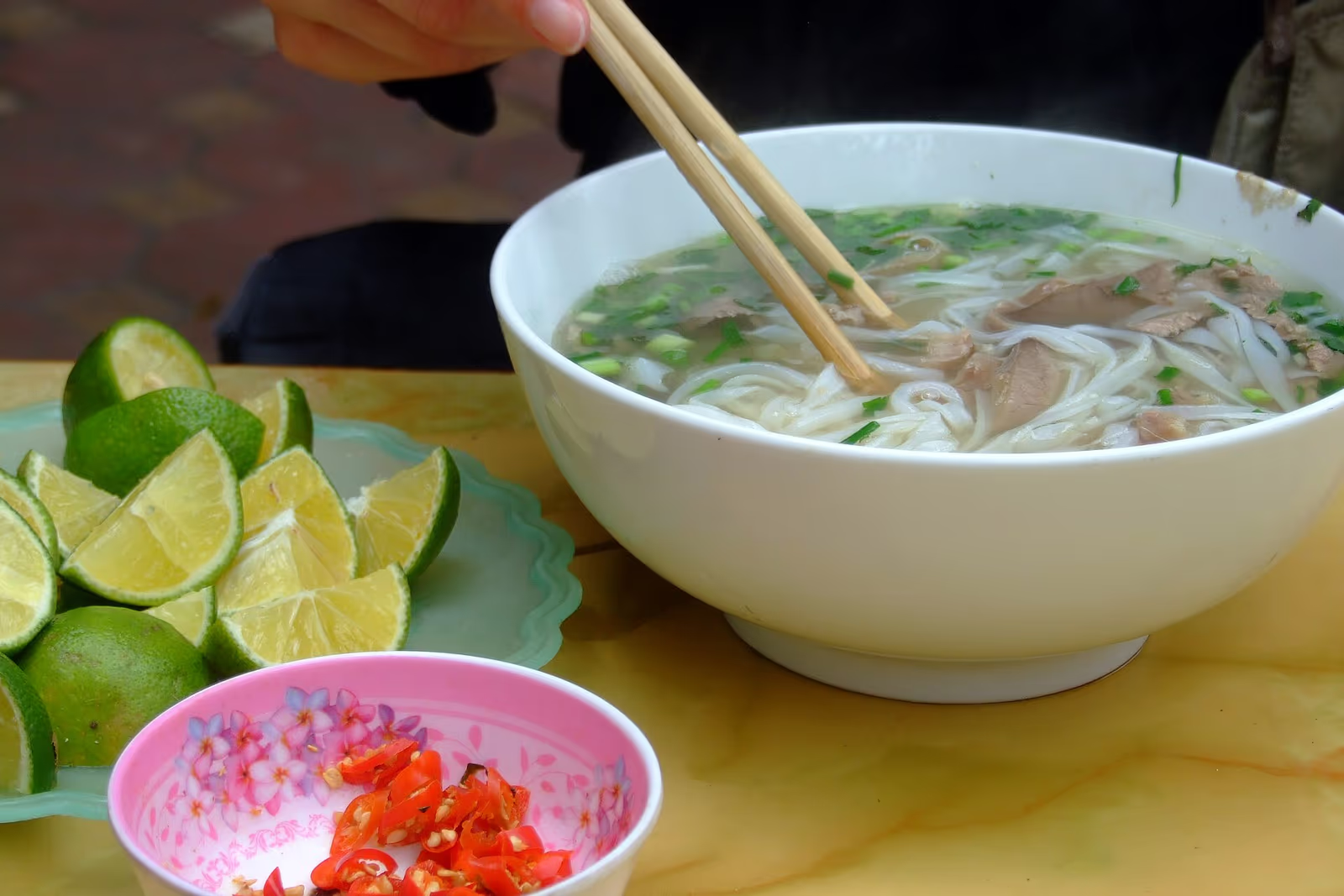
Vietnam street food changes every few hundred kilometres. The north eats clear, herb-heavy noodle soups and grilled pork, the centre eats hotter and builds plates around dipping sauces, and the south cooks sweeter, with sugar and coconut in the pot. This guide takes the regions in that order and spends most of its depth on the north.
We are a Sapa trekking company, not a food-tour operator, so the only thing we sell here is the Sapa end of a trip. We checked every fact on 31 October 2026 against Vietnam’s national tourism board, Vietnamese news outlets, Michelin and the US CDC. Our own observations are labelled, and where we found no source we say so. For the Sapa dishes, see what to eat in Sapa and Sapa restaurants; we do not repeat them.
Key Takeaways
- North: pho, bun cha (bún chả) and rice-flour rolls. Vietnam Tourism describes northern food as mild, with chilli, lime and garlic vinegar added at the table.
- Centre: bun bo Hue (bún bò Huế) with its red, spicy broth, small plates in Hue, and cao lau (cao lầu) in Hoi An.
- South: sweetness defines the cooking, and com tam (cơm tấm) is the everyday plate in Ho Chi Minh City.
- The CDC (page last reviewed 6 January 2026) says to avoid food from street vendors and, if you eat it, to avoid raw vegetables and choose food cooked and steaming hot.
- Prices: only dated figures, such as a Hanoi pho bowl at VND 40,000 in one suburb on 12 March 2026. Others are marked unverified.
Why North, Centre and South Taste Different
Vietnam Tourism, the national tourism board, sums up the split in three short passages. Our own notes sit outside the quotation marks.
North
“Food from the North tends to have mild flavours and highlights the natural taste of ingredients.”
Chillies, limes and garlic vinegar go in at the table. Broths use star anise, cardamom and cinnamon.
Centre
“The secret to amazing food lies in the dipping sauce.”
Fermented shrimp and fish paste are common, and Hue is known for heat.
South
“If there’s one taste that characterises the cuisine of Southern Vietnam, it’s sweetness.”
Sugar and coconut milk are used often.
Treat these as tendencies, not borders: the 2024 Michelin Guide put a Hue-style beef noodle shop on its Ho Chi Minh City Bib Gourmand list (VietnamPlus, 22 June 2024). We do not rank stalls. The only official list is Michelin, whose 2026 Vietnam edition names 193 places in Hanoi, Ho Chi Minh City and Da Nang, including 72 Bib Gourmand entries that its inspectors consider “good quality cooking for good value” (release of 5 June 2026). Hue, Hoi An and the northern mountains are outside it, so there you rely on crowds, not stars.
Hanoi and the Red River Delta: Where Vietnam Street Food Starts
In Hanoi the stall is the normal place for breakfast and lunch, and the menu is mostly noodles, rice-flour rolls and sticky rice. Pho first appeared in Hanoi in the early 20th century, and street vendors sold it between 1907 and 1910, says the Vietnam Government portal (13 August 2024). Egg coffee and bia hoi (bia hơi) are in our Hanoi guide and two-day itinerary. Six dishes come first.
Pho
Breakfast noodles- What it is
- Rice noodles in a clear beef or chicken broth simmered for hours with spices (Vietnam Tourism). Hanoi pho was recognised as national intangible heritage in August 2024.
- How it is eaten
- Often at breakfast. Add lime, fresh chilli and garlic vinegar from the table; herbs come on the side.
- Where
- Across the city. One dated example is Phu Doan Street, Old Quarter (VietnamNet, 19 June 2026).
- Diet and allergy
- Beef or chicken broth. Vegetarian pho (pho chay) exists; ask for no fish sauce.
Bun cha
Lunch- What it is
- Grilled pork with rice vermicelli, herbs and a dipping sauce (nuoc cham, nước chấm), “a symbol of Ha Noi’s vibrant street food culture” (Vietnam Tourism).
- How it is eaten
- Shared at the table. Noodles and herbs go into the sauce with the pork; crab spring rolls (nem cua be, nem cua bể) may come alongside.
- Where
- Across Hanoi. We found no sourced neighbourhood.
- Diet and allergy
- Pork and a fish-sauce dip; no vegetarian or halal version in our sources.
Bun rieu (bún riêu)
Crab noodle soup- What it is
- Crab noodle soup: vermicelli under a steamed crab-and-pork mix, tomato and spring onion, with hot broth poured over (VnExpress, 15 December 2023).
- How it is eaten
- With shrimp paste (mam tom, mắm tôm), lime, chilli, banana blossom and bean sprouts.
- Where
- A sidewalk stall on Nguyen Chanh Street, Cau Giay district (VietnamNet, 12 March 2026).
- Diet and allergy
- Crab, shrimp, pork; fuller recipes add blood curd and trotter, so ask. Not for shellfish allergy.
Banh cuon (bánh cuốn)
Breakfast rolls- What it is
- Steamed rice-flour rolls, a traditional Hanoi breakfast filled with minced pork, mushroom or egg (Vietnam Tourism).
- How it is eaten
- With fried shallot, herbs and sweet-and-sour fish sauce. In Cao Bang the rolls come with a bowl of bone broth (VnExpress, 15 August 2019).
- Where
- The sources name no street. It is a morning dish.
- Diet and allergy
- Pork and fish sauce by default; a mushroom filling is listed, so try “chay”.
Xoi xeo (xôi xéo)
Sticky-rice breakfast- What it is
- Sticky rice topped with mung-bean paste and crisp fried shallots (VOV, 20 May 2024).
- How it is eaten
- Typically with meat floss; other toppings include braised meat with egg, pate, pickles and cucumber.
- Where
- The source names no street.
- Diet and allergy
- The rice and bean base is plant-based, but usual toppings are meat. We could not confirm a plain version.
Cha ca (chả cá)
Sit-down dish- What it is
- Turmeric fish with dill, spring onion, peanuts, vermicelli and a fermented shrimp-paste sauce, finished in sizzling fat at the table (VietnamNet, 17 December 2025).
- Where
- Cha Ca Street, Old Quarter, renamed after the dish per the same report.
- Diet and allergy
- Fish, peanuts, shrimp paste. It is usually a seated meal, which is our note, so it sits at the edge of street food.
The Northern Mountains Beyond Sapa: Market-Day Food
Outside the cities, northern food is corn, sticky rice and stew, sold on market days. Our sources are tourism and news pieces, so each carries its date. We run Sapa treks, not Ha Giang or Cao Bang tours.
| Place | What the sources name | Source and date |
|---|---|---|
| Bac Ha, Lao Cai (Sunday market) | Five-colour sticky rice with sesame salt; a ration was VND 10,000 | VietnamNet, 9 November 2021 |
| Lung Phinh, Bac Ha district (Friday market) | Phu La-style sour pho, thang co (thắng cố) stew, black-pig dishes | VietnamNet, 25 April 2025 |
| Ha Giang province | Men men (mèn mén) corn, thang co, au tau porridge, buckwheat cake; no market day confirmed by an official page | Vietnam Tourism (undated); Viet Nam News, 10 May 2022 |
| Cao Bang province | Rolls with bone broth, fried duck-meat cake, seven-flavour roast duck, ant-egg cake | VnExpress, 15 August 2019; VietnamNet, 3 October 2021 |
Men men is steamed ground corn, a Mong staple in Ha Giang: corn is the only ingredient, steamed twice and eaten with kohlrabi, pumpkin-shoot or gourd soup, or a soured soy soup (Viet Nam News). Thang co is a soup of bones, organs and 12 spices, originally horse meat and now often buffalo, beef or pork for visitors, eaten with men men, grilled corn cakes and corn wine (Vietnam Tourism). Our Bac Ha market guide covers the Sunday market itself.
In Cao Bang the dish with a dated recipe is seven-flavour roast duck, marinated in fish sauce, salt and seasonings including ginger, garlic, pepper and honey (VietnamNet, 3 October 2021). Ant-egg cake is seasonal, early April to the end of May. For the routes, see Sapa vs Cao Bang, Sapa to Ha Giang and the Ha Giang Loop guide. Thang co is meat and offal, and no halal or vegetarian version appears in the sources.
Sapa: The Highland Chapter
Sapa is where this mountain food meets a tourist town, and we have written two full guides, so this chapter says only where it fits.What to Eat in Sapa covers the dishes, night market and a day of eating; Sapa Restaurants covers streets and budgets.
Sapa lets you eat highland food in one town instead of chasing market days across three provinces, and the nearest big market is Sunday in Bac Ha. The Love Market guide covers the courtship tradition. The food we can vouch for is the lunch or homestay dinner on our own treks.
Sapa Treks That Include a Village Meal
 1-Day Trek
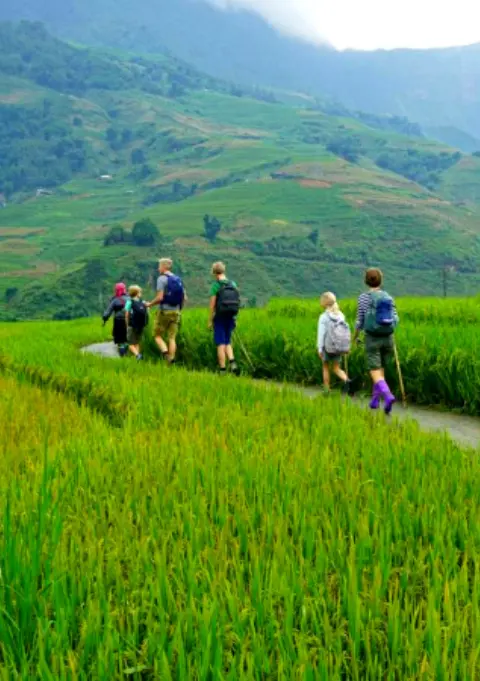
Trekking Through Rice Terraced Fields
Lao Chai to Ta Van with lunch at a family restaurant in Y Linh Ho.
 Homestay
Rice Terraced Fields & Homestay
Dinner and breakfast with a family in Ta Van, lunch on day one.
 Local Favourite
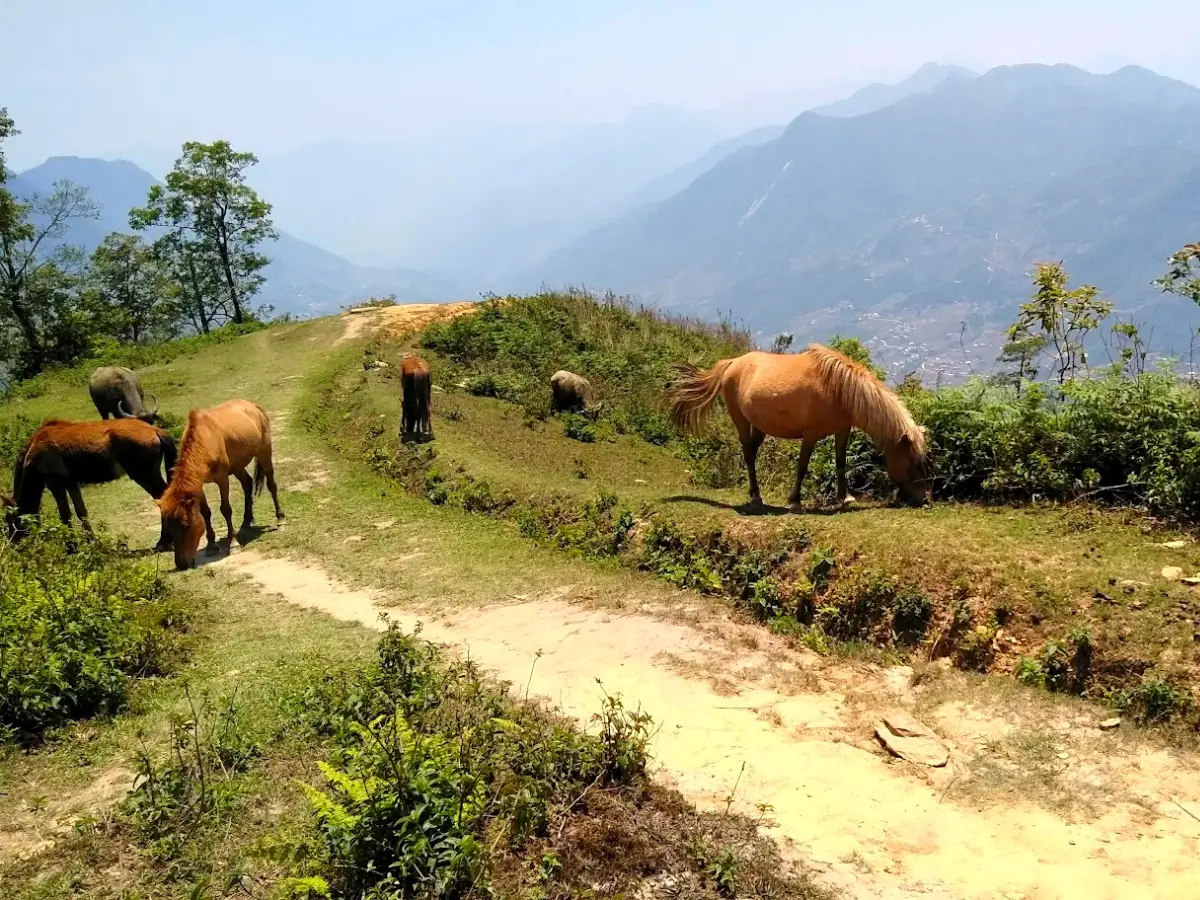
Mountain Views and Villages Trek
Lunch at a restaurant run by local people in Hang Da village.
Hue, Da Nang and Hoi An: Central Vietnam’s Street Food
Central Vietnam eats hotter than the north and in smaller pieces, and the sauce matters as much as the dish. Vietnam Tourism describes Hue’s banh beo (bánh bèo) rice cakes as “only the size of a silver dollar”, each steamed in its own saucer. Five dishes carry the region.
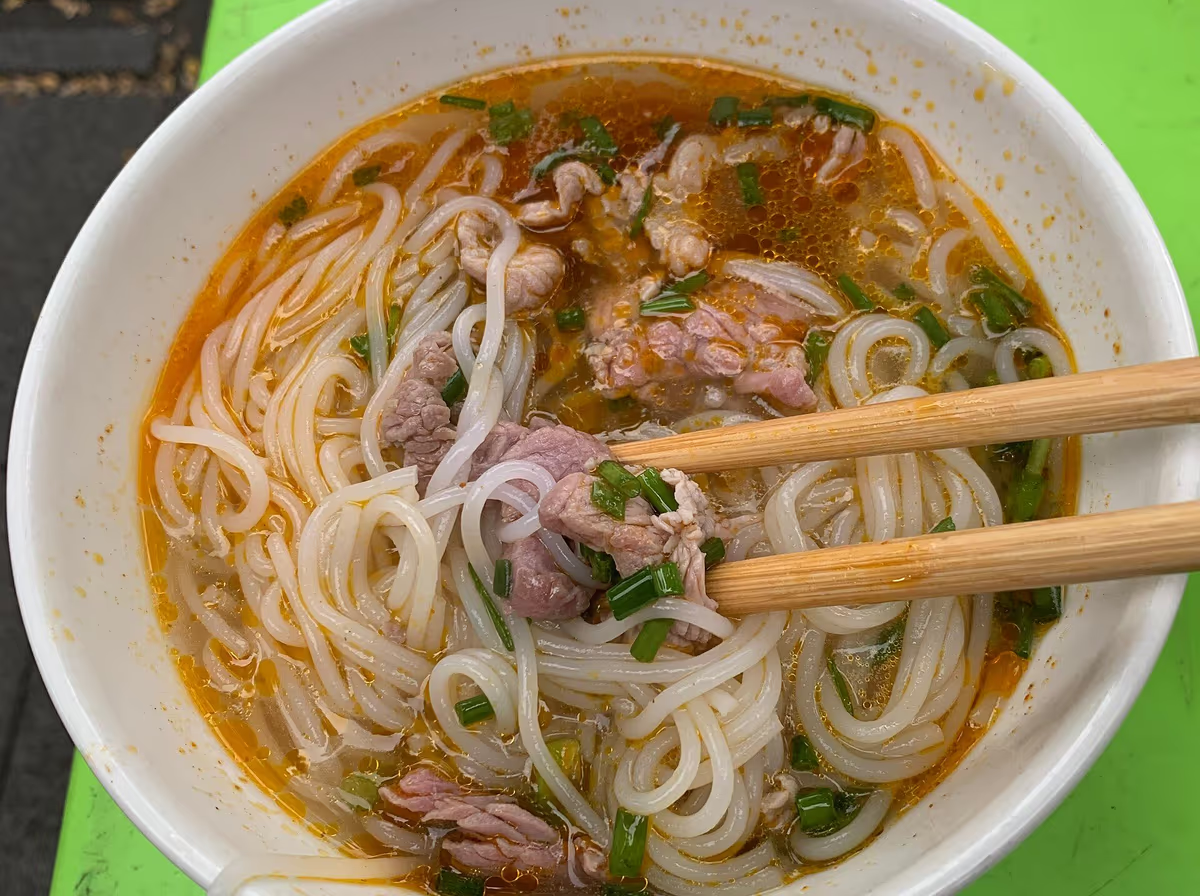
Bun bo Hue
Spicy beef noodles- What it is
- Spicy beef noodle soup with a broth of pork and beef bones, lemongrass, shrimp paste and lime juice (Vietnam Tourism). It was recognised as national intangible heritage under Decision 2203/QD-BVHTTDL (VietnamNet, 6 July 2025).
- How it is eaten
- The sources describe the bowl, not the table; we found no condiment list.
- Where
- Our photo was taken at Dong Ba Market, Hue.
- Diet and allergy
- Pork and beef bones, shrimp paste in the broth. Not vegetarian, not halal.
Banh khoai (bánh khoái)
Crisp pancake- What it is
- A pan-fried crepe of shrimp, quail egg, bean sprouts and pork belly, yellowed with turmeric (Vietnam Tourism).
- How it is eaten
- With a fig, starfruit and cucumber salad to cut the grease, and a thick peanut-and-pork-liver sauce.
- Where
- The tourism board points to the Kim Long area of Hue.
- Diet and allergy
- Shrimp, egg, pork; the sauce has peanuts and pork liver.
Com hen (cơm hến)
Clam rice- What it is
- Rice with baby clams, herbs, banana blossom, peanuts, fried onion and crisp pork fat, with clam broth (VietnamNet, 31 January 2025).
- How it is eaten
- Mix, then pour the broth over. Toppings include fermented shrimp paste (mam ruoc, mắm ruốc), sweet-and-sour fish sauce and chilli vinegar.
- Where
- Street vendors to restaurants across Hue (Tuoi Tre, 17 March 2021); one dated stop is Han Mac Tu Street.
- Diet and allergy
- Shellfish, pork fat, peanuts, shrimp paste.
Mi Quang (mì Quảng)
Soup-salad noodles- What it is
- A “soup-salad” from Quang Nam: flat, chewy, often turmeric-tinted noodles with a little broth. Listed as national intangible heritage in August 2024 (VietnamPlus, 12 August 2024).
- How it is eaten
- Tossed with pork, chicken, beef, shrimp or quail eggs, then rice crackers, herbs, roasted peanuts and chilli.
- Where
- Da Nang and Hoi An, per Vietnam Tourism.
- Diet and allergy
- Peanuts, shrimp and pork are common; ask which protein is in the bowl.
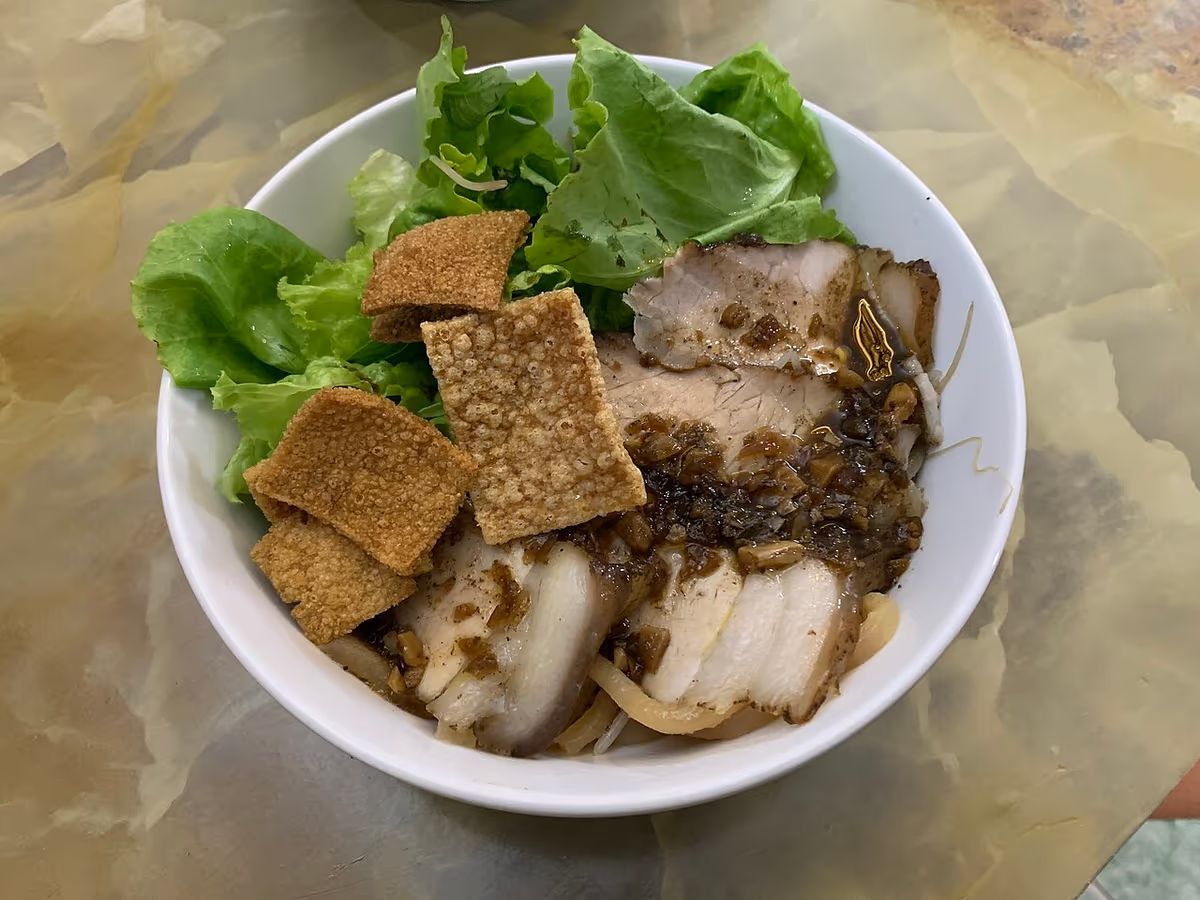
Cao lau
Hoi An only- What it is
- “Hoi An in a bowl”, says Vietnam Tourism: noodles made with Ba Le well water and Cham-island tree ash, topped with pork belly, bean sprouts, herbs and crisp pancake.
- How it is eaten
- Finished Vietnamese-style with a spoonful of broth.
- Where
- Hoi An Old Town, on streets such as Tran Phu and Thai Phien.
- Diet and allergy
- Pork belly topping; we found no source for a vegetarian version.
For these places as destinations, see our Da Nang guide and the comparison of Vietnam’s cities.
Saigon and the South: Sweeter and Out on the Pavement
Southern cooking is sweeter, and Ho Chi Minh City eats outdoors at low tables with the cooking in view. Vietnam Tourism names street clusters rather than stalls: Vinh Khanh in District 4, where diners grill meat and seafood on coal stoves at the table, Nguyen Thuong Hien in District 3 and Chinatown in District 5.
Banh mi (bánh mì)
Baguette- What it is
- A baguette with pate and margarine, “loaded with pickled vegetables, fresh cilantro, pork belly, pork floss and cucumber”. Vietnam Tourism says it is said to have originated in Ho Chi Minh City.
- How it is eaten
- In the hand, with the sauce, which the tourism board calls mandatory.
- Where
- Street vendors and local eateries across the city; two dated sales are in the price table.
- Diet and allergy
- Pate and pork are standard; ask a stall for “chay”. No banh mi shop in Vietnam is on any 2026 Michelin list (Tuoi Tre, 6 June 2026).
Hu tieu (hủ tiếu)
Noodle soup- What it is
- A clear, peppery, slightly sweet broth sweetened with rock sugar, served wet (nuoc) or dry (khô, broth on the side).
- How it is eaten
- Often at breakfast; a visitor ate a chicken bowl that way (VietnamNet, 20 November 2024).
- Where
- Best in Ho Chi Minh City, says the tourism board.
- Diet and allergy
- Congealed pork blood is standard; you can ask to leave it out. We could not confirm the broth base.
Com tam
Broken rice- What it is
- Broken rice with grilled pork, “perhaps the most essential Saigonese dish”, found on nearly every street (Vietnam Tourism).
- How it is eaten
- With nuoc cham of chilli, fish sauce and sugar, green-onion oil, pork rinds, shallots and pickled vegetables.
- Where
- A street-side stall on Ham Nghi Street, District 1 (VietnamNet, 20 November 2024).
- Diet and allergy
- Pork and fish sauce throughout; no vegetarian version in the sources.
Banh xeo (bánh xèo)
Crisp crepe- What it is
- A crisp crepe of shrimp, pork and bean sprouts, folded like a taco and yellowed by turmeric.
- How it is eaten
- Rolled in herbs and greens and dipped in fish sauce; the tourism board warns “it can get messy”.
- Where
- The south and Hoi An; Michelin’s 2024 Ho Chi Minh City list includes a banh xeo shop.
- Diet and allergy
- Shrimp and pork; not for shellfish allergy.
Che (chè)
Sweet dessert- What it is
- A sweet dessert soup or pudding, hot or cold. Cold versions are usually “doused in coconut cream”, and che ba mau gets crushed ice and coconut milk (Vietnam Tourism).
- Where
- We found no sourced neighbourhood.
- Diet and allergy
- Toppings vary and we could not confirm which are plant-based. The ice is what the CDC cautions about, below.
How to Order and Pay at a Street Stall
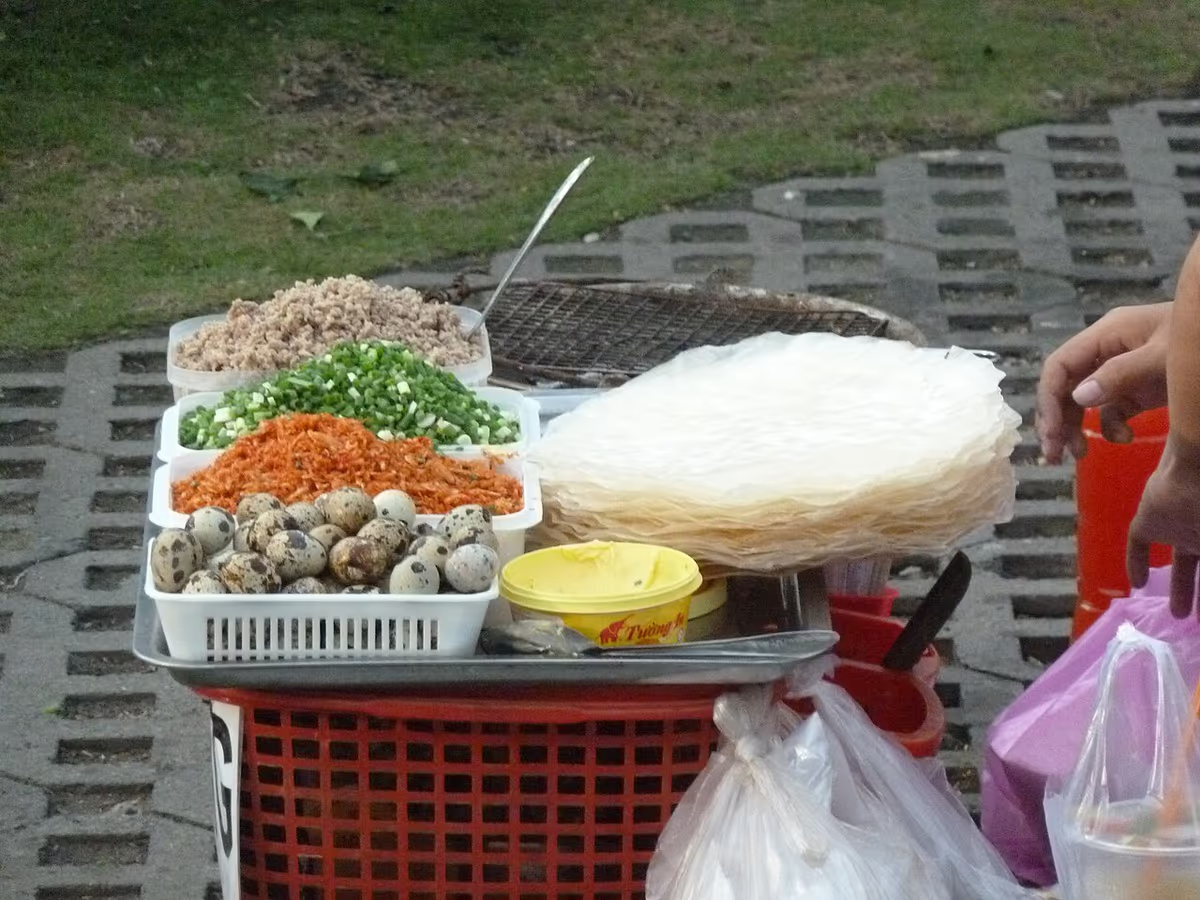
Order at the front, sit where you like, and pay the cook when you leave. Vietnam Tourism’s beginner’s guide says small-stall diners usually ask the total and pay the chef directly on the way out; a written bill is not common for local food.
Carry small dong notes. QR links for visitors are spreading: Viet Nam News (28 September 2026) reports them for visitors from China, Singapore, South Korea, Laos, Cambodia and Thailand, reaching markets and food stalls, and Tuoi Tre (7 August 2026) says Mastercard’s Pay Local lets visitors scan domestic QR codes with an existing Mastercard. We could not confirm that a US, UK, French, German or Australian card or wallet works at a given stall. Our travel costs guide covers cash and ATMs.
We found no official tipping rule. A Tuoi Tre contributor wrote in March 2024 that tipping is not customary at everyday local eateries, and that the writer often leaves roughly VND 20,000 to 100,000 at a local restaurant, at personal discretion. At a pavement stall our own advice, not a sourced rule, is to pay the cook directly and say thanks.
How to Read a Stall Before You Sit Down
Pick the stall with a local queue, a short menu and food cooked in front of you. The steps combine Vietnam Tourism’s advice with the CDC rule on hot food.
Look for local customers
Vietnam Tourism suggests “a gaggle of local customers eating or waiting to be served”. Fast turnover means fresher food.
Watch the cooking
The CDC says “cold food should be served cold, and hot food should be served hot”. Choose steaming broth and meat cooked in front of you.
Check the set-up
The same guide says to check that it is clean and organised. Our own rule: a short menu means the cook makes each dish often.
Order simply
If the menu is Vietnamese-only, ask for “whatever the next table is having”, as Vietnam Tourism suggests.
Wipe your chopsticks
A quick wipe is “perfectly normal (and even wise)”, says the same page.
Food Safety, Tap Water and Ice: What the CDC Says
The CDC’s advice is firm, so read it before you decide. Its “Eat and drink safely” page (last reviewed 6 January 2026) says: “Avoid eating food from street vendors.” It adds: “If you choose to eat street food, follow the same food safety rules as you would with other foods. For example, avoid raw vegetables and eat food cooked and steaming hot.”
The herb plate that comes with pho and bun cha is raw vegetables, which the CDC says to avoid. We cannot tell you the risk at a particular stall. It is your call; a hot, freshly cooked dish is lower-risk.
The CDC’s Vietnam page (last reviewed 25 August 2026) lists hepatitis A vaccination as “recommended for unvaccinated travelers one year old or older” and typhoid as “recommended for most travelers”. Ask your doctor; our Vietnam safety guide covers general health.
On water, the CDC says to brush teeth with bottled or disinfected water and that vendors in some countries may replace bottled water with untreated water. On ice: “Do not use ice in destinations with limited access to clean water.” Vietnam Tourism notes that stalls serve iced green tea (tra da, trà đá) instead of water. We cannot verify any stall’s ice or tea. The WHO five keys to safer food page would not open on 31 October 2026, so we do not quote it.
Vegetarian, Halal and Allergy Notes
Vegetarian is possible but needs asking, halal is scarce, and allergy cover depends on the cook. Vietnam Tourism’s vegetarian guide gives the phrases “Tôi ăn chay” (I am vegetarian), “không thịt” (no meat) and “không nước mắm” (no fish sauce), and says Vietnamese Buddhists eat meat-free food on the 1st and 15th of each month.
Fish sauce, shrimp paste, pork fat, pate and blood curd turn up in dishes that look plain, and VnExpress (16 August 2023) warns that some restaurants sold as vegetarian may use pork or animal fat. For allergies, treat peanuts, shrimp and fish as likely in the dishes above; no stall can promise a surface free of them.
VnExpress (16 August 2023) reports that halal products are usually sold in only a few outlets and that halal beef is imported. Vietnam Tourism lists halal restaurants in Hanoi and Ho Chi Minh City, including one near Ben Thanh Market in District 1. For street stalls we found no source, so assume pork or pork fat unless the stall shows otherwise.
What Street Food Costs: The Figures We Could Source
Prices vary, and we have not verified a figure for any dish not in this table. These are the only prices we could tie to a dated article.
| Item and place | Price (VND) | Source and date |
|---|---|---|
| Pho bowl, Linh Dam, Hoang Mai, Hanoi | 40,000, up from 35,000 | VietnamNet, 12 March 2026 |
| Bun rieu, sidewalk stall, Cau Giay, Hanoi | 35,000, up from 30,000 | VietnamNet, 12 March 2026 |
| Chicken pho, Michelin-listed shop, Old Quarter | About 55,000 breast; up to 120,000 thigh | VietnamNet, 19 June 2026 |
| Beef pho, Hanoi (range) | 30,000 to 50,000 | Vietnam Government portal, 13 August 2024 |
| Com hen, Han Mac Tu Street, Hue | 10,000 a serving | VietnamNet, 31 January 2025 |
| Com tam, grilled pork, Ham Nghi, District 1 | 44,000 | VietnamNet, 20 November 2024 |
| Banh mi, street vendor (sausage, egg); local eatery (chicken, egg) | 20,000; 30,000 | VietnamNet, 20 November 2024 |
| Hu tieu with chicken, breakfast | 30,000 | VietnamNet, 20 November 2024 |
Two cautions. VietnamNet (12 March 2026) reports shops in several Hanoi neighbourhoods raising bowls by VND 3,000 to 5,000, so older figures are floors. And the 2024 Saigon prices come from one couple’s day, not a survey. Our travel costs page is wider, but we have not re-sourced its figures.
Sources and the Dates We Checked Them
We read these pages on 31 October 2026; undated pages are marked. The dishes also cite VnExpress, VOV, Viet Nam News, Tuoi Tre and VietnamPlus pieces by date in the text.
- CDC Travelers’ Health, Eat and drink safely, last reviewed 6 January 2026.
- CDC Travelers’ Health, Vietnam, last reviewed 25 August 2026.
- Vietnam Tourism, a foodie guide by region, undated.
- Vietnam Tourism, a beginner’s guide to street food, undated.
- Vietnam Tourism, a vegetarian guide, undated.
- VietnamNet, Hanoi street food prices, 12 March 2026.
- Michelin Guide Vietnam 2026 release, via Viet Nam News, 5 June 2026.
The Part We Do Sell
- Hanoi to Sapa transport — sleeper buses, limousines and the overnight train, bookable with your trek
- Hanoi to Sapa guide — what each option costs and how long it takes
- How to get to Sapa — the first leg, in detail
For the wider trip, see Vietnam for first-timers, things to do in Vietnam, a one-week itinerary and northern Vietnam.
Rent at Our Office Before You Trek
 Gear Rental
Trekking Boots Rental
Waterproof ankle-support boots. Cleaned and checked before each rental. Available at 105 Thach Son Street.
 Gear Rental
Walking Poles Rental
Trekking poles available to rent at $2/day at our office, 105 Thach Son Street. Essential for descents.
Frequently Asked Questions
Pho and banh mi appear on almost every list we read, and Vietnam Tourism calls pho the most famous noodle soup. The regional dishes, bun cha in Hanoi, bun bo Hue in Hue, cao lau in Hoi An and com tam in Saigon, are why this guide is split by region.
The CDC page for travellers, last reviewed 6 January 2026, says to avoid food from street vendors and, if you eat it, to avoid raw vegetables and eat food cooked and steaming hot. We cannot rate any stall. Ask your doctor about hepatitis A and typhoid vaccines.
Prices vary, and we have not verified a figure for most dishes. Dated examples: a Hanoi pho bowl at VND 40,000 in one suburb (VietnamNet, 12 March 2026), com hen in Hue at VND 10,000 (31 January 2025) and a Saigon com tam at VND 44,000 (20 November 2024).
We do not rank regions, and no official source does. The north suits clear broths and grilled pork, the centre suits heat and small plates, and the south suits sweeter, coconut-based dishes. The Michelin Guide covers only Hanoi, Ho Chi Minh City and Da Nang.
Yes, with care. Vietnam Tourism gives the phrases Tôi ăn chay (I am vegetarian), không thịt (no meat) and không nước mắm (no fish sauce). Fish sauce, shrimp paste, pork fat and pate can still appear in dishes that look plain.
Not by default. VnExpress reported in August 2023 that halal food is sold in only a few outlets, and Vietnam Tourism lists halal restaurants in Hanoi and Ho Chi Minh City. We found no source for halal street stalls, so assume pork or pork fat unless the stall shows otherwise.
We found no official rule. A Tuoi Tre contributor wrote in March 2024 that tipping is not customary at everyday local eateries. At a pavement stall we suggest paying the cook directly and saying thanks, which is our advice, not a sourced rule.
Our two Sapa guides cover that in full: What to Eat in Sapa for the dishes and night market, and Sapa Restaurants for streets and budgets. Sapa food is highland food, and it overlaps with what the northern mountain markets sell.