 Sinh Giang
Banh mi is a Vietnamese sandwich on a short, light baguette, filled with pate, pork and pickled carrot and daikon, topped with cucumber, coriander and chilli, and on a Hanoi street cart in 2026 it costs about 15,000 to 45,000 VND (roughly $0.60 to $1.80), according to a food-budget page updated on 3 October 2026. It is eaten for breakfast, lunch or a late snack, it is the cheapest filling meal in the country, and it is worth getting right: the bread, the fillings and the price change a lot between Hanoi, Hoi An and Saigon.
We are a Sapa trekking company, not a bakery, so this is a traveller’s guide and not a recipe. Many of our guests pass through Hanoi and fly or drive on to Hoi An and Saigon, and a banh mi is the meal they ask us about most. Below you will find what is inside one, a short history with the places where accounts disagree, how to order without pork or chilli, how the regions differ, named places to eat in Hanoi, Hoi An, Da Nang and Saigon, what to pay, and what to do about banh mi in Sapa itself. We checked every price, address and date on 31 October 2026 and say so beside each, because shops move and prices rise. Where we could not confirm something, we say that too.
The Short Answer: What You Get and What You Pay
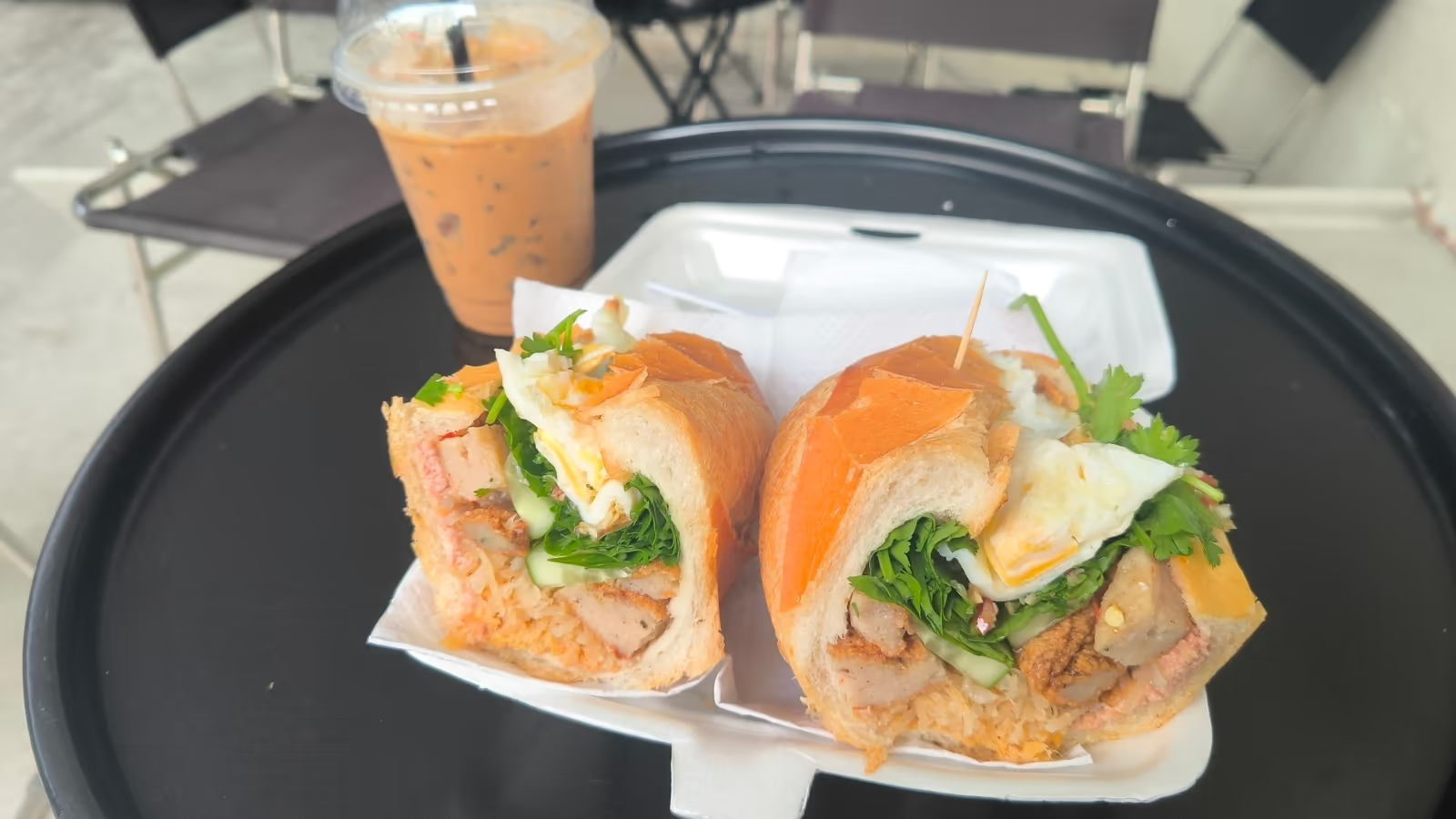
A banh mi is a one-person sandwich on bread made with wheat and rice flour, so the crust is thin and the crumb is airy. The classic fillings are pate, cold cuts, chicken or pork, pickled carrot and daikon called do chua, cucumber, coriander, chilli and a spread of mayonnaise or butter. You eat it standing or sitting at a stall, usually within minutes of ordering, and nearly every seller will pack it in paper for you to carry.
The English word is said roughly “bahn mee”. In Vietnamese, bánh is the word for baked or steamed items and mì means wheat, so the name simply means wheat bread. In the north you will also see it spelled bánh mỳ. Wikipedia notes that northerners used to call a baguette bánh tây, “Western bread”, and rejects the folk story that the name comes from the French pain de mie.
What Is Actually Inside a Banh Mi
The bread comes first. A Vietnamese baguette is short, about the length of a forearm, with a crackly crust that shatters and a very light, hollow crumb, because rice flour is mixed in with the wheat. In our experience, good banh mi bread is bought fresh in the morning and often warmed over a flame or in a small oven when you order. That is our own habit of watching, not a published rule: a stall with a basket of crisp loaves is a better sign than one with a tray of pale, soft ones.
The fillings that Wikipedia lists as typical are pate, cha lua (Vietnamese pork sausage), thin-sliced cold cuts called thit nguoi, cucumber, coriander, pickled carrot and daikon, chilli, and mayonnaise or butter. Wikipedia adds that cold cuts are the most popular version, and other fillings include fried egg, sardine, pork floss, grilled pork and fish patties. A vegetarian banh mi, banh mi chay, is usually made with tofu or seitan. The pickled carrot and daikon matters more than it looks, because its sharp sweetness cuts the richness of the pate and meat, and a banh mi without it tastes flat.
What a good one has
- Bread that crackles when you press it
- A thin layer of pate, not a thick wedge
- Fresh coriander and crunchy pickles
- A chilli you can leave out
What to walk away from
- A tray of pale, soft loaves from the day before
- A price that is not shown or said, for a tourist menu
- Meat sitting out in the sun for hours
- A tout who steers you to one cart only
A Short History, and Where the Stories Disagree
Banh mi is a Vietnamese dish made from a French bread, and the way it got there is a story of colonisation, war and migration. We give the account that the sources agree on and flag the places they do not.
The baguette arrives with the French (Wikipedia gives both “mid-century” and the 1860s)
Bread is a city staple; rice flour enters it during World War I wheat shortages
The Saigon-style meat sandwich emerges; about a million northerners move south after 1954
A luxury again, then revived as street food after the Doi Moi reforms
“Banh mi” enters the Oxford English Dictionary
The baguette came with the French in the 19th century. Wikipedia’s own article says “mid-19th century” in one place and “the 1860s” in another, so we do not give a year. By the early 20th century bread was an everyday item in cities, and Wikipedia says that wheat shortages during World War I led bakers to add rice flour, which is part of why a Vietnamese baguette is lighter than a French one. Before the filling we know today, the sandwich was closer to a French jambon-beurre, ham and butter in a loaf.
The sandwich as a meat-and-pickle street food took shape in the 1950s in Saigon, Wikipedia says, and the 1954 partition of the country, which brought about a million northerners south, helped spread northern tastes. A Tuoi Tre series gives 1958 for Hoa Ma, one of the first bakeries to sell banh mi thit, founded by a couple from Hanoi, with butter, pate, cold cuts and pork floss settled by the 1960s. We read that series only in search summaries, and sources disagree on the shop’s original street and on where the name comes from, so we treat the details as unconfirmed. After 1975 the sandwich became a luxury again, and the later market reforms brought it back to the street.
Banh mi went abroad with refugees. Wikipedia says Lee’s Sandwiches began selling it in the United States in the 1980s, that about 94,000 Vietnamese refugees reached Australia in the decade after the war, and that more than 300 shops in Melbourne sold banh mi in 2022. The Oxford English Dictionary added “banh mi” on 24 March 2011 in an update of about 900 entries; one report gives February, and we use the date from Wikipedia and the Vietnamese press. Google marked it with a Doodle on 24 March 2020. Our Vietnam street food by region page notes that, as of Tuoi Tre’s report of 6 June 2026, no banh mi shop appeared on any 2026 Michelin list.
How to Order, and What to Say If You Cannot Eat Something
Ordering is easy because the stall does the work: you point at what you want or say “banh mi” and the seller builds it in about a minute. If you cannot eat something, say so before the seller starts, because the pate and mayonnaise go on first. The words below are standard Vietnamese, written in the plain letters the site uses and with the written form beside them. Ask your hotel staff or guide to confirm any dietary need before relying on a phrase.
| You want | Say | Written |
|---|---|---|
| No chilli | khong cay | không cay |
| No pate | khong pate | không pate |
| No coriander | khong rau mui | không rau mùi |
| Vegetarian sandwich | banh mi chay | bánh mì chay |
| To take away | mang di | mang đi |
For allergens, think about wheat in the bread, pork in the pate and cold cuts, egg in mayonnaise and the fried egg, and in some versions fish sauce or soy sauce. A “chay” sandwich is made for vegetarians, but a street stall may use shared knives and mayonnaise, so a strict vegan or someone with an allergy should ask the seller what goes in. If you travel with a dietary need, our first time in Vietnam guide and Vietnam travel costs cover eating and budget more widely.
How Banh Mi Differs From Hanoi to Saigon
There is no official map of banh mi styles, and the claims you read are mostly writers’ opinions. The comparison below sets out what we could source and marks the weak spots. We could not verify a distinct Hue or Dalat style, so we do not describe them; our Hue guide covers the city for travellers.
| Where | What to expect | How sure we are |
|---|---|---|
| Hanoi | Simpler: pate and pork cold cuts, pickles, herbs; usually less sauce | Opinion of one writer; shops vary |
| Saigon | Heavily stuffed, more herbs and pickles, mayonnaise plus a seasoning sauce | Opinion of one writer, but widely repeated |
| Hoi An | Cooked pork rather than cold cuts, a small loaf, a soy-based sauce | Medium: one writer, one Vietnam Tourism summary |
| Da Nang | Skillet banh mi (banh mi chao), stick loaves (banh mi que), salt-and-chilli versions | Medium: one airline guide, prices undated |
| Hai Phong | Thin loaf with pate, pork floss and chilli sauce, called banh mi cay or banh mi que | Low: Vietnamese travel sites only, and the origin shop is claimed by a single blog |
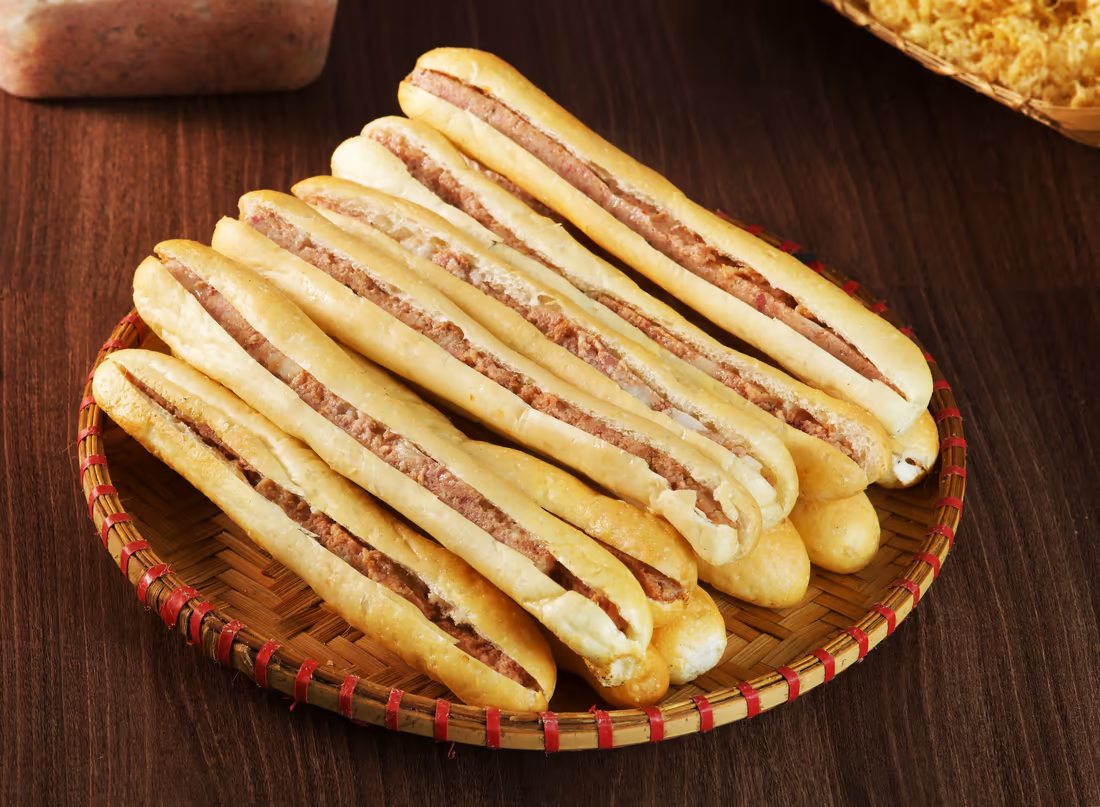
The one difference every source agrees on is stuffing. Saigon banh mi are the heaviest, with several meats, butter or mayonnaise, herbs and pickles, and the best-known shops charge for it. The northern version is smaller and plainer. Hoi An and Da Nang add their own touches, and the thin stick loaf is a cheap snack more than a lunch. If you are comparing, buy a small one in each city and decide for yourself; at these prices it costs less than a coffee.
Eat in the Lowlands, Then Walk Off the Bread in Sapa
 1-Day Trek
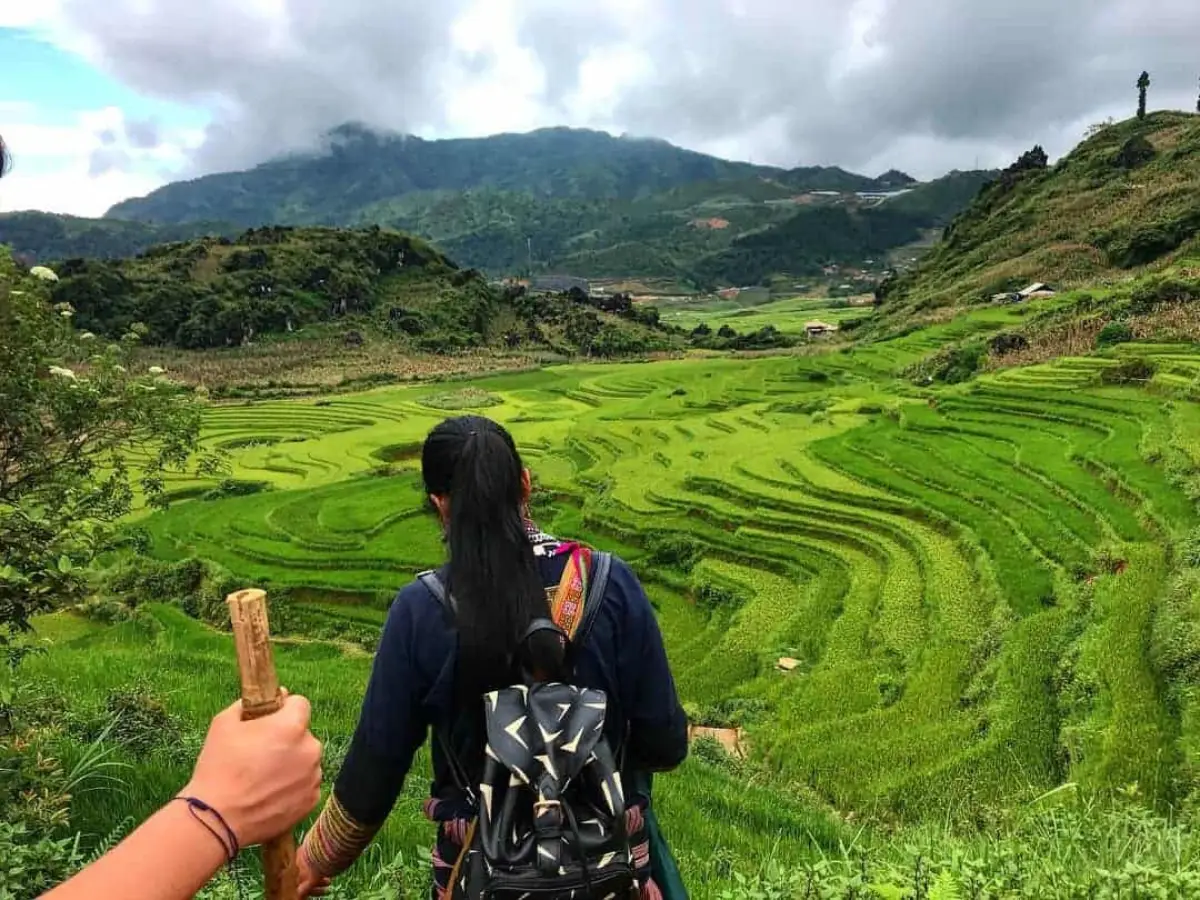
Trekking Through Rice Terraced Fields
The Lao Chai to Ta Van valley day, with a local guide and a finish in Sapa town.
 Homestay
Rice Terraced Fields & Homestay
A night with a local family in the valley.
 3 Days
Experience The Real Sapa
Three days through quieter villages, with two nights hosted by local families.
Where to Eat Banh Mi in Hanoi
Hanoi has banh mi on nearly every street, and the best advice is to follow a queue of local people. For named places we use one source, a vietnamtourism.com guide updated on 25 September 2026, and we say where another source gives a different address. Always check the address and opening time before you cross town, because shops move and close.
Banh Mi Pho Hue
Morning classic- Where
- 118 Pho Hue Street
- What the guide says
- About 25,000 to 30,000 VND, best before 9 am; the page calls it Anthony Bourdain’s pick, which we could not confirm elsewhere
Banh Mi 25
English menu- Where
- 25 Hang Ca Street, Old Quarter
- What the guide says
- English menu, a 15 to 20 minute wait, about 30,000 to 45,000 VND
Banh Mi Hoi An (Hanoi)
Rich pate- Where
- 98 Hang Bac Street
- What the guide says
- Known for a rich pate, according to the guide
Lan Ong and Ba Dan
Cheap and local- Where
- 12 Lan Ong Street (about 20,000 VND, closes by noon); Ba Dan at 34 Lo Su (a sit-down shop)
- Check first
- One food-tour blog gives Lan Ong as number 45, so confirm the number
The same guide lists carts on Hang Bo, Hang Dieu and Ly Quoc Su at about 15,000 to 20,000 VND, and late-night carts around Ta Hien until about 11 pm. Its prices for basic pate banh mi are 15,000 to 20,000 VND, an egg or single meat version 20,000 to 30,000, and a tourist-oriented place 30,000 to 45,000. Treat these as indicative: the guide is a tourism-promotion site, and VietNamNet reported on 31 August 2025 that bun and pho bowls had risen by 5,000 to 10,000 VND since mid-June 2025, so the cheap end of every range keeps moving up.
To pair banh mi with the rest of a Hanoi day, see things to do in Hanoi and two days in Hanoi, and for the evening, water puppets, egg coffee and food tours and the Old Quarter and Train Street. To avoid overpaying, read Vietnam scams in Hanoi and Sapa.
Banh Mi in Hoi An, Da Nang and Saigon
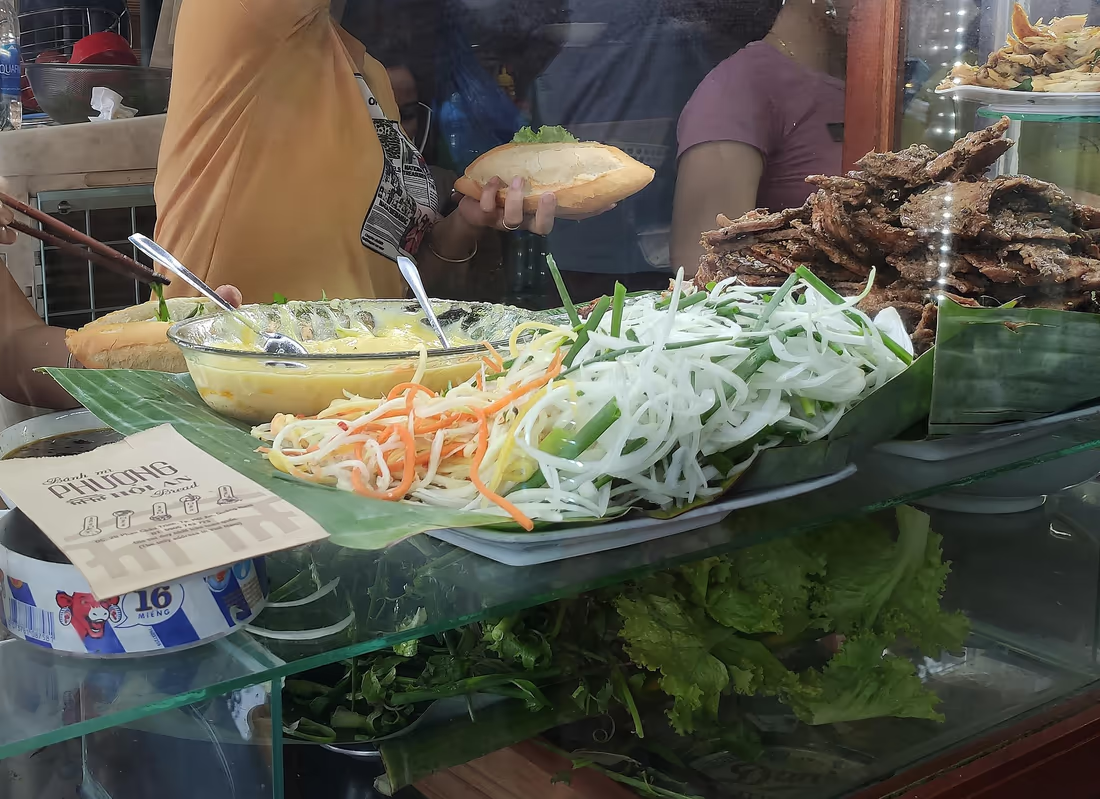
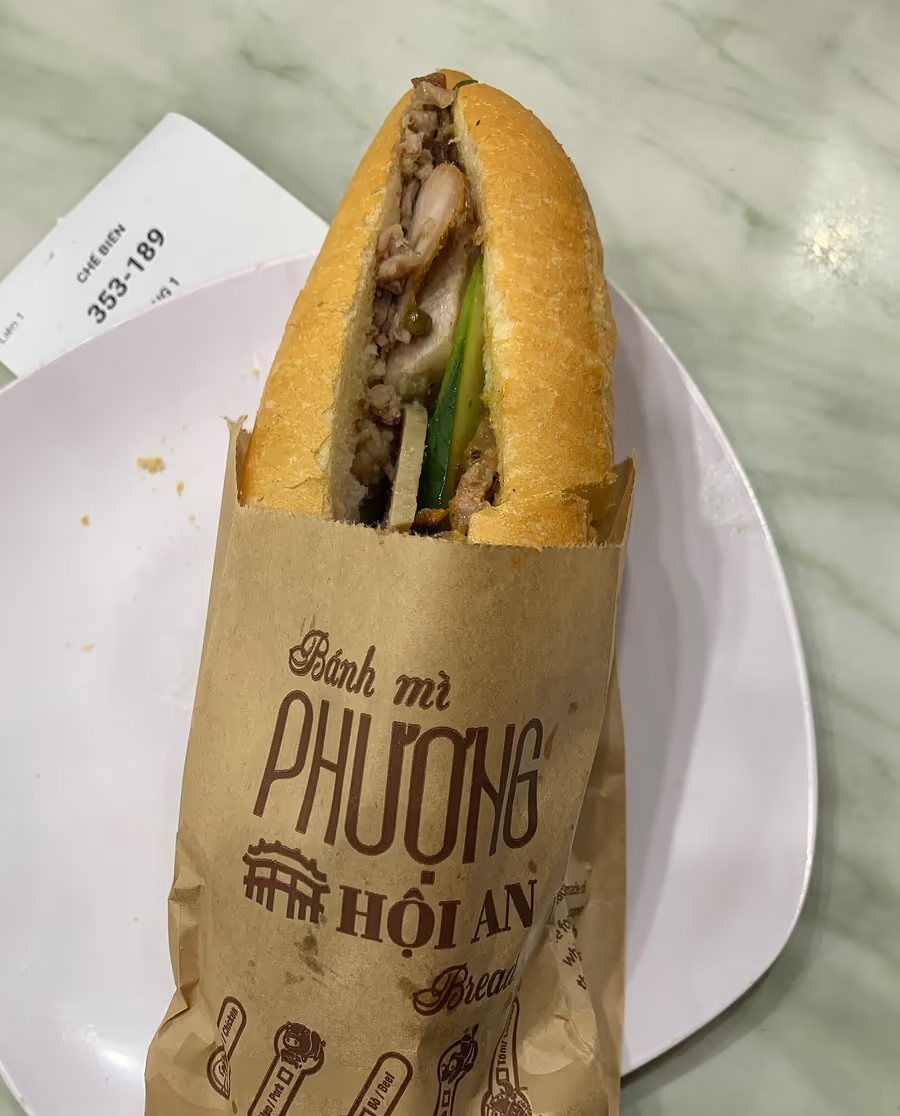
Hoi An is the town most travellers name when they talk about banh mi, because of one shop. Banh Mi Phuong is run by Truong Thi Phuong, and Tuoi Tre reported on 4 August 2023 that the stall began in Hoi An Market and later moved to a larger shop on Phan Chau Trinh Street. Anthony Bourdain was told about it in 2007 and went back about two years later for the television series No Reservations. A photograph of the shop sign taken in 2024 reads “2B Phan Chau Trinh”, “Since 1989” and “Open from 6h30am to 9h00pm”; confirm the hours before you go. The shop is busy, so expect a queue. Madam Khanh, “the Banh Mi Queen”, at 115 Tran Cao Van Street is the other name travellers use, with prices around 20,000 to 30,000 VND in the sources we found, which disagree on the hours.
Da Nang has its own long-running shops. The Vietnam Airlines travel guide lists Banh Mi Ba Hung at 40 Le Van Hien Street (open since 1987) and Banh Mi Ba Lan at 62 Trung Nu Vuong Street (open since 1990, with a salt-and-chilli sauce from Sa Huynh), plus skillet banh mi at about 15,000 to 35,000 VND. The guide is undated, and a Polish tourism page gives Ba Lan as 1979, so the founding year is uncertain. For the city itself, see things to do in Da Nang.
In Saigon, Huynh Hoa at 26 Le Thi Rieng Street in District 1 is the best-known loaded banh mi. Vietcetera reported a price of 73,000 VND on 7 July 2025, and VnExpress reported 58,000 VND on 15 October 2021 for a roughly 400 gram sandwich with four to six meats, which shows how much the price has risen; the opening hours also differ between the two reports. Co Thy at 448 Le Van Sy Street in District 3 is quoted at 20,000 to 25,000 VND, and Sau Minh at 170 Vo Van Tan Street at 45,000 VND. For the cities side by side, best Vietnamese cities to visit helps you decide how long to stay in each.
What Banh Mi Costs in 2026
A street banh mi is one of the cheapest meals in Vietnam, and a loaded one in a famous shop costs three or four times more. The food-budget page updated on 3 October 2026 gives 15,000 to 45,000 VND for a street banh mi and 70,000 VND (about $2.80) for one in a clean cafe, and says a day of eating only street food costs 150,000 to 250,000 VND. That page also says tourist areas run 50 to 200 per cent above local prices. Both 20,000 VND and 73,000 VND are honest prices; they buy different sandwiches.
| Type | VND | Source |
|---|---|---|
| Hanoi basic pate | 15,000–20,000 | vietnamtourism.com, 25 Sep 2026 |
| Hanoi egg or single meat | 20,000–30,000 | vietnamtourism.com, 25 Sep 2026 |
| Hanoi tourist-oriented | 30,000–45,000 | vietnamtourism.com, 25 Sep 2026 |
| Clean cafe | about 70,000 | vietnamtourism.com, 3 Oct 2026 |
| Saigon, Huynh Hoa | 73,000 | Vietcetera, 7 Jul 2025 |
If you are budgeting for a trip, our Vietnam travel costs page puts food in context with transport and hotels.
Banh Mi in Sapa, and Carrying One on a Trek
Sapa has no banh mi style of its own that we could find in any source. What you get is the standard lowland sandwich on a street cart in town, and the same shops and carts that sell snacks at the market. Our own pages on what to eat in Sapa and Sapa restaurants list where visitors eat; breakfast in Sapa costs more than in Hanoi, with one of our pages putting it at 30,000 to 60,000 VND. The mountain town has its own dishes, from grilled meats to hot pot, and a banh mi is best treated as a cheap breakfast or a lunch for a travelling day.
As for carrying one on a trek, here is our own advice, not a published rule, and our guides decide on the day. A banh mi eaten within a few hours is fine, and the paper wrapping keeps the crust crisp longer than a plastic bag. If you will be walking all day in warm weather, ask your guide what lunch is included before you buy one, and keep it out of the sun in a bag. Walking poles and boots can be rented at our office, and what to pack for Sapa trekking lists the rest. To reach Sapa from Hanoi, how to get to Sapa and our transport page cover the sleeper bus, limousine and night train.
Street Food Safety: What the CDC Says and What We Do
The US Centers for Disease Control and Prevention’s travel page, last reviewed on 6 January 2026, is blunt: “Avoid eating food from street vendors.” It adds that if you choose to eat street food, you should follow the same food safety rules as for other foods, and that you should avoid raw vegetables and eat food cooked and steaming hot. A banh mi has raw cucumber, coriander and pickles, so it does not meet the last rule, and we want you to know that rather than pretend the risk is nil.
Local people eat banh mi every day, and the CDC’s line is a cautious default for travellers, not a ban; you decide how much risk you accept. Our own habits are to pick a busy stall where bread and meat turn over quickly, avoid meat that has been sitting in the heat, ask for the version you are comfortable with, and wash your hands. If you have a sensitive stomach, a cooked filling such as egg or grilled pork is a safer choice than cold cuts. If you are ill, speak to a doctor; this is not medical advice.
How We Checked This
We opened these pages on 31 October 2026: Wikipedia’s Bánh mì article; the vietnamtourism.com guides on where to eat banh mi in Hanoi (updated 25 September 2026) and on food budgets (updated 3 October 2026); Tuoi Tre on Banh Mi Phuong (4 August 2023); Vietcetera on the origins of banh mi (8 August 2017) and on Saigon banh mi (7 July 2025); VnExpress (15 October 2021); the Vietnam Airlines Da Nang banh mi guide; VietNamNet on food prices (31 August 2025); and the CDC food and water safety page (last reviewed 6 January 2026). A Tuoi Tre series on Hoa Ma and some Vietnamese travel sites we read only in search summaries.
What we could not confirm: any distinct Hue or Dalat style, the origin of the Hai Phong spicy banh mi, a local style in Sapa, opening hours that differ between sources, the Anthony Bourdain link to the Pho Hue shop, and any Hanoi cash-only claims. We found no free photograph of a Hanoi cart, so the photos in this guide are from Saigon and Hoi An. The Vietnamese phrases are common usage, not from a cited source.
Rent at Our Office Before You Trek
 Gear Rental
Trekking Boots Rental
Waterproof ankle-support boots. Cleaned and checked before each rental. Available at 105 Thach Son Street.
 Gear Rental
Walking Poles Rental
Trekking poles available to rent at $2/day at our office, 105 Thach Son Street. Essential for descents.
Frequently Asked Questions
A banh mi is a short baguette made with wheat and rice flour, filled with pate, cold cuts or grilled pork, pickled carrot and daikon, cucumber, coriander, chilli and mayonnaise or butter. Fried egg, sardine, pork floss and fish patties are other fillings, and a vegetarian version uses tofu or seitan.
English speakers say it roughly as bahn mee. In Vietnamese, banh means baked or steamed items and mi means wheat, so the name means wheat bread. In the north it is also spelled banh my.
A food-budget page updated on 3 October 2026 puts a street banh mi at 15,000 to 45,000 VND, about 0.60 to 1.80 US dollars, and one in a clean cafe at about 70,000 VND. Famous loaded shops in Saigon charge more, for example 73,000 VND at Huynh Hoa in July 2025.
No source can name one best shop. A vietnamtourism.com guide updated on 25 September 2026 lists Banh Mi Pho Hue at 118 Pho Hue, Banh Mi 25 at 25 Hang Ca, Banh Mi Hoi An at 98 Hang Bac, a shop at 12 Lan Ong and Ba Dan at 34 Lo Su. Check the address and hours before you go.
The standard banh mi is not, because it has pate and meat. Ask for banh mi chay, which is usually made with tofu or seitan. Mayonnaise contains egg, and a street stall may use shared knives, so strict vegetarians and vegans should ask the seller what goes in.
The baguette came with the French in the 19th century, and the Saigon-style meat sandwich took shape in the 1950s. Wikipedia gives the baguette arrival as both mid-century and the 1860s, so exact years vary. The Oxford English Dictionary added banh mi on 24 March 2011.
We found no local Sapa style in any source. In Sapa you get the standard lowland sandwich from street carts and shops, and the mountain town is better known for grilled meats and hot pot.
The US CDC travel page, last reviewed on 6 January 2026, advises avoiding food from street vendors and avoiding raw vegetables. Banh mi has raw herbs and pickles. Choose a busy stall, avoid meat left in the heat, and speak to a doctor if you have health concerns.