 Sinh Giang
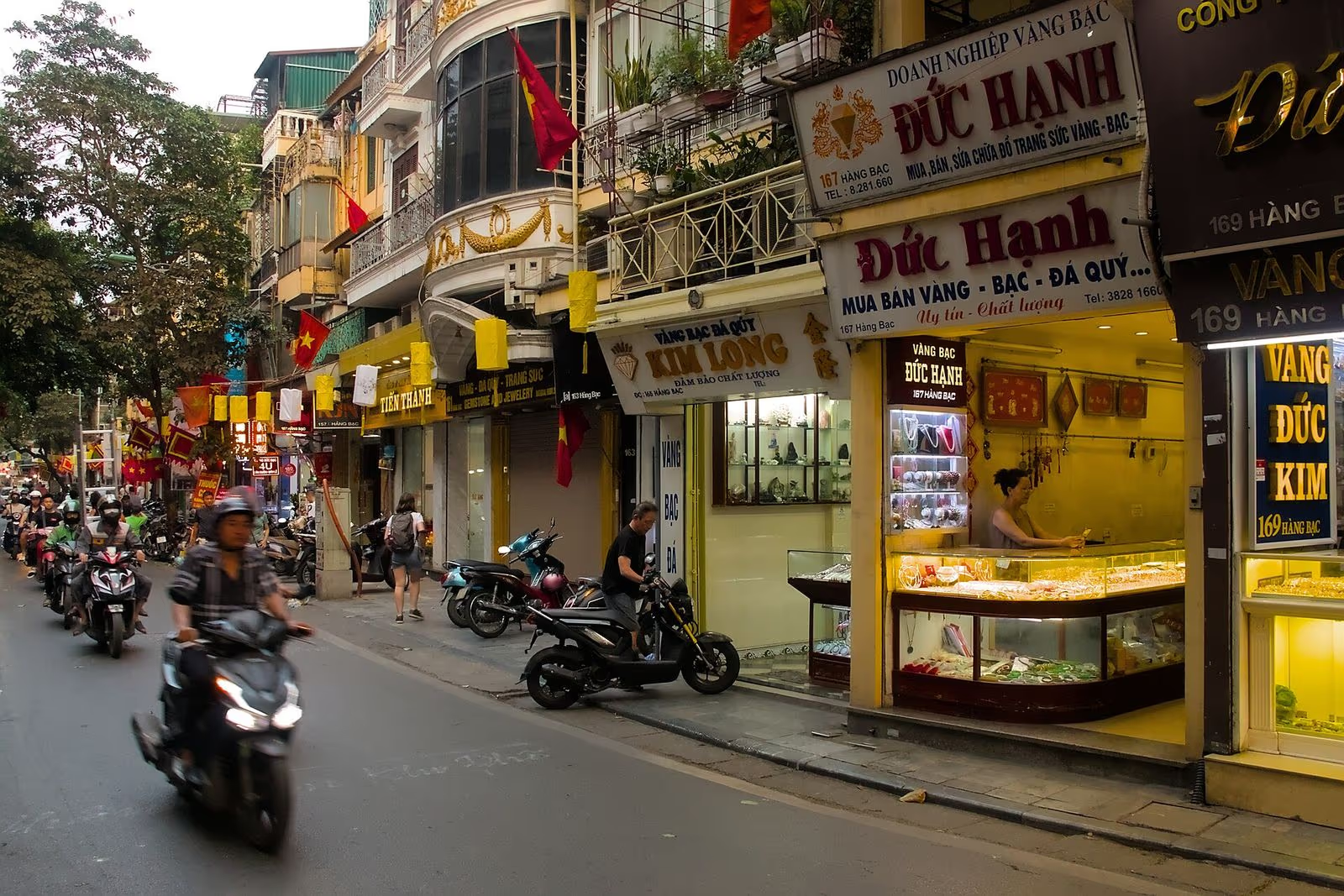
The Old Quarter is the part of Hanoi you can cross on foot in under an hour and still not finish in a day: a dense grid of trade streets north of Hoan Kiem Lake where a jeweller, a stall of paper offerings and a pot of noodle soup can share one pavement. Train Street, the railway strip at the edge of the quarter where cafe tables sit a step from the rails, is a different story in 2026. It is officially restricted, the rules have changed several times since 2019, and we could not confirm what applies today. This guide covers both, and it tells you which fact comes from which source and when we checked it (31 October 2026).
The short version: give the Old Quarter half a day on foot between Hoan Kiem Lake and Dong Xuan Market, come back on a Friday to Sunday evening for the night market, and treat Train Street as something to check on the day rather than build a plan around. We are a Sapa company, and Hanoi is where our trips start; the full city list is in Things to Do in Hanoi and a day-by-day plan is in 2 Days in Hanoi. This page goes deeper on the two places those guides cover in a paragraph each.
The Old Quarter in Plain Terms
The Old Quarter is Hanoi's historic trading district, set between Hoan Kiem Lake on its southern side and Dong Xuan Market to the north, and it takes its nickname, the 36 streets, from the guilds that once worked there. Vietnam's official tourism website describes 36 guild streets named for the trades that supplied the royal court at the nearby Thang Long Citadel (checked 31 October 2026).
Treat "36" as a label, not a count. A Vietnamese government portal article from April 2010 says the number of guilds changed over the centuries, with 61 in the Tran dynasty falling to 36 under the Le, and adds that "the exact number of streets depends, to some extent, on how one counts" (Hanoi Capital portal, 12 April 2010). A Vietnam Tourism portal guide updated on 18 September 2026 puts it more bluntly: the name is a historical label, not a census, and around 70 named lanes exist today. In practice that means you will keep meeting streets that are not on any "36 streets" list, and that is fine.
To find your way, the same portal guide suggests three landmarks: Hoan Kiem Lake on the south, the railway and Long Bien Bridge on the east, and Dong Xuan Market on the north, with St Joseph's Cathedral marking the west-centre. It also recommends an offline map alongside GPS in the narrowest lanes. We would add one habit: keep your hotel's name and address on a card, so any driver can read it.
Which Street Sells What
Most streets in the Old Quarter start with the word Hang, which means merchandise, and the word that follows names the product; Hang Bac is silver, Hang Gai is silk, Hang Ma is paper offerings (Vietnam Tourism portal guide, updated 18 September 2026). That naming system is still the quickest way to decide where to walk, with one honest caveat: shops have moved, and several streets now sell something different from their name.
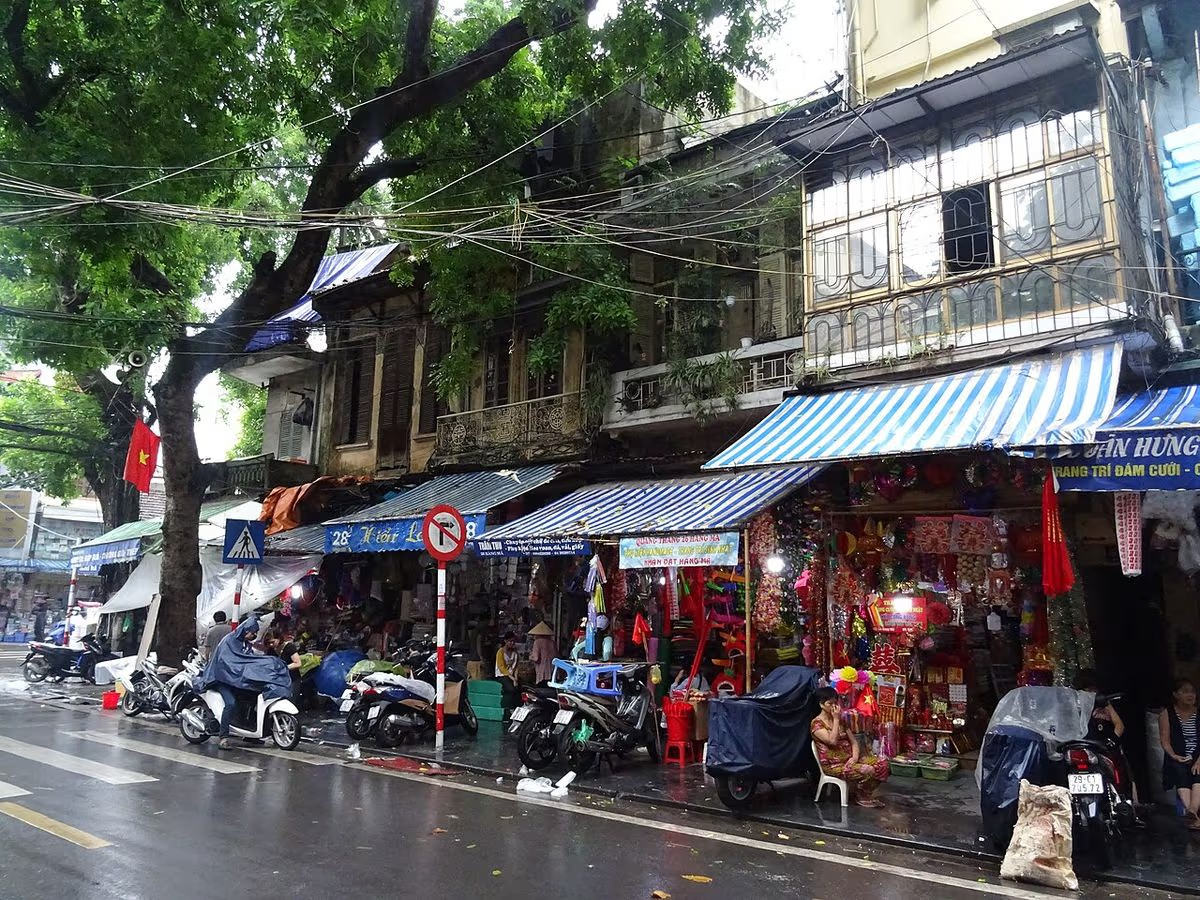
The table below lists ten streets. "Traditional trade" comes from the street name and, for Hang Dao, a guild record cited by the Hanoi government portal; "today" is what the Vietnam Tourism portal guide of 18 September 2026 reports, with Hang Gai, Hang Bac, Hang Ma and Lan Ong also named by Vietnam's official tourism website.
| Street | Traditional trade | What you will find today |
|---|---|---|
| Hang Bac | Silver | Jewellery, gold leaf and currency exchange |
| Hang Gai | Silk | Fabrics, custom tailoring and fashion |
| Hang Ma | Paper offerings | Lanterns and festival decorations |
| Lan Ong | Herbal medicine | Dried roots and traditional remedies |
| Hang Dao | Dyed red silk (guild record) | Fashion and souvenirs; the weekend night market after dark |
| Hang Quat | Fans | Religious goods and fans |
| Hang Non | Hats | Hats and accessories |
| Hang Thiec | Tin (sheet metal) | Metal boxes and household goods |
| Hang Tre | Bamboo | Bamboo and rattan goods |
| Hang Chieu | Mats | Mats and textiles |
Two streets deserve a note because sources describe them differently. Hang Buom, whose name means sails, is described by the Vietnam Tourism portal guide as a street of fish sauce and food shops and by an encyclopedia entry as dominated by Vietnamese cakes and sweets; go and look rather than rely on either. And Hang Dao is the street the official tourism website names as turning into the night market after dark on weekends, which is why it feels like two different streets depending on the hour.
If you want to buy something, ask two shops for the same item and keep larger purchases for places where the price is displayed. For the wider question of overcharging in Vietnam, our guide Is Vietnam Safe for Tourists? covers the common scams and how to avoid them.
A Half-Day Walking Route
You can walk the main axis of the Old Quarter in about 50 minutes without stopping, and the Vietnam Tourism portal guide estimates four to six hours if you browse, which is the realistic figure. The route below follows streets and landmarks that the sources name together; it is a sequence, not turn-by-turn directions, so use an offline map for the gaps.
One Morning in the Old Quarter
- Start at the lake: Hoan Kiem Lake is the quarter's southern landmark. Go early, before the traffic builds.
- Hang Bac and Hang Gai: silver and jewellery, then silk and tailoring. Look at the shopfronts; you do not need to buy.
- The Hang Ngang, Hang Dao and Hang Duong spine: these three streets, running north toward Dong Xuan, are the ones that host the weekend night market.
- Hang Buom and Ma May: Vietnam's official tourism website lists the Ma May house as a heritage home of Chinese merchant families. Opening hours differ between sources, so ask at the door.
- Dong Xuan Market: the quarter's northern landmark. Colonial-era papers from 1888 and 1891 about clearing land for the market survive.
- O Quan Chuong gate: built in 1749 and rebuilt in 1817, the only remaining gate of the old citadel wall, according to Vietnam's official tourism website. The portal guide suggests starting here and walking west; either direction works.
Crossing the street is the skill that matters most. The Vietnam Tourism portal guide gives the rule locals use: walk slowly and steadily, do not stop, do not reverse. Motorbikes steer around a predictable pedestrian; they cannot steer around someone who darts.
After the Old Quarter: Our 3 Most Popular Sapa Tours
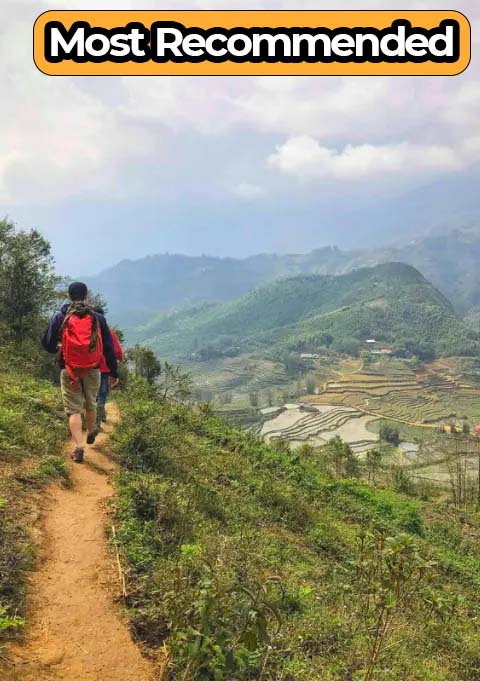 Best Seller
Trekking Through Rice Terraced Fields
A day on the Muong Hoa Valley floor through Lao Chai and Ta Van, a calm contrast to the Old Quarter.
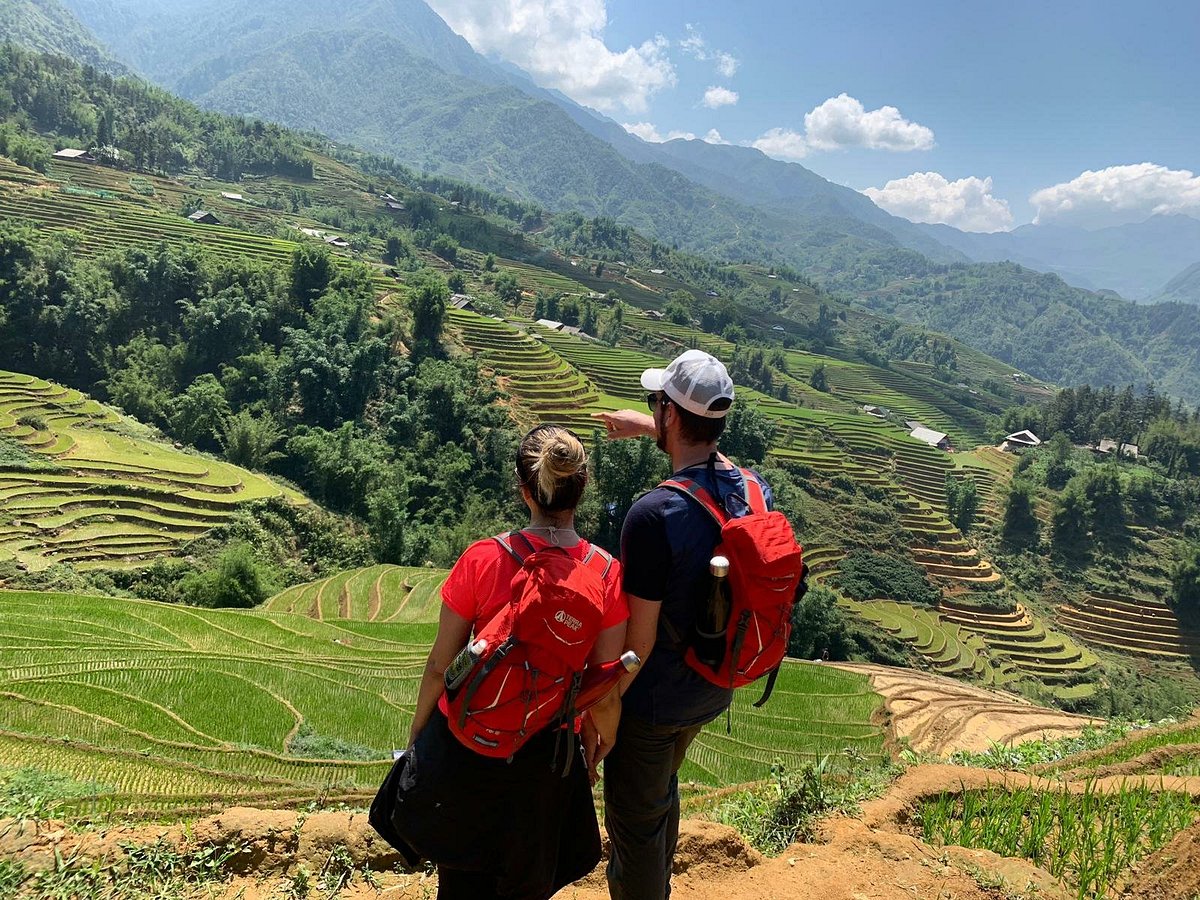
Rice Terraced Fields & Homestay
Overnight with a Black H'mong family in Lao Chai, with a home-cooked dinner and the terraces at dawn.
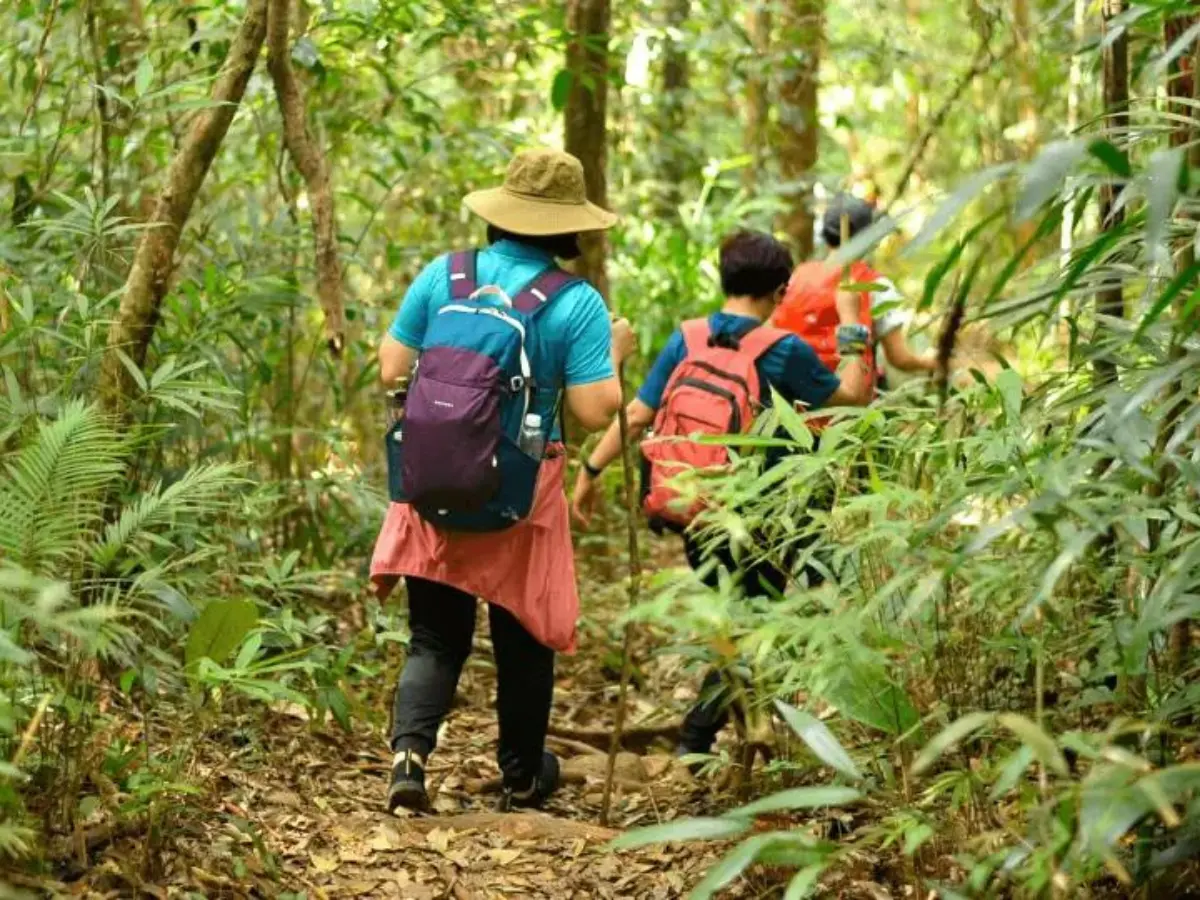
Fansipan Trek One Day Tour – Roof of Indochina
The cable car to Indochina's highest peak, for travelers with one day to spare in the mountains.
The Weekend Night Market and Walking Streets
The last dated source we found says the pedestrian zone around Hoan Kiem Lake runs every weekend from 7 pm on Friday to midnight on Sunday, and that the night market on Hang Ngang, Hang Dao and Hang Duong streets runs from 7 pm to midnight (VnExpress International, 17 August 2023). That article is more than three years old, so use it as a pattern to confirm, not a timetable. Other listings online give slightly different hours, so ask your hotel.
What VnExpress describes is a market laid out on a strict plan. Vendors set up mobile stalls in the middle of the street and leave a walkway of 3 to 3.5 metres on each side, goods are mostly clothing, handicrafts and souvenirs, and the zone is a walking street. The same article puts typical weekend crowds at 25,000 to 35,000 people and says the walking street opened officially in September 2016 after a two-year pilot. Vietnam's official tourism website also notes that vehicles are banned from the lake area at weekends.
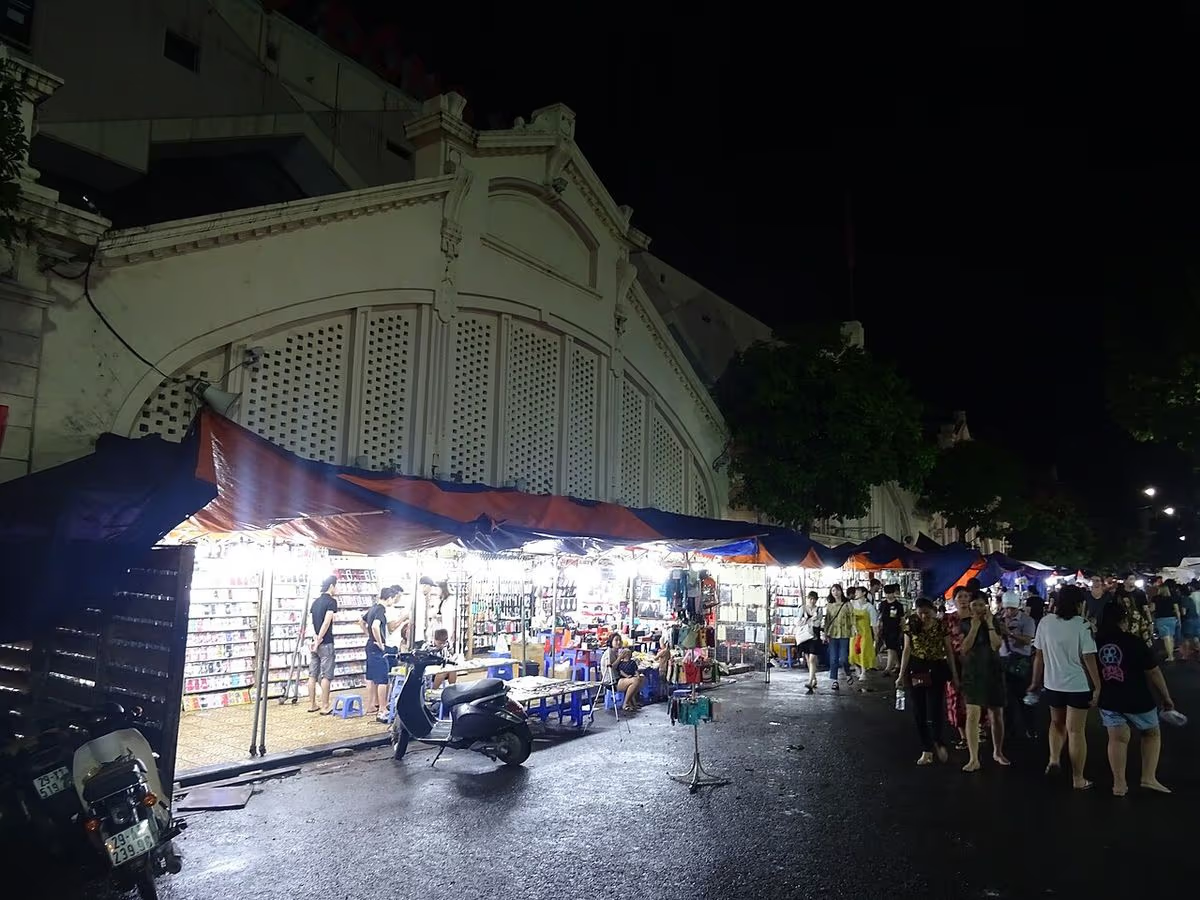
Three practical points follow from that layout. First, if your hotel is inside the pedestrian zone, ask where a taxi or Grab can drop you on a Friday or Saturday evening, because the car cannot reach the door. Second, a walkway only 3 metres wide fills fast, so keep your phone and wallet in a front pocket or a zipped bag and move with the crowd rather than against it. Third, go for the atmosphere and the street food rather than for a specific purchase; the trade streets listed above are better for the goods they are known for.
Come early in the evening, eat before the crowd peaks, and then walk the market in one direction, from the lake toward Dong Xuan. Walking back against the flow is slow; a short Grab ride home is easier, and you can catch it at the edge of the zone.
Train Street: What Is Allowed, With Dates
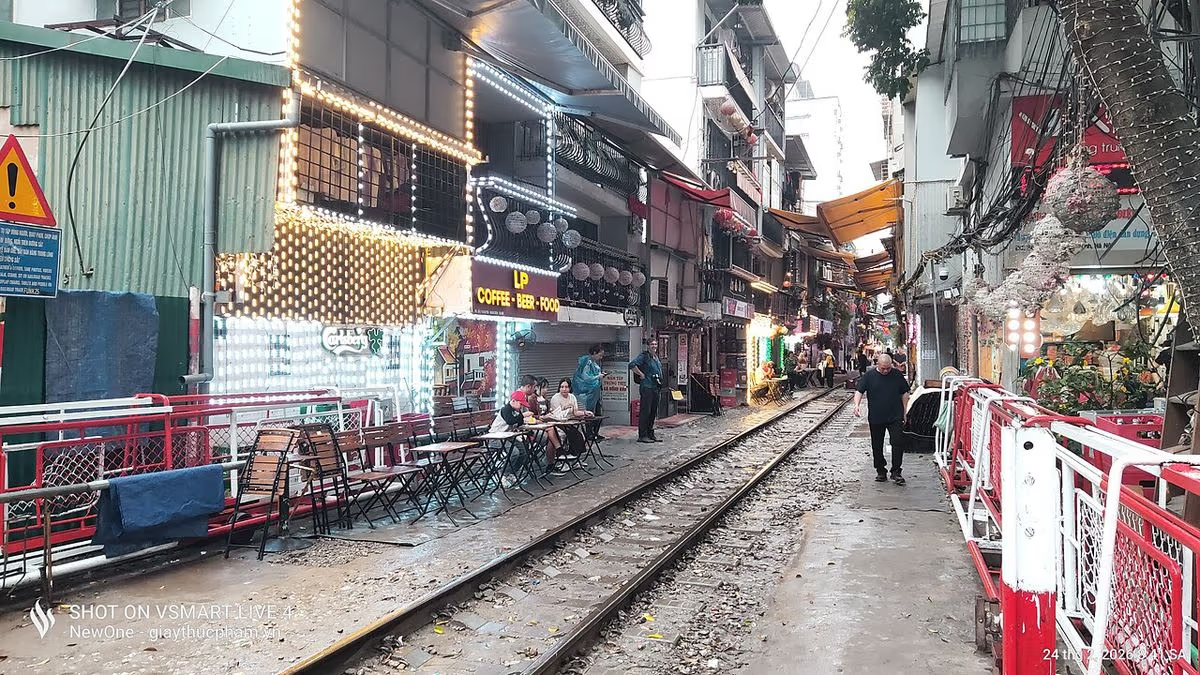
Train Street is not an official attraction in 2026. It is a working railway line that runs between houses on a narrow strip between Hanoi Station and Long Bien Station, where cafes have operated along the track since 2018 (VnExpress International, 5 March 2026). VietnamNet reported police patrols focused on the cafe stretch from Phung Hung to Le Duan streets (15 June 2025). Everything below is dated, and where sources stop, so does this article.
How the rules changed
The sequence matters because travel blogs often compress it into "it is closed" or "it is open", and neither is accurate. The timeline below follows reporting in Vietcetera (10 March 2026), the Hanoi Department of Tourism directive reported by Dan Tri International (10 March 2025), VietnamNet (15 June 2025 and 28 February 2026) and VnExpress International (5 March 2026).
Authorities order a ban on all commercial activity along the street. Cafes are back within about three months.
Enforcement tightens: barriers go up and cafes face losing their business licences.
Hanoi's tourism department tells travel companies not to organise tours. Vietnam Railways opens a cafe inside Long Bien Station.
A tourism department directive bans tour and transport operators from promoting or arranging visits to the cafe-lined section.
A visitor nearly falls in front of a train; police tell cafe owners to clear their setups and ask guests to leave.
The Ministry of Construction and Hanoi agree to cut passenger trains and suspend freight through the area.
The pattern to keep in mind is the first entry: a ban in October 2019, and cafes operating again within about three months. Vietcetera also notes that in 2025 authorities continued enforcing the ban and warned tour operators, which is why every later announcement deserves a check on the day.
The March 2025 directive is worth reading for what it does and does not say. Dan Tri International reports that it prohibits tour operators and businesses providing transport services for tourists from promoting or arranging visits to the cafe-lined railway section, to ensure railway safety and public order. The article does not say that individual tourists are barred from the area, that cafes must close, or what penalties apply. That is a restriction on businesses; it is not a statement about you walking down the street.
The June 2025 incident shows why enforcement can be sudden. VietnamNet reports that on the night of 14 June 2025 a foreign tourist filming on the tracks nearly fell in front of an oncoming train and was pulled back by other visitors, a day after a video showed tourists sitting in the rail corridor. Police and local officials ran a joint operation at 8 pm: officers told cafe owners to clear their setups, asked all guests to leave and helped railway staff close the safety barriers.
Where that leaves you in November 2026
The most recent reporting we could find concerns the trains rather than the cafes. VietnamNet reported on 28 February 2026 that the Ministry of Construction and the Hanoi People's Committee had agreed to reduce passenger and tourist train frequencies on the Hanoi to Gia Lam line, to stop freight trains on the Hanoi, Long Bien and Gia Lam corridor, and to transfer that railway infrastructure to the city. VnExpress International followed on 5 March 2026 with the detail of a 2 March letter from the ministry: if the plan is fully implemented, passenger trains would no longer pass through the residential strip, and the ministry asked the city to complete all the work before July 2026.
We found no report, as of 31 October 2026, saying whether the July 2026 deadline was met, whether passenger trains actually stopped using the strip, or whether the cafes are open or closed this week. If a blog tells you the answer with certainty, ask where it got it. The answer may differ from morning to evening, and from one section of the street to the next.
The Vietcetera article also records a view from inside the industry. Nguyen Tien Dat, vice chairman of the Hanoi Tourism Association, is quoted saying that "from a safety and security perspective, all activities at Train Street cafes are currently in violation." He proposed officially recognising the street as a designated attraction with strict safety controls, funded by business fees; we found no report that this has been adopted. VnExpress says thousands still entered the strip daily despite the official ban.
On the day: how to check without taking a risk
Our advice is to treat the strip as closed unless the people in charge on the spot tell you otherwise, and to check before you travel there. Ask your hotel reception that morning whether visitors are being allowed in; staff are more likely to know than a website. When you arrive, look at the barriers: if staff or officers are turning people back, accept it. Do not pay anyone who offers to open a barrier or to take you through a "special entrance," and be wary of any driver who insists the street is closed and offers to take you somewhere else.
The line is a live railway. A train can arrive faster than you expect, and the June 2025 near-miss happened while a visitor was filming on the tracks. Never stand, sit or take photographs on the rails, and never lean in for a photo as a train approaches. The residents who live a metre from the track have to put up with this every day; if you are on the street at all, be quiet and keep their doorways clear.
Legal Ways to See a Train Pass
The one legal, purpose-built way we can source is the cafe inside Long Bien Station. Dan Tri International reported on 10 June 2023 that Vietnam Railways opened the Hoa Xa Coffee Shop in the station, next to the railroad, covering about 80 square metres in a French-style building with views of Long Bien Bridge and passing trains. The railway corporation installed a fence and posted guards for safety, and its representative said visitors can also come in just to relax or ask for train information, free of charge and without buying anything. The article says the cafe opened after the railside cafes near Tran Phu and Phung Hung streets had closed.
Our caveats are specific. The latest dated source we opened is from June 2023, so we cannot confirm today's opening hours, and guides online disagree about them. Train frequency is also a problem: sources give very different figures, and the February 2026 agreement is meant to reduce passenger services through the central stretch, so you may wait. If you go, ask the staff at the station for the next train and treat the cafe as a pleasant place to sit by a historic line, not as a guaranteed photograph.
If you simply want a picture of a Hanoi train, seen from behind a lowered level-crossing barrier on an ordinary public road it looks the same without the risk; stay behind the barrier and leave the track bed alone. And if you want to ride rather than watch, the overnight train from Hanoi Station to Lao Cai is a trip in its own right, which we describe in our Chapa Express review and King Sapa Train review.
Eating and Drinking in the Quarter
Food in the Old Quarter is less tidily organised by street than the trades are, which is why asking a local "where is the best bun cha" starts an argument. For a first visit, follow the simplest rules. Eat where you can see the cooking, choose the stall with a queue of Hanoians, and ask or point to the price before you sit down; it is much easier to agree on a price than to dispute a bill. Our guides to eating in Hanoi and 2 Days in Hanoi list the dishes, with typical prices for beer-corner drinks, so we will not repeat those here.
The night market and the beer corner at Ta Hien are the two places where the Old Quarter eats and drinks after dark. Vietnam's official tourism website lists the night market's street food, including snail meatballs, grilled quail and cured pork sausage, and names the Bia Hoi Junction as the most famous beer corner, spilling onto Ta Hien Street. Both are lively and loud, so if you have an early start the next morning, eat and leave before the second drink.
Getting There and Where to Sleep
For most visitors, the Old Quarter is the base, not a day trip. It is the easiest place to start if you are heading north: our Hanoi to Sapa timetable says Sapa van pickups usually start from Old Quarter corners, and the overnight train to Lao Cai leaves from Hanoi's main railway station, a short taxi ride away. If you are landing at Noi Bai, our Hanoi airport guide explains what to do before you leave the terminal, and the 45-minute figure our other Hanoi guides use is for a car or airport bus.
Choosing a street to sleep on is a trade-off between access and noise, and we can only describe it in general terms. Rooms close to the lake are the easiest to walk in and out of, but the lake area is closed to vehicles at weekends. Rooms near the beer corner are in the thick of the nightlife. Rooms deeper in the trade streets are quieter at night but may be harder for a car to reach. Whichever you choose, ask for a room on an upper floor or at the back, and write down the pickup instructions for your onward transport the day before.
From the Old Quarter to the Mountains

Behaving in a Living Neighbourhood
The Old Quarter is a place where people live and work above and behind the shops. Three habits make you a better guest. Ask before photographing someone at work, and accept a no. Do not block a shop entrance to take a picture. And keep your voice down in the narrow lanes at night, where sound carries.
Respect goes both ways: most people working in the quarter are simply earning a living, and the few overcharging cases are easy to avoid if you know the reference prices. Our guide to scams in Hanoi and Sapa lists them with sources. Timing matters too, so check the Hanoi weather month by month before you fix a walking day.
The same logic applies at Train Street, with higher stakes: the people there live beside a working railway, and the reporting we read describes police operations after crowds gathered and a near-accident. If you go, keep to the street, stay off the line, and leave when asked.
From the Old Quarter to Sapa
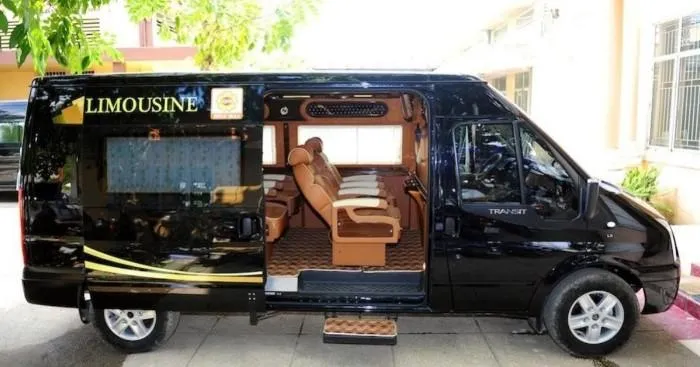
Hanoi is the gateway to Sapa, so the Old Quarter works as the hinge between the two. A half-day in the quarter on the morning you land, a night in a hotel here, then a limousine van, a sleeper bus or the overnight train north is a common pattern. Our guide How to Get to Sapa from Hanoi compares the options, and Sapa Tour from Hanoi explains what is included if you book a tour with transport.
If you only have a few spare days, our guide to day trips from Hanoi ranks the options, and Best Vietnamese Cities to Visit places Hanoi against the others. If you are heading up to trek, rent your boots and poles from our Sapa office the day before you walk instead of carrying them through the Old Quarter's narrow lanes.
Rent at Our Office Before You Trek
 Gear Rental
Trekking Boots Rental
Waterproof ankle-support boots. Cleaned and checked before each rental. Available at 105 Thach Son Street.
 Gear Rental
Walking Poles Rental
Trekking poles available to rent at $2/day at our office, 105 Thach Son Street. Essential for descents.
Sources and What We Could Not Confirm
Every source below was opened and read on 31 October 2026. Where we could not tie a number to an official or news source, we left it out and told you to check.
- Vietnam's official tourism website, "Explore the Old Quarter your way" (no date shown): 36 guild streets, trades, O Quan Chuong gate, Ma May house, night market.
- Hanoi Capital portal, "Layers of meaning," 12 April 2010: how the guild count changed.
- Vietnam Tourism portal guide to the 36 streets, updated 18 September 2026 (its publisher is not stated): about 70 lanes, ten streets' trades, landmarks, walking times.
- VnExpress International, 17 August 2023: walking street and night market hours and layout.
- Vietcetera, 10 March 2026: the 2019 to 2023 timeline, the 27 February 2026 agreement, the tourism association quote.
- Dan Tri International, 10 March 2025 and 10 June 2023: the tours directive; the station cafe.
- VietnamNet, 15 June 2025 and 28 February 2026; VnExpress International, 5 March 2026: the near-miss and police operation; the plan to reduce passenger trains and the July 2026 deadline.
What we could not confirm: whether the Train Street cafes are open now, whether the passenger-train reduction took effect, the current opening hours of the station cafe, the current night-market hours, and the entry fee and hours of the Ma May house, where published sources disagree. If you learn something newer on the ground, tell us on WhatsApp and we will correct this page.
Frequently Asked Questions
Not officially. Hanoi ordered a ban on commercial activity there in October 2019, told tour operators in March 2025 not to arrange visits, and agreed on 27 February 2026 to cut passenger trains through the strip. We found no report as of 31 October 2026 confirming whether the cafes are open this week, so check with your hotel on the day.
The March 2025 directive we read bans tour and transport businesses from promoting or arranging visits, and does not say what applies to an individual visitor. Police have cleared the cafes and asked guests to leave, so follow the instructions of staff and officers on the spot and never stand on the track.
The name says 36, but that is a historical label tied to the trade guilds. A Vietnam Tourism portal guide updated in September 2026 says around 70 named lanes exist today, and a government portal article says the exact number depends on how you count.
The last dated source we found, VnExpress International in August 2023, says the pedestrian zone runs from 7 pm on Friday to midnight on Sunday and the night market on Hang Ngang, Hang Dao and Hang Duong streets runs from 7 pm to midnight. Hours can shift with the season, so confirm with your hotel.
A Vietnam Tourism portal guide estimates about 50 minutes of walking without stops and four to six hours if you browse. Plan half a day on foot, and return on a Friday to Sunday evening if you want the night market.
In or beside the Old Quarter. Our Hanoi to Sapa timetable says van pickups usually start from Old Quarter corners, and the overnight train to Lao Cai leaves from Hanoi's main railway station, a short taxi ride away. Confirm your pickup point the day before.