 Sinh Giang
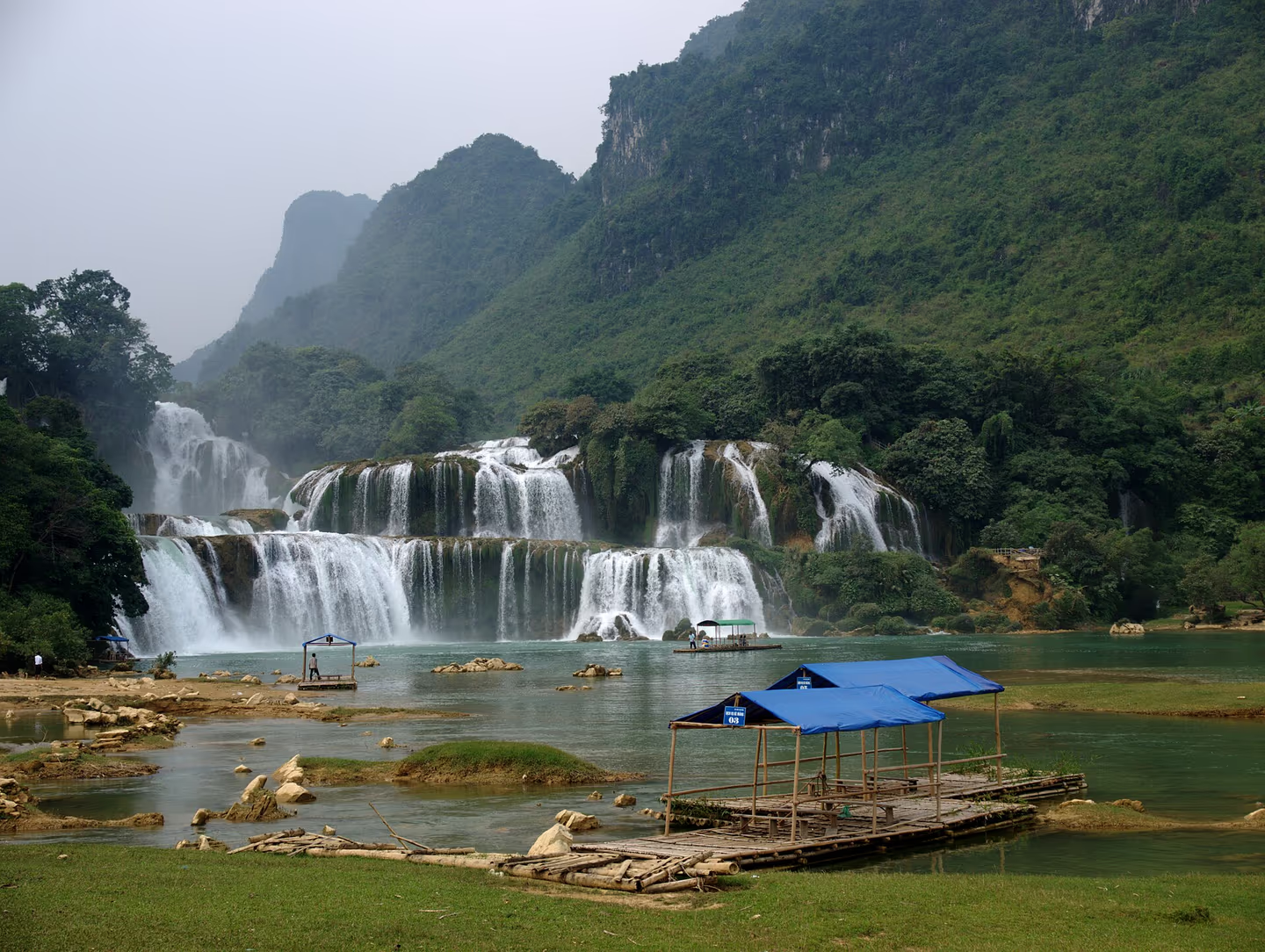
Ban Gioc Waterfall is on the Vietnam-China border in Cao Bang province, about 85 km from Cao Bang city and about 280 km from Hanoi. The usual trip is a bus or limousine van from Hanoi to Cao Bang (5 to 7 hours on the listings we read), then a local bus, taxi or motorbike for the last 2 to 3 hours. Storms have closed the falls for days at a time, so check the weather before you commit.
We checked every figure below on 31 October 2026, date any older source, and say where sources disagree or where we found nothing. We could not open the Ban Gioc management board's own website, so tickets and hours come from news and travel-guide pages. We run Sapa treks, not Cao Bang tours, so this is not a sales pitch. To choose between the two regions, read Sapa vs Cao Bang; this page is the practical guide.
How to Get From Hanoi to Cao Bang
Take a bus or limousine van: the listings give about 280 km and 5 to 7 hours, at roughly 350,000 to 610,000 VND a seat. We found no train to Cao Bang and no scheduled flight.
The distance is not settled. Wikipedia says 270 km; VnExpress's Cao Bang guide (published April 2022, updated 5 January 2026) and a ticket platform both say about 280 km. VnExpress lists the My Dinh, Giap Bat and Gia Lam bus stations in Hanoi. The platform says limousines pick up in the Old Quarter or at a meeting point, and that some run on to Trung Khanh, the town on the way to the falls, so confirm the drop-off before you pay.
| Vehicle | Time listed | Fare from |
|---|---|---|
| Limousine van | 5 h 20 min to 6 h 30 min | 350,000 VND |
| Seated bus | About 6 h | 520,000 VND |
| Sleeper bus | 6 h 30 min to 7 h | 610,000 VND |
| Cabin bus | 7 h to 7 h 30 min | 530,000 VND |
| Private car | 5 h 30 min to 8 h | 2,810,000 VND a vehicle |
Fares also disagree with older figures: VnExpress gave 200,000 to 300,000 VND for a bus in 2022. We do not know why, so ask an operator for the fare in writing.
On the train: the nearest railway we found is the Hanoi to Dong Dang line in Lang Son province, and Dong Dang is a border town, not Cao Bang. Listings disagree on whether it carries domestic passengers now, so we do not rely on it. On flights: Cao Bang has an airport, and a VnEconomy report of 3 July 2026 on the national airport plan says it is envisioned to be upgraded to 4E status by 2050. It does not mention scheduled flights, and we found no airline timetable.
Which Expressway Sections Are Open (Checked 31 October 2026)
No continuous expressway reaches Cao Bang. You drive expressway as far as Cho Moi, then ordinary national road 3 through Bac Kan, or take the Lang Son side, where the new Dong Dang to Tra Linh expressway had not opened to ordinary traffic in anything we found.
Route A: via Thai Nguyen and Bac Kan
Open since 18 May 2014, four lanes, 100 km/h limit (Wikipedia). A groundbreaking on 30 June 2026 will widen it to six lanes (VnEconomy), so expect roadworks.
VnExpress lists it as part of the drive. The same 30 June 2026 project is to complete it as a four-lane expressway. We found no source for its opening date.
Work began on 15 March 2025 with completion planned within 24 months (Nhan Dan). The Thai Nguyen government set 15 June 2026 as the deadline to hand over the whole site. Not open.
National road 3, narrow and winding after Ngan Son (VnExpress). We found no report of an expressway under construction here.
Route B: via Lang Son
The 64 km Chi Lang to Bac Giang part of the Bac Giang to Lang Son expressway has been open since 2019 and joins the Hanoi to Bac Giang expressway. The 43 km Huu Nghi to Chi Lang part is still under construction (Wikipedia). From Chi Lang you continue on ordinary roads (VnExpress).
Phase 1 (93.35 km) was 74 per cent built by contract value on 2 May 2026, with a 62 km technical opening to Dong Khe planned for 19 May (Dai Bieu Nhan Dan). A Government notice reported on 1 October 2026 still lists Dong Dang to Dong Khe as targeted for 2026 and proposes a free temporary opening at Tet 2027.
Two cautions. Ceremonies and "technical openings" are not the same as ordinary traffic, and we found no report of cars using Dong Dang to Dong Khe. Plan on 5 to 7 hours, as the listings say. In 2026 reports it is the Ministry of Construction that inspects these projects, and news about the Cho Moi to Bac Kan link comes from Thai Nguyen province, because Bac Kan merged into it in 2025.
From Cao Bang City to Ban Gioc
It is 80 to 85 km, about 2 to 3 hours by car, and a local bus costs about 80,000 VND. Sources give different distances and times, which the table shows.
VnExpress says about 80 km, while Vietnam Airlines' travel guide and a ticket platform say 85 km. The airline says 2.5 to 3 hours on provincial road 206; the platform says a taxi takes 2 hours and a bus 3 to 4. The platform counts about 10 buses a day from Cao Bang's main bus station between 06:00 and 15:00 and prices a seat at 80,000 VND. We found no operator timetable, so do not assume a late return bus. The platform also lists a taxi at 800,000 to 1,200,000 VND one way and a driver on a motorbike at 400,000 to 600,000 VND a day. VnExpress put motorbike rental at about 200,000 VND a day in 2022 and warned of few petrol stations.
| Place | Distance | Source |
|---|---|---|
| Ban Gioc Waterfall | 80 to 85 km | VnExpress 80; airline guide and platform 85 |
| Trung Khanh town | About 60 km | VnExpress |
| Nguom Ngao Cave | 3 to 5 km from the falls | VnExpress 3; VietNamNet 5 |
| Pac Bo | 50 to 52 km north | VnExpress 50; VOV 52 |
| Thang Hen lakes | About 1 hour by motorbike | VnExpress, no distance given |
Ban Gioc Waterfall: Facts, Tickets and Hours
Ban Gioc is a three-tier waterfall on the Quay Son River that drops over 30 m, and its Chinese side is called Detian. The ticket we found is 45,000 VND and the listed hours are 07:00 to 18:00 in summer and 07:30 to 17:30 in winter, but none of it comes from the management board itself.
- Where
- Cao Bang province, on the border with China. The Chinese side is in Guangxi (Wikipedia).
- Height
- Over 30 m (national tourism website). We found no width in an official source, so we give none.
- Ranking
- The national tourism website calls it the world's fourth-largest waterfall along a national border. Wikipedia traces that claim to a 2011 Chinese television list.
- Ticket
- 45,000 VND for an adult (VnExpress, 2022; a ticket platform, 21 October 2026). An airline guide gives 20,000 to 45,000 VND.
- Hours
- 07:00 to 18:00 in summer, 07:30 to 17:30 in winter (Vietnam Airlines travel guide, copyright 2025). We could not confirm the dates the seasons change.
- Bamboo raft
- 50,000 VND, per person in two sources and per raft in the airline guide. The platform says some operators ask 100,000 VND, so agree the price first.
The Ban Gioc management board stopped admitting visitors from 30 September to 3 October 2025 for Typhoon Bualoi, and again from 7 October 2025 after rain from the remnants of Matmo raised the water to a fast, unsafe level (Zing News, 7 October 2025). It said visits would resume once the weather settled and the water fell. Check the day before, especially from August to October.
The Border: What You May and May Not Do
On the Vietnamese side you buy a ticket, take a raft and walk to the foot of the falls; you do not cross the line. We found no source that lets a foreign passport holder cross to China at the falls.
Sources support
- Buying a ticket and visiting the Vietnamese side.
- Taking a bamboo raft towards the falls.
- Carrying your passport. The airline guide says the checkpoint may ask for it, and Decree 299/2025, as reported, tells foreigners to carry a passport or international travel document in the border area (Nghe An newspaper, 22 March 2026).
Do not
- Cross the fence. A 2026 guide says the path ends at a fenced line and visitors must not cross it.
- Fly a drone. The same guide says drones are banned and confiscated. We found no official notice, so we treat it as banned.
- Swim. The airline guide says not to swim unless guides or signs allow it.
We could not confirm
- Whether foreigners can use the joint Ban Gioc to Detian zone.
- Whether that zone runs today.
- Official raft rules. We found none.
The joint zone is the confusing part. A pilot began on 15 September 2023: tourists "from both sides" registered in advance in groups of up to 20 and used "passports or entry/exit permits" (VietNamNet, 15 September 2023). Cross-border trips were paused on 11 August 2024 after what the board called an incident on the Chinese side (VietnamPlus), and the zone opened officially on 15 October 2024, running 08:00 to 14:00 Hanoi time (Nhan Dan; Viet Nam News). None of these reports mention third-country passport holders. We cannot say whether the scheme runs today, so do not plan to cross.
Do You Need a Border-Area Permit for Cao Bang?
We could not confirm it either way. We found no official source saying a tourist at Ban Gioc needs a permit, and the national rule exempts tourist zones for residents.
Decree 299/2025/ND-CP, in force from 17 November 2025, says foreigners who live in Vietnam need a permit from the provincial police to enter the land border area, except in tourist, service and economic zones, and that foreigners carry a passport or international travel document. We read that through Vietnamese press (27 November 2025 and 22 March 2026), not the decree's full text. It speaks of residents, not short-stay visitors, and we could not confirm that the Ban Gioc tourist area counts as an exempt zone. Tour blogs say no separate permit is needed; those are not official statements.
Compare Ha Giang, where operators say a permit is needed and arrange it; see Sapa to Ha Giang. For Cao Bang, carry your passport, ask your hotel or operator the day before, and ask the provincial police if you plan to leave the main roads. Our Sapa-side answer is in Do You Need a Permit to Trek in Sapa?
When to Go: Water Level by Month
The falls carry the most water in the rainy season, roughly June to September, and are calmer and bluer in the dry season. Sources disagree on which is best, and we found no gauge data for the river.
The bars show average rain at Cao Bang city (World Climate Guide figures as shown on Wikipedia). It is a proxy for the river, not a measure of flow, and the Quay Son rises in China, so rain elsewhere may matter too.
- Jan22 mm
- Feb26 mm
- Mar39 mm
- Apr91 mm
- May174 mm
- Jun229 mm
- Jul224 mm
- Aug249 mm
- Sep150 mm
- Oct91 mm
- Nov44 mm
- Dec20 mm
| Source | What it says |
|---|---|
| National tourism website | June to September: a wide wall of white water. October to May: calmer and turquoise. |
| VnExpress (updated 5 January 2026) | June to September: full force, white with foam. August and September: best, clear water and ripening rice. October: still good. |
| Vietnam Airlines guide | September to October: most powerful. April to June: mild weather, fewer tourists. |
| Ticket platform (21 October 2026) | October to April is best overall. It says a dam upstream releases water about 10:30 to 13:00 in February to April; we found no second source, so we do not rely on that. |
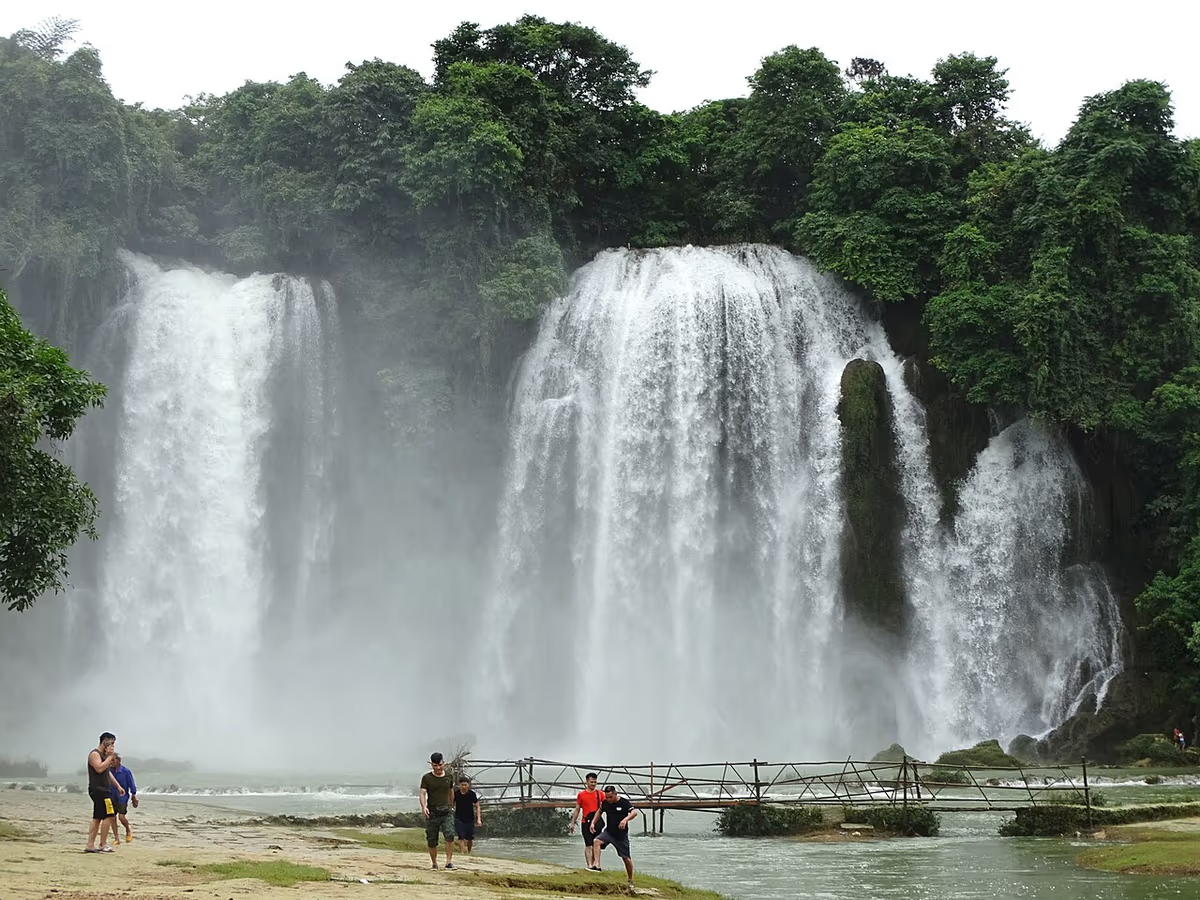
Our reading, which is judgement and not a sourced fact: August to October is where most sources agree on strong, clearer water, but it is also when storms closed the site in 2024 and 2025. The dry months have less water; rain is lowest from December to February. VnExpress adds that buckwheat and wild sunflowers bloom in November and December, and that the chestnut harvest starts in October. For the same months in Sapa, see our October weather and best time to visit Sapa guides, and Vietnam rainy season for the wider pattern.
What to See Near Ban Gioc and Around Cao Bang
The cave and the old stone village are beside the falls, the lakes are a separate drive, and Pac Bo and Phja Oac are day trips from Cao Bang city.
Nguom Ngao Cave
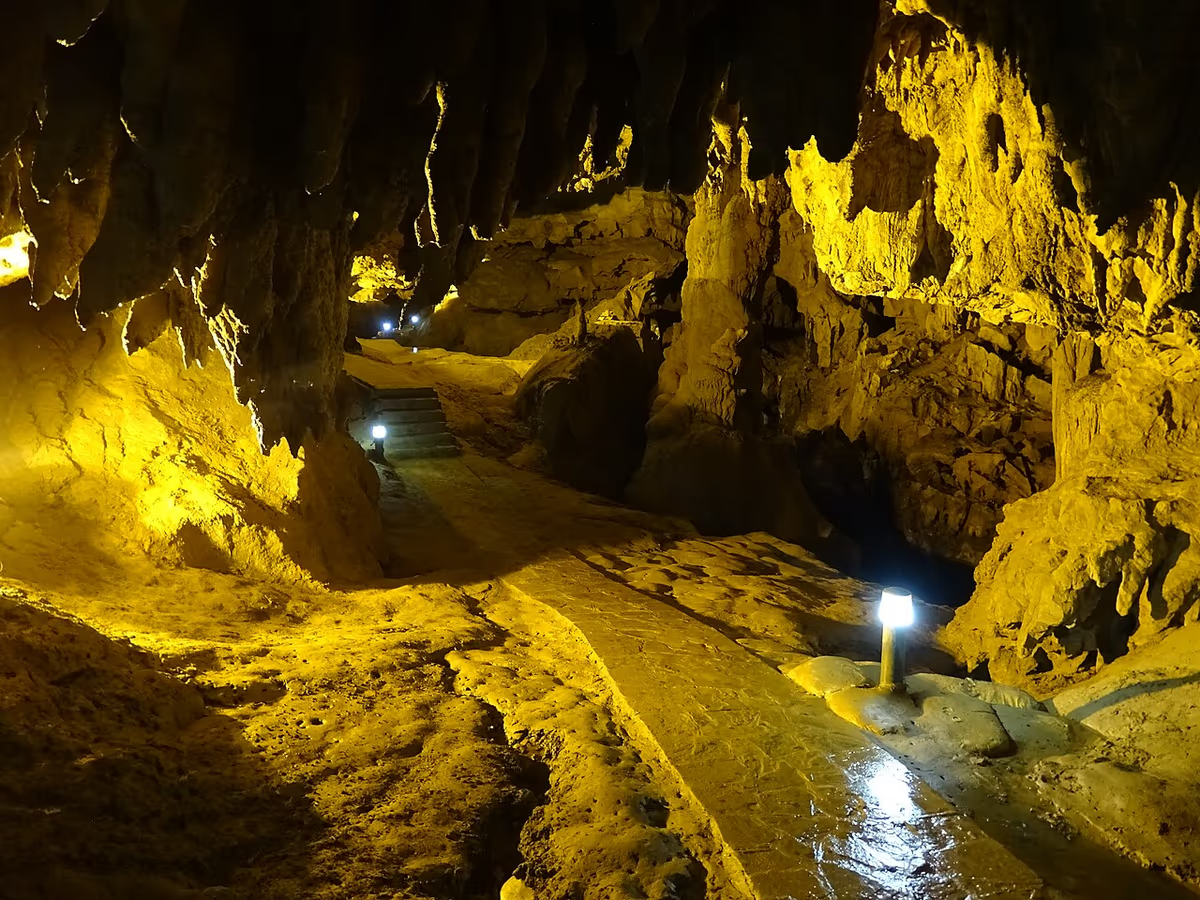
Nguom Ngao is a lit cave a few kilometres from the falls; VnExpress gives about 3 km and VietNamNet about 5 km. It was discovered in 1921, opened to visitors in 1996 and ranked a national scenic spot in 1998 (VietNamNet, 7 October 2023). The total length disagrees: VietNamNet says nearly 3,000 m with three entrances, VnExpress over 2,100 m. Visitors walk only about 1 km, 40 to 50 minutes, and low ceilings mean crouching. The ticket is 45,000 VND (VnExpress, 2022).
Cao Bang UNESCO Global Geopark
The geopark was designated in 2018 (12 April 2018, Vietnam News Agency) and UNESCO re-confirmed it in April 2026. UNESCO's page lists 339,000 ha, eight Indigenous groups, the Thang Hen system of 36 linked lakes and ammonite fossils about 260 million years old. Vietnam News Agency says more than 3,683 sq km, which does not match 339,000 ha (3,390 sq km), and we do not know why. After experts visited in June 2025, the geoparks council recommended a Green Card in September 2025, and the certificate was presented in Paris on 27 April 2026, extending its status by four years. That was its second revalidation. Vietnam's other northern geopark is covered in our Dong Van guide.
Pac Bo
Pac Bo is where Ho Chi Minh crossed the border on 28 January 1941 and based the revolution until 1945, about 50 to 52 km north of Cao Bang city in Ha Quang. Vietnam News (27 January 2026) says a new Ho Chi Minh Cultural Space is due to open "soon" in Truong Ha commune; we found no opening date. VnExpress gave 25,000 VND plus 20,000 VND for the electric shuttle in 2022 and advised about 4 hours.
Phja Oac and Phia Den
Phia Oac to Phia Den National Park in Nguyen Binh was set up in January 2018 and covers over 10,000 ha (Nature and Biodiversity Conservation Agency). VnExpress gives Phia Oac peak as 1,931 m and the cloud season as December to March, with frost possible. We found no sourced drive time from Cao Bang city, so ask locally.
Thang Hen lakes
The lakes sit at about 1,000 m in Quoc Toan commune, Tra Linh, roughly an hour by motorbike from Cao Bang city according to VnExpress, which also lists a "Mat Than" viewpoint about 39 km away. We found no ticket price or season for the lakes.
Food and Homestays
Expect roast duck, pho, chestnuts and basic homestays; we can source only a few names and prices, all dated.
VietNamNet (3 October 2021) names seven-spice roast duck, Trung Khanh chestnuts, black canarium sticky rice and Phia Den canna noodles. VnExpress adds banh cuon at about 25,000 VND and a duck pancake sold from November to February. Chestnut timing disagrees: Vietnam News Agency and VietnamPlus say September and October; VnExpress says October and November. VnExpress listed homestays near the falls at about 200,000 VND a night and city rooms at about 300,000 VND, in 2022 prices. We name none.
Sample Itineraries: 2, 3 and 4 Days
Two days is the minimum and mostly travel, three is workable, and four lets you add Pac Bo and the lakes. These are our plans from the times above, not sourced schedules.
2 days
- Day 1
- Early limousine Hanoi to Cao Bang (5.5 to 6.5 h), then 2 to 3 h to Ban Gioc. Sleep near the falls.
- Day 2
- Falls at opening, Nguom Ngao, then Cao Bang and Hanoi, arriving at night.
- Vehicle time
- About 17 to 18 hours in two days. Our arithmetic.
3 days
- Day 1
- Hanoi to Cao Bang. Sleep in the city.
- Day 2
- Cao Bang to Ban Gioc, raft, Nguom Ngao. Sleep near the falls.
- Day 3
- Morning at the falls if the weather allows, then back to Hanoi.
- Vehicle time
- About 17 to 18 hours, with more daylight at the sights.
4 days
- Day 1
- Hanoi to Cao Bang.
- Day 2
- Pac Bo (allow 4 h) and the city.
- Day 3
- Thang Hen, or Ban Gioc if you start early. Sleep near the falls.
- Day 4
- Falls and cave at opening, then Hanoi.
None of these is a day trip; for genuine day trips from the capital, see best day trips from Hanoi. Add a spare day if a flight leaves the day you return; in storm weeks the falls can close.
Walk the Sapa Valleys on the Same Trip

What the 2025 Administrative Changes Mean for Cao Bang
Cao Bang province was not merged, but its communes were, and Bac Kan on the road to it now belongs to Thai Nguyen province.
Resolution 202/2025/QH15, adopted on 12 June 2025, keeps Cao Bang among 11 provinces and cities left unchanged and merges Bac Kan into Thai Nguyen (text of the resolution). The new units began operating on 1 July 2025. VietNamNet reports that Cao Bang's commune-level units fell from 161 to 56 and that the district layer was dropped, though it does not name Trung Khanh. We could not confirm what the old Ban Gioc commune is called now. Tickets, buses and signs still say Ban Gioc, Trung Khanh and Cao Bang, as they did before.
Pairing Cao Bang With Sapa
Cao Bang and Sapa are on opposite sides of Hanoi, so a combined trip goes through the capital. We do not sell Cao Bang tours, transport to Cao Bang or Ban Gioc tickets; we sell Sapa treks, gear rental and the Hanoi to Sapa leg.
Our comparison page says the two are not direct and that you should not combine them in under 7 days; read it for the choice. For the pairing, one overlap helps: sources put strong, clearer water at Ban Gioc from August to October, and our own guides put golden Sapa terraces in September and October (harvest season). Do Cao Bang first from Hanoi, return to Hanoi, then go on to Sapa; our 5-day northern itinerary and Sapa itinerary planner show how the days fit, and the northern Vietnam guide and hidden places guide put Cao Bang on the wider map. Ha Giang is in the Loop guide.
The Part We Do Sell
- Hanoi to Sapa transport — sleeper buses, limousines and the overnight train, bookable with your trek
- Hanoi to Sapa guide — what each option costs and how long it takes
- How to get to Sapa — the first leg, in detail
Rent at Our Office Before You Trek
 Gear Rental
Trekking Boots Rental
Waterproof ankle-support boots. Cleaned and checked before each rental. Available at 105 Thach Son Street.
 Gear Rental
Walking Poles Rental
Trekking poles available to rent at $2/day at our office, 105 Thach Son Street. Essential for descents.
Frequently Asked Questions
Take a bus or limousine van from Hanoi to Cao Bang city (about 280 km, 5 to 7 hours on the listings we read), then a local bus, taxi or motorbike for the last 85 km, which takes 2 to 3 hours by car. We found no scheduled direct bus to the falls. Some limousine vans run on to Trung Khanh, the town on the way, so check the drop-off point. We checked this on 31 October 2026.
Five to seven hours by road. A ticket platform listing dated 24 October 2026 gives 5 h 20 min to 6 h 30 min by limousine, 6 h 30 min to 7 h by sleeper bus and 5 h 30 min to 8 h by private car, and VnExpress gives 6 to 7 hours by bus. The distance is about 280 km, although Wikipedia says 270 km. Roadworks and rain can add time.
No. On 31 October 2026 the Hanoi to Thai Nguyen expressway is open and being widened, the 28.8 km Cho Moi to Bac Kan link is under construction, and the road on to Cao Bang is ordinary national road 3. On the Lang Son side, a Government notice reported on 1 October 2026 still lists the Dong Dang to Dong Khe section as targeted for 2026 and proposes a free temporary opening at Tet 2027. We found no report of ordinary traffic on it.
Sources disagree. The national tourism website says the falls are a wide wall of white water from June to September and calmer and turquoise from October to May. VnExpress recommends August and September, and an airline guide says September and October. Storms can close the site: it stopped admitting visitors from 30 September to 3 October and again from 7 October 2025. We found no gauge data for the river.
The adult ticket we found is 45,000 VND, in VnExpress (2022 prices) and on a ticket platform on 21 October 2026. A bamboo raft is listed at 50,000 VND, per person in two sources and per raft in one, and some operators ask 100,000 VND. Listed hours are 07:00 to 18:00 in summer and 07:30 to 17:30 in winter. We could not open the management board's own page, so confirm on arrival.
We found no source that says they can. The Vietnamese side ends at a fenced border line, and visitors should not cross it. A joint Ban Gioc to Detian zone has run since a pilot on 15 September 2023, with groups of up to 20 registered in advance, but state reports speak only of tourists from the two countries and we found nothing on third-country passport holders. Do not plan on it.
We could not confirm it either way. Decree 299/2025/ND-CP, in force from 17 November 2025, requires foreigners who live in Vietnam to hold a provincial police permit for land border areas, except in tourist, service and economic zones, and says foreigners must carry a passport. We found no official source saying a tourist at Ban Gioc needs a permit. Carry your passport and ask your hotel or operator.
No. We sell Sapa treks, gear rental and Hanoi to Sapa transport. We do not sell Cao Bang tours, tickets or transport, so book those with a local operator. We can help you fit a Sapa trek before or after a Cao Bang trip.