 Sinh Giang
The Vietnamese dessert most visitors meet first is che, a sweet soup, pudding or drink of beans, jelly, fruit and coconut milk, served in a glass or bowl for 10,000 to 40,000 VND (vietnamtourism.com, 9 August 2026). Start with che ba mau, the three-colour cold dessert of red beans, mung beans and green pandan jelly over ice, then try a warm che chuoi or che troi nuoc when it is cool. Order from a busy stall, point at the glass cases, and ask for less sugar with it duong.
We are a Sapa trekking company, not a pastry guide, so this page is built from published food sources that we read on 3 November 2026, with the source and date beside every price and claim. Where two sources disagree, as they do on the red bean in che ba mau and on the festival of che troi nuoc, we say so. For the savoury dishes, see our guides to pho, banh mi, banh xeo and spring rolls, which follow the same method.
Key Takeaways
- Che is any sweet Vietnamese soup, pudding or drink. A street bowl costs 10,000 to 25,000 VND and a sit-down tourist shop 30,000 to 40,000 VND (vietnamtourism.com, 9 August 2026).
- North, centre and south differ: northern che is lighter and less sweet, central che is richer with Hue specialties, southern che is sweeter and more elaborate.
- Order cold (che da or che lanh) or hot (che nong). Cold che is typically eaten from April to September, hot che from November to February.
- Most che is vegan, but some vendors add egg or dairy, so ask. Coconut, peanut, sesame and mung bean are the common allergens.
- The best hour is between 3 pm and 8 pm. The main food-safety risk is ice, which is usually made from filtered water in cities.
What Che Is, and Why It Has So Many Forms
Che is a family of sweets, not one dish. One of the guides we read says that all che are desserts but not all desserts are che, and that the nearest English word is “pudding”, though there is no real resemblance. Vietnamtourism.com (9 August 2026) describes the form: a glass or bowl of sweetened beans, jellies, fruit or tapioca in a liquid of coconut milk or syrup, often over ice. It is eaten standing or on a small stool, usually with a spoon and sometimes a straw, and most people finish a bowl in under ten minutes.
The best way to find a stall is to look for glass cases or pots with a crowd. The same page recommends the hours between 3 pm and 8 pm and warns that an empty stall is a warning. Local people pick a favourite, but a visitor does not need to: point at the case, or name the bowl you want. Our street food by region guide explains how to read a stall in general.
The Classics: Ba Mau, Chuoi, Troi Nuoc and Thap Cam
Four bowls cover most first visits. The table gives what each contains and how it is served, from vietnamtourism.com (9 August 2026), localvietnam.com (11 May 2026) and Will Fly for Food (25 October 2026). They agree on the main points and differ on small details, which we mark.
| Che | What is in it | Served | Street price |
|---|---|---|---|
| Che ba mau | Red beans, mung beans, green pandan jelly, coconut milk, crushed ice | Cold | 15,000 to 25,000 VND |
| Che chuoi | Ripe banana, coconut milk, tapioca pearls, sugar, topped with peanuts or sesame | Usually warm; cold versions exist | 15,000 to 25,000 VND |
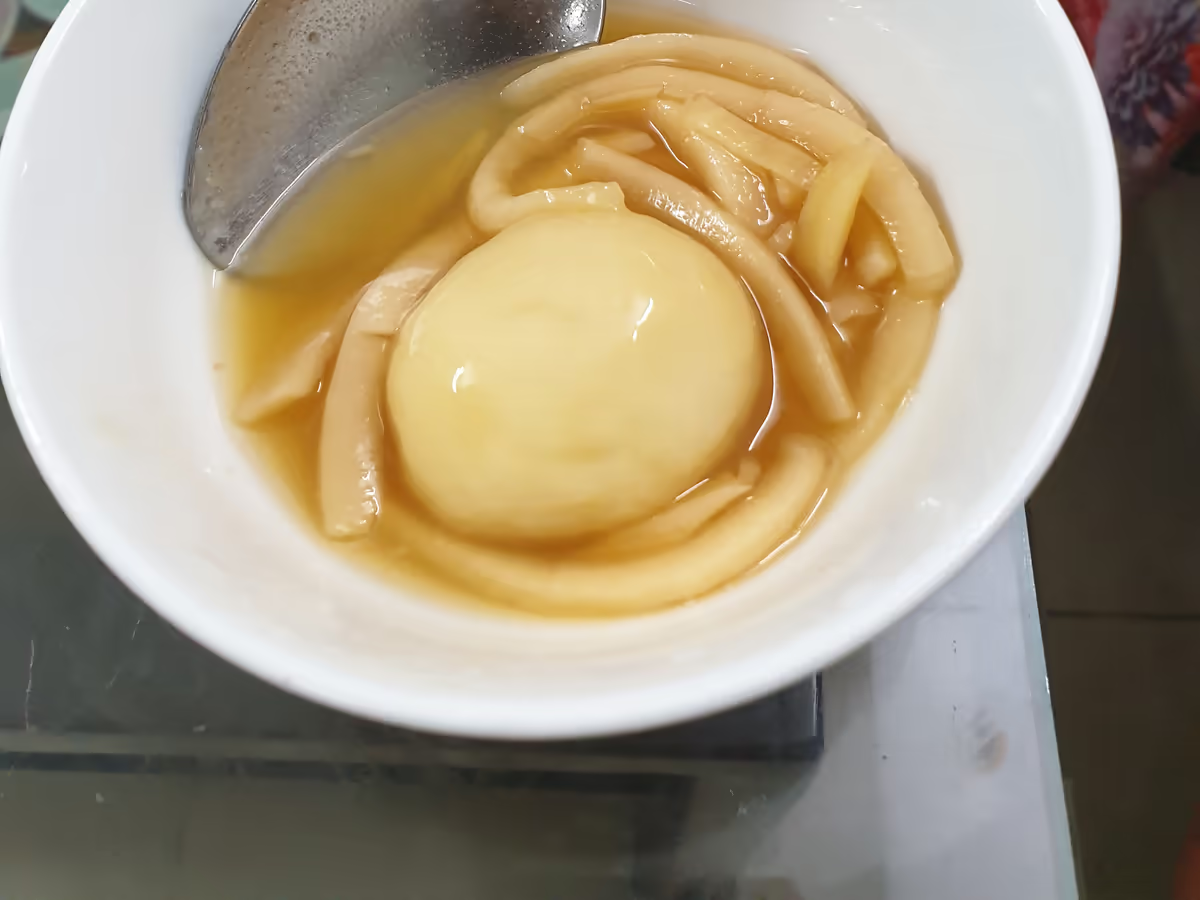
| Che troi nuoc | Glutinous rice balls filled with mung bean paste, in warm ginger syrup, with coconut milk or sesame | Hot | 20,000 to 30,000 VND |
| Che thap cam | A mix of beans, jellies, fruit, tapioca pearls, lotus seeds and coconut milk | Cold, with ice | 20,000 to 35,000 VND |
Two small disagreements are worth noting. Vietnamtourism.com says the red beans in che ba mau are adzuki and Will Fly for Food says red kidney beans, while localvietnam.com says red bean paste, so the bean varies by stall. And the same two pages disagree on che chuoi: vietnamtourism.com and localvietnam.com say it is warm or has cold versions, and Will Fly for Food says warm or room temperature. If you want to eat warm, look for a steaming pot.
More Che: Beans, Corn, Lotus and Root Vegetables
Beyond the four, the sources list a dozen more bowls, and a visitor will see several of them on a menu board. These are the ones that recur, with the source of each description.
| Che | What is in it | Source |
|---|---|---|
| Che dau xanh | Mung beans, sugar, coconut milk or cream; may include aloe vera or seaweed | vietnamtourism.com; Will Fly for Food |
| Che dau trang, che dau den | White kidney beans or black beans with a hint of vanilla | vietnamtourism.com |
| Che kho | Beans, rice and coconut pressed into a block and cut into squares; served at room temperature, a Hue signature | vietnamtourism.com |
| Che hat sen | Lotus seeds, sugar and sometimes coconut milk; cold or warm | vietnamtourism.com |
| Che con ong | A honeycomb-textured rice cake in syrup, a northern specialty | vietnamtourism.com |
| Che ba ba | Taro, cassava, sweet potato, mung bean and tapioca pearls in a coconut base; hot or cold | Will Fly for Food |
| Che bap | Corn, glutinous rice and coconut milk; the best is said to come from the centre | Will Fly for Food |
| Che khuc bach | Jellied milk cubes in syrup with toasted almonds and fruit such as longan or lychee | Will Fly for Food |
| Che thai | Tropical fruit, coloured jellies, water chestnuts, tapioca balls and cold coconut milk | Will Fly for Food |
| Durian che | Durian blended into coconut milk with sticky rice or sago, a southern specialty | vietnamtourism.com |
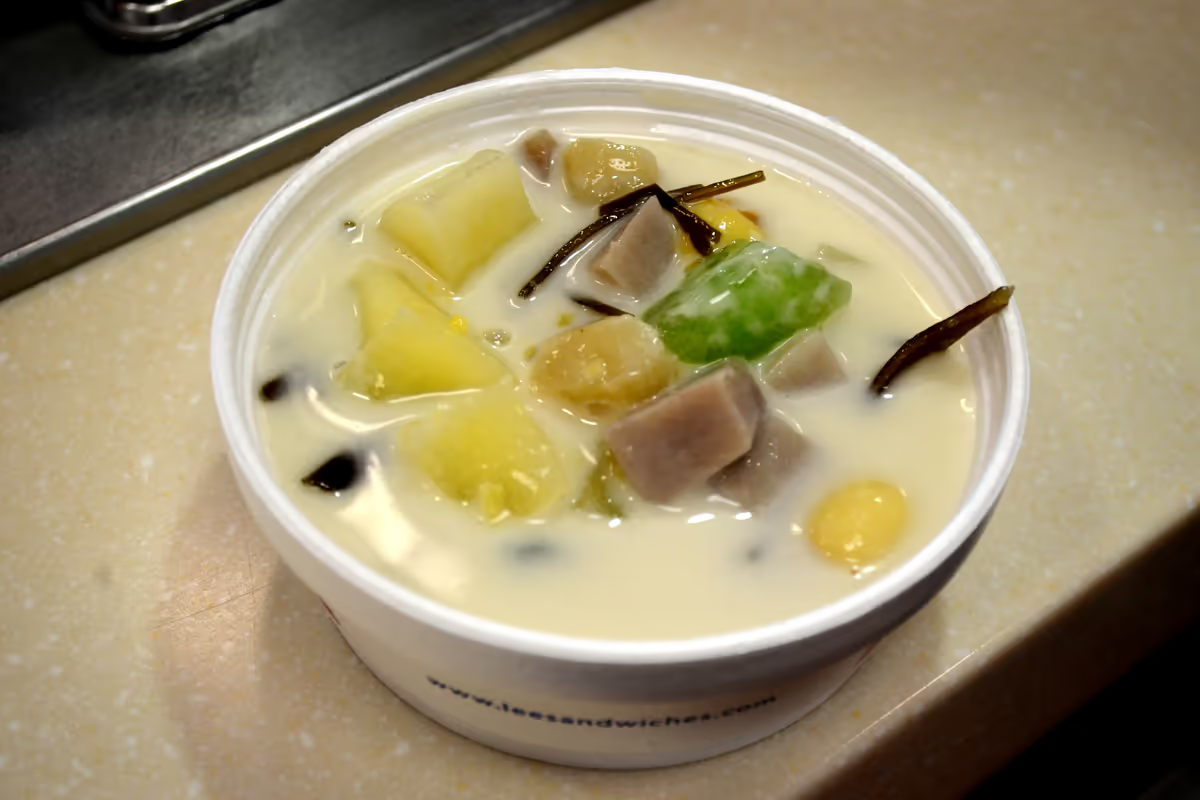
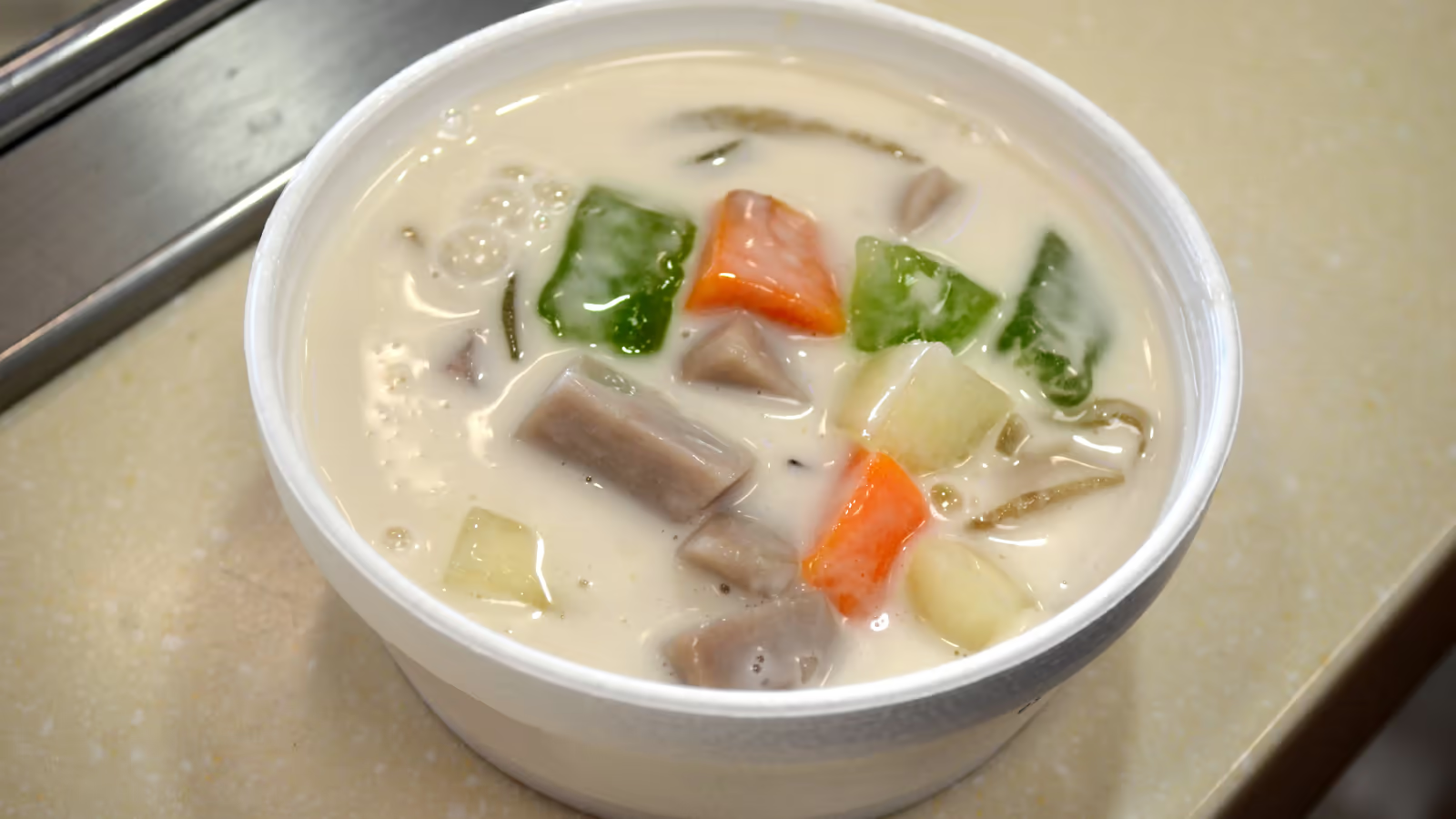
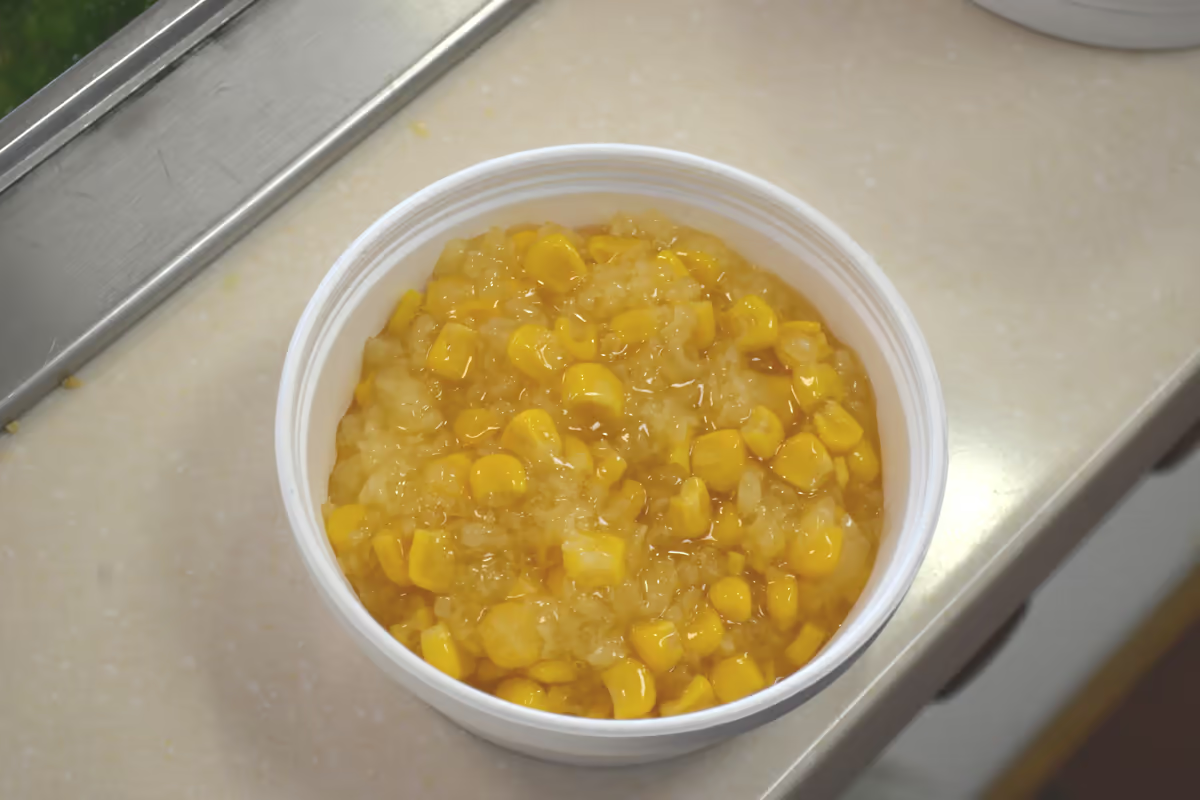
The photographs on this page show three bowls: che ba ba at the top, che bap with sweet corn in a thick syrup, and a bowl the photographer labels che thung, a milky soup with pieces of fruit and taro. Treat the labels on a menu as a guide, not a recipe, because a stall may mix its own bowl. If an ingredient is unfamiliar, ask the vendor to name it; the answer is often a word you can then look up in our phrase guide.
Desserts That Are Not Che
Will Fly for Food (25 October 2026) lists several sweets that are not che, and they are worth knowing because they sit next to the che pots. Black sticky rice yogurt (sua chua nep cam) combines black sticky rice, palm sugar, pandan and yogurt, with optional condensed milk, honey or ice. Tau hu nuoc duong is silken tofu pudding in ginger syrup. Khoai mi nuoc cot dua is boiled cassava in coconut sauce with grated coconut, roasted sesame and crushed peanuts. Xi ma is a sweet of black sesame, rice flour, coconut and sugar served in small portions.
The page also lists cakes and fried sweets: banh chuoi, a banana cake of ripe bananas, coconut milk, rice flour and condensed milk that can be baked, steamed or fried; banh ran, fried glutinous rice balls with mung bean paste and sesame; banh bo nuong, a honeycomb sponge of rice flour, tapioca starch and coconut cream, often green with pandan; banh tieu, a fried yeast doughnut with sesame; and banh dau xanh, fudge-like mung bean cubes from Hai Duong province that are eaten with tea. The mooncake, banh trung thu, belongs to the Mid-Autumn Festival with fillings such as mung bean paste and lotus seed. Vietnamese ice cream comes in flavours such as coconut, durian, young sticky rice, taro and coffee.
A glossary of what goes in the bowl
| Ingredient | What it is | Source |
|---|---|---|
| Coconut milk | The base or topping of most bowls | vietnamtourism.com; Will Fly for Food |
| Pandan | A fragrant leaf used for green jelly and for flavour | vietnamtourism.com; Will Fly for Food |
| Tapioca pearls | Small chewy balls in che chuoi, che thap cam and che ba ba | vietnamtourism.com; Will Fly for Food |
| Mung beans | The main bean in che dau xanh, che ba mau, the che troi nuoc filling and banh ran | vietnamtourism.com; Will Fly for Food |
| Lotus seeds | The main ingredient of che hat sen and a filling of mooncakes | vietnamtourism.com; Will Fly for Food |
| Duong phen | Unrefined cane sugar used to sweeten banh troi | Will Fly for Food |
| Glutinous rice | Sticky rice, used in che bap, che troi nuoc and sweets such as banh ran | Will Fly for Food |
One dumpling, several names
The sweet rice dumpling in ginger syrup has more than one name in the sources, and they do not fully agree. Vietnamtourism.com calls it che troi nuoc and ties it to the Cold Food Festival. Will Fly for Food calls it a Tet staple and says it is also called banh chay in the north and che xoi nuoc in the south, while listing banh troi, dumplings filled with unrefined cane sugar and rolled in sesame or grated coconut, as a separate sweet that it also calls banh troi nuoc. The practical rule is to say what you see: a round dumpling in warm syrup is what you are looking for, and if the vendor uses another name, you have learned a new word.
North, Centre and South
The sources agree on the shape of the regional differences, which is the same shape as Vietnamese cooking in general. Vietnamtourism.com says northern che tends to be lighter, with a thinner liquid and less sugar, and names che troi nuoc and che con ong as northern specialties. Central che is richer, and Hue has imperial-style dessert shops and the signature che kho and che hat sen. Southern che is sweeter and more elaborate, with durian che and, per Will Fly for Food, che ba ba. Will Fly for Food also says the best che bap is said to come from the centre, in Hoi An and Hue.
If you are following the food route down the country, our Hue guide, Hoi An guide and street food by region are the right companions, and the weather guide will tell you whether you want cold or warm che.
What It Costs and Where to Look
The price range is wide but small in dollars. Vietnamtourism.com (9 August 2026) says a bowl costs 10,000 to 40,000 VND (US$0.40 to 1.60), a che ba mau from a street cart should cost about 15,000 VND (US$0.60), and a sit-down shop in a tourist area may charge double that. Its FAQ gives 10,000 to 25,000 VND from a street cart and 30,000 to 40,000 VND in a sit-down tourist shop; localvietnam.com agrees that a generous cup from a street stall costs 10,000 to 25,000 VND.
| Che | Price range |
|---|---|
| Che ba mau | 15,000 to 25,000 VND |
| Che chuoi | 15,000 to 25,000 VND |
| Che troi nuoc | 20,000 to 30,000 VND |
| Che thap cam | 20,000 to 35,000 VND |
| Che kho | 25,000 to 40,000 VND |
| Che hat sen | 25,000 to 40,000 VND |
For where, the pages name areas, not stalls. In Hanoi, the Old Quarter is “the best hunting ground”, with a cluster of well-established che stalls around Hang Bac and Hang Dieu, another group near the Quang Ba Flower Market early in the morning, and a pot of che troi nuoc at any vendor with steam in winter. In Ho Chi Minh City, look in Cholon around Thap Muoi and Hai Thuong Lan Ong streets. Hue has family-run dessert shops, and the markets of Hoi An, Da Nang, Nha Trang, Can Tho and Da Lat are also mentioned. Will Fly for Food mentions a vendor on the Thu Bon River in Hoi An who sells xi ma. None of the pages names a Sapa vendor.
How to Order and Eat
Point at the glass cases, or say “che thap cam” for an assorted bowl. The vendor ladles the base and pours coconut milk over it, and adds ice if you ask. Three words help most: che nong for hot, che da or che lanh for cold with ice, and it duong for less sugar (vietnamtourism.com, 9 August 2026).
Eat with a spoon, sometimes with a straw. The page describes a southern habit of stirring everything together, drinking the liquid through the straw and then eating the solids with a spoon. You will probably finish standing or on a low stool, and the bowl rarely takes more than ten minutes. If you try the sit-down shops, a bowl in a tourist area may cost twice as much, as above.
A first tasting evening, in four bowls
This plan is our own suggestion, built from the descriptions above and not a description of a particular stall. It works in any city with a cluster of che vendors.
- Arrive around 4 pm, when the best hours begin, and pick a stall with customers and a clean glass case.
- Start with che ba mau, the easiest and the most photographed, and ask for it duong if you do not like sweet things.
- Move to a warm bowl, such as che chuoi or che troi nuoc, in the cool of the evening.
- Try one that is not che, such as black sticky rice yogurt, tofu pudding in ginger syrup or a fried banana cake.
- Pay in small notes and stop at three bowls. The ranges above put the whole tasting at about 50,000 to 100,000 VND, which is roughly US$2 to 4 at 25,000 VND to the dollar (our arithmetic).
Which bowl for which mood
| You want | Try | Why |
|---|---|---|
| Something cold on a hot afternoon | Che ba mau, che thap cam, che thai | Served with crushed ice and coconut milk |
| Something warm on a cool evening | Che troi nuoc, che chuoi | Hot or warm, with ginger syrup or coconut milk |
| Less sugar | A northern che | Lighter with a thinner liquid and less sugar, or ask for it duong |
| A heavier, richer dessert | Che kho, che ba ba | Beans, rice and coconut pressed into a block; a thick root-vegetable soup |
| No dairy and no egg | Most che, after asking | Most che is vegan, but ask because some vendors add egg or dairy |
Vegan, Allergies and Safety
Most che is naturally vegan, but the same page warns that some vendors add egg or dairy to certain recipes, so ask. Coconut milk is the base or topping of most bowls. Peanuts top che chuoi and khoai mi nuoc cot dua, sesame appears on che troi nuoc, banh tieu, banh ran and banh troi, and mung beans are the main ingredient of many bowls. Will Fly for Food also lists toasted almonds in che khuc bach, yogurt in sua chua nep cam, eggs and condensed milk in some banh chuoi and gelatin in che khuc bach. None of the pages gives allergy advice, so a serious allergy needs a plain conversation and a written note. Gelatin is usually animal-derived, which is our general knowledge and not on the pages, so a strict vegetarian should ask about khuc bach.
On safety, the page says the answer is yes with the usual caveats. The main risk is ice, which is usually made from filtered water in cities, and the dessert itself is boiled, so the main ingredients are cooked. Stick to busy stalls and avoid anything that has been sitting out for hours. Our health guide and insurance guide cover the wider picture.
Seasons and Festival Desserts
Cold che is eaten from April to September and hot che from November to February, according to vietnamtourism.com; Will Fly for Food calls che dau xanh especially popular in summer and black sticky rice yogurt a summertime treat. Two festival links are not settled. Vietnamtourism.com ties che troi nuoc to the Cold Food Festival, on the third day of the third lunar month, and says che kho is served at Tet and at weddings. Will Fly for Food calls che troi nuoc a staple Tet dish and says it is also called banh chay in the north and che xoi nuoc in the south. Both can be true, but neither page says so. The mooncake belongs to the Mid-Autumn Festival; no date is given. Our Tet 2027 guide has the new-year dates.
Seasonal sweets and what to eat with tea
Some sweets belong to a moment more than a bowl. Mooncakes (banh trung thu) are sold for the Mid-Autumn Festival with fillings such as mung bean paste and lotus seed. The fudge-like mung bean cubes of Hai Duong province, banh dau xanh, are eaten with tea, which makes them an easy gift or a tea-time snack. The honeycomb sponge, banh bo nuong, is a warm cake of rice flour, tapioca starch and coconut cream, often green with pandan, and the fried banana cake, banh chuoi, can be baked, steamed or fried. If you are choosing a sweet to take home, Will Fly for Food does not recommend one, so ask a shop which keeps best and which is made without egg or dairy.
What we could not find
Three gaps are worth stating. No page names a particular Hanoi stall with an address, only streets and markets. No page covers Sapa. And none of the pages gives allergy advice or says how the gelatin in che khuc bach is made. If any of these matters to you, the answer is a conversation with the vendor, and we would like to hear what you learn so that we can correct the page.
Desserts After a Sapa Trek
None of the dessert pages covers Sapa, so we will not claim a vendor. What we can say is that Sapa is cool for much of the year, which is the weather the warm bowls suit, and that the most useful thing to carry from this page is three phrases: che nong for hot, che da for cold with ice, and it duong for less sugar. Our guide to what to eat in Sapa and Sapa restaurants cover the town, and the coffee guide covers the drink that often comes with dessert. A day in the valleys on foot is a good way to earn a bowl, and the tour cards below show the options.
Sapa Treks That End With a Sweet Stop
 1-Day Trek
Trekking Through Rice Terraced Fields
Lao Chai to Ta Van with lunch at a family restaurant in Y Linh Ho.
 Homestay
Rice Terraced Fields & Homestay
Dinner and breakfast with a family in Ta Van, lunch on day one.
 Local Favourite
Mountain Views and Villages Trek
Lunch at a restaurant run by local people in Hang Da village.
Sources and the Dates We Checked Them
We read these pages on 3 November 2026. Where a page could not be opened in full or two pages disagree, the text says so. All are commercial or travel sites.
- vietnamtourism.com, che: a guide to Vietnam’s sweet dessert soups, updated 9 August 2026; the source of most prices, regions and advice.
- localvietnam.com, che, 11 May 2026; cut off after the first three items, so used only for che ba mau, che chuoi and the price range.
- Will Fly for Food, Vietnamese desserts, last updated 25 October 2026; a food blog, the source of the long dessert list.
- Two further pages could not be used: Authentic Food Quest refused access and the Vietnam Airlines desserts page was not found.
The Part We Do Sell
- Hanoi to Sapa transport — sleeper buses, limousines and the overnight train, bookable with your trek
- Hanoi to Sapa guide — what each option costs and how long it takes
- How to get to Sapa — the first leg, in detail
Rent at Our Office Before You Trek
 Gear Rental
Trekking Boots Rental
Waterproof ankle-support boots. Cleaned and checked before each rental. Available at 105 Thach Son Street.
 Gear Rental
Walking Poles Rental
Trekking poles available to rent at $2/day at our office, 105 Thach Son Street. Essential for descents.
Frequently Asked Questions
Che is a Vietnamese sweet soup, pudding or drink of beans, jelly, fruit, tapioca and coconut milk, served warm or over ice. One guide says all che are desserts but not all desserts are che (vietnamtourism.com, 9 August 2026).
The three-colour che: red beans, mung beans and green pandan jelly under coconut milk and crushed ice. It is cold, usually costs 15,000 to 25,000 VND on the street, and is the easiest first che for most visitors.
A bowl of che costs 10,000 to 40,000 VND. Street carts charge 10,000 to 25,000 VND and sit-down shops in tourist areas 30,000 to 40,000 VND, often double the street price (vietnamtourism.com, 9 August 2026).
Most che is naturally vegan, but some vendors add egg or dairy to certain recipes, so ask. Che khuc bach contains gelatin and sua chua nep cam contains yogurt (Will Fly for Food, 25 October 2026).
Che troi nuoc, glutinous rice balls with mung bean paste in warm ginger syrup, is served hot, and che chuoi is usually warm. Ask for che nong when you want it hot and che da when you want it with ice.
Coconut milk is the base of most bowls, peanuts top che chuoi and cassava in coconut sauce, sesame appears on several sweets, and mung beans are in many bowls. None of the pages we read gives allergy advice, so ask the vendor and carry a written note.
Vietnamtourism.com says the main risk is ice, which is usually made from filtered water in cities, and that the dessert itself is boiled. Choose busy stalls and avoid anything that has been sitting out for hours.
Between 3 pm and 8 pm. Cold che is typical from April to September and hot che from November to February (vietnamtourism.com, 9 August 2026).