 Sinh Giang

Most of Vietnamese etiquette comes down to a few habits: greet the oldest person first, take your shoes off at a door, cover your shoulders and knees at a temple, hand things over with both hands, keep your voice level, and ask before you photograph a person. Get those right and almost everything else is forgiven.
We are a trekking company in Sapa, so we cannot speak for every province. Customs differ between Hanoi, a Black H’mong village and a beach town. What follows is what the best published sources agree on, checked on 31 October 2026, and the text says where a source is only a blog or where we found none. For the Sapa end of the trip, see our guides to Black H’mong culture and homestays.
Key Takeaways
- Greet elders first, use a title with a given name (anh, chị, em), and give and receive things with both hands or your right hand (Cultural Atlas; vietnam.travel).
- Cover shoulders and knees at pagodas and cultural sites. The Ho Chi Minh Mausoleum adds a rule against shorts and bans photos and phones inside.
- Take your shoes off at a home’s door, never stick chopsticks upright in rice, and never point the soles of your feet at someone.
- Tipping is optional. Bargain only at markets and stalls, and politely.
- Vaping is banned nationwide, drug penalties are severe, and you must carry photo ID or a printed copy of your passport (FCDO; Tuoi Tre, 2 January 2026).
- In a village, ask before photographing anyone and do not give sweets or money to children.
Greetings, Names and Titles
Vietnamese people address each other by a kinship word plus a given name, in formal and informal settings alike. So the person you know as Lan is “chị Lan” (older sister Lan) if she is a little older than you, or “em Lan” if she is younger. Cultural Atlas says the pronoun depends on age, gender and status, which is why you will be asked how old you are. That question is not rude: it simply fixes which word to use.
You will meet these titles most: anh (an older man), chị (an older woman), em (someone younger), cô and chú (your parents’ generation), bác (older than your parents), and ông and bà (grandparent generation). Using “em” for someone clearly older is rude, and “bạn” (friend) is the neutral word when you are unsure. The list is from a Vietnam Airlines name guide and usage varies by region.
To get a waiter’s attention, vietnam.travel, the official national tourism site, suggests “Em ơi” or “bạn ơi” in place of “excuse me”. The standard polite hello is “xin chào” and thank you is “cảm ơn”. Both are safe whoever you are talking to.
On handshakes, Cultural Atlas says men shake hands with a small nod, while women often give a nod or bow instead, so wait for a woman to offer her hand. In the countryside and with elders, a bow with hands clasped at waist height is traditional. Greet the oldest person first, and use the same bow for monks and nuns.
Passing things works the same way. vietnam.travel says to give and receive with both hands or your right hand, not your left. It covers business cards, cups of tea, gifts and bills, and it is the one gesture most visitors can copy on day one.
What to Wear: Pagodas, the Mausoleum and Everywhere Else
Cover your shoulders and knees at religious and cultural sites, whatever your gender. The UK Foreign, Commonwealth and Development Office (FCDO) gives the same advice for Vietnam, and tells visitors to look for dress-code signs. A Viet Nam News guide to temple etiquette, published on 26 March 2026, spells it out: a top with sleeves or a collar reaching the elbows, trousers or a dress covering the knees, nothing see-through, no sleeveless tops, no short shorts. A shawl is fine in hot weather. Take your hat off, and at some sites your shoes too.
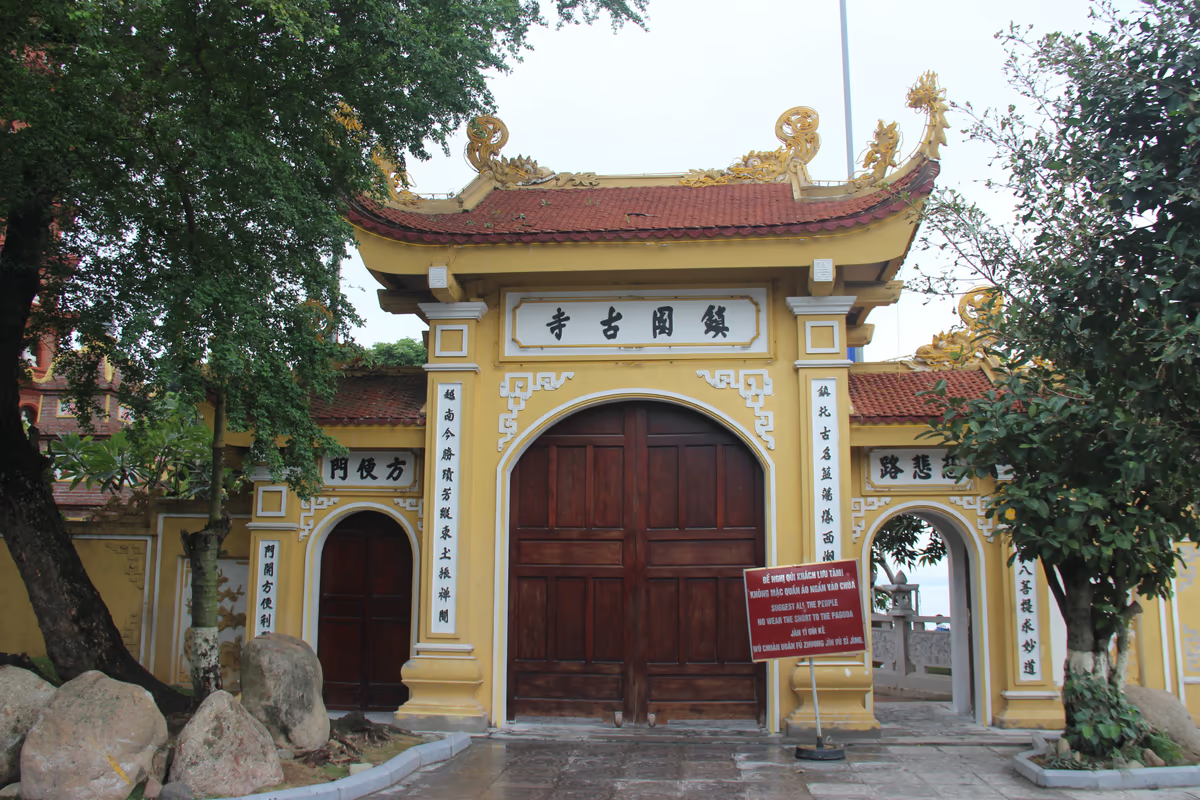
The photo above shows the gate of Tran Quoc Pagoda in Hanoi, with a red sign in Vietnamese and English asking visitors not to wear short clothing into the pagoda. You will see signs like it at many temples, and the staff will turn you away without one.
The Ho Chi Minh Mausoleum
The mausoleum in Ba Dinh Square has the strictest rules of any site most visitors enter. Viet Nam News reported on 10 August 2026 that it would close for maintenance from 4 September to 2 November 2026 and reopen on 3 November. We could not confirm the reopening, so check before you plan a morning around it. Visits run Tuesday to Sunday mornings, and it is closed on Monday and Friday.
On behaviour, the one commercial travel site we found (vietnamtourism.com, updated 24 October 2026, not a government source) and Wikivoyage agree: shoulders covered, no tank tops, nothing above the knee, closed shoes preferred, silence, hats and sunglasses off, and no photos or phone use inside. Guards do turn people away.
Everywhere else
Outside sacred sites the rule is modest rather than strict. vietnam.travel advises men not to walk around towns shirtless and to keep swimwear for the beach. Hanoi and Ho Chi Minh City are relaxed about shorts. A village, a pagoda or a government building is not.
Inside a Pagoda: Incense, Offerings, Photos and Monks
Be quiet, move slowly, and do not touch what you did not bring. Viet Nam News says not to point at statues, laugh loudly or eat inside, and not to walk between a procession and the people kneeling before it. Do not touch offerings on an altar, and put money in the donation box, not on the statue.
Incense is for rituals, anniversaries, mourning and temples, according to Cultural Atlas. The Viet Nam News guide says not to light a lot of it, and if you do, to use one stick.
Photography is usually allowed in courtyards and not in the main altar hall. Obey no-photo signs, and ask before photographing a ritual or a monk. Cultural Atlas says women should not touch Buddhist monks; blog-level sources add that a woman should put an object down or pass it on a cloth, so follow the monks and your guide.
Many Vietnamese homes keep an altar for deceased relatives, with portraits, fruit and incense. Cultural Atlas and vietnam.travel both say not to step over altars at ground level or walk straight in front of them. If you see one in a home or a homestay, treat it the way you would a temple altar: do not touch the offerings and do not lean on it.
Visiting a Home or Homestay
Take your shoes off just outside the door, or where you see other shoes. Both vietnam.travel and Wikivoyage say it is customary to remove shoes before entering a private home, and you may carry them in a bag if you prefer. In a homestay the same rule applies to the sleeping area and often to the whole house. If you are unsure, look at the floor. A neat row of shoes is the answer.
If you are invited into a family home, vietnam.travel suggests biscuits or cake, fruit, flowers or soft drinks as a gift. It says never to give anything black. Cultural Atlas adds handkerchiefs and yellow flowers or chrysanthemums to the list to avoid, and the second source is less authoritative, so we would keep to fruit and sweet things and skip the flowers.
Hosts will keep filling your glass and your bowl. vietnam.travel says you can decline more food by saying you are very full. Cultural Atlas adds that hosts often play down their cooking, so a kind word about the meal is the right answer. Elders are served first, and the eldest person or the host usually starts eating.
Two body rules matter in a home. Feet are the lowest and dirtiest part of the body, so do not point the soles at anyone. And do not touch another person’s head, especially a child’s. Cultural Atlas gives both rules.
At the Table: Chopsticks, Shared Dishes and Toasts
Dishes sit in the middle of the table and everyone serves themselves from them, according to Cultural Atlas. In a family meal you will often have rice in individual bowls and two or three shared plates, as in the photo below.
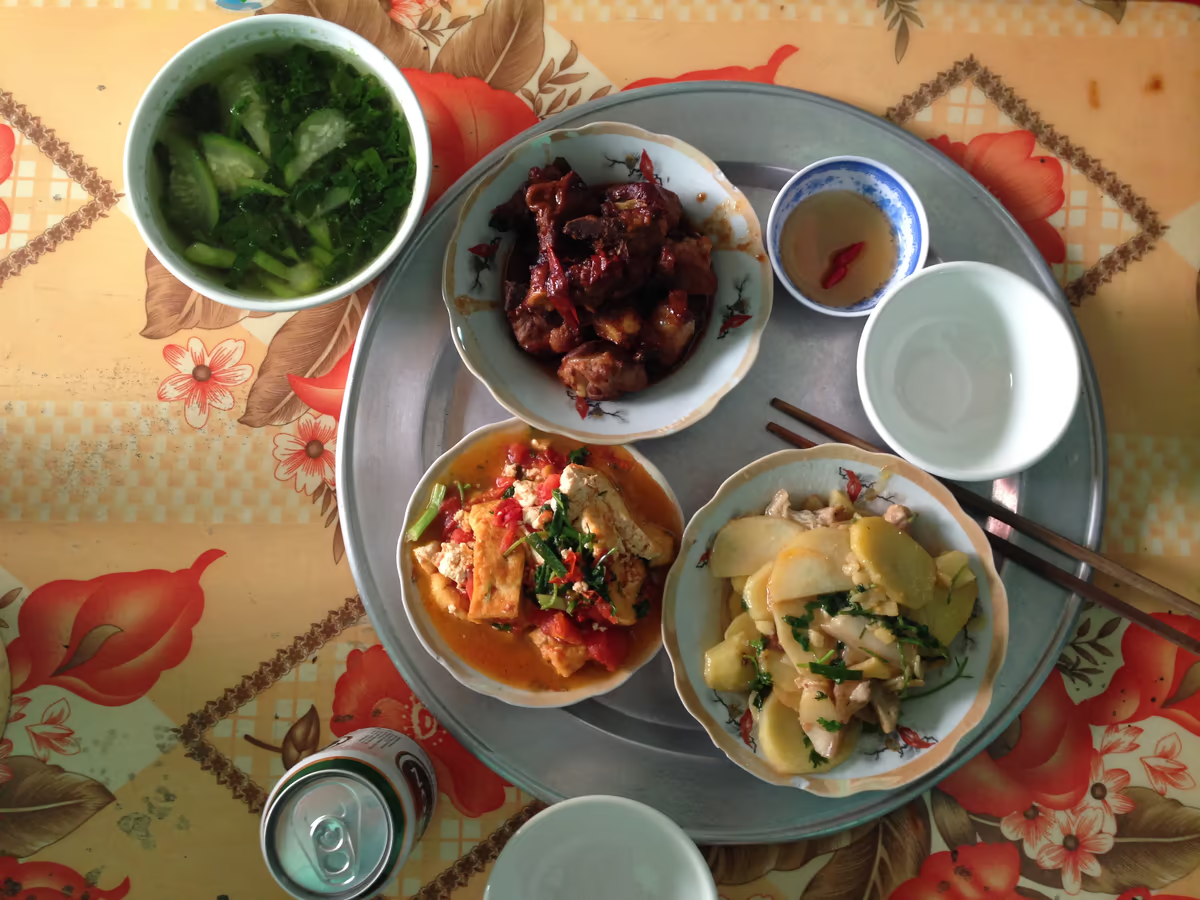
The one chopstick rule every source repeats is this: never stand chopsticks upright in a bowl of rice. Cultural Atlas says it resembles incense burned for mourning, and the local operator Local Vietnam says it resembles an offering to the dead. Lay them across the bowl or on the rest instead. Blog-level sources add that you should not point chopsticks at people or tap them on a bowl, and that it is kind to put food for another person straight into their bowl. We have no primary source for those, but they are easy to follow.
Toasts, rice wine and who pays
The toast is “một, hai, ba, dô!” (one, two, three, cheers). vietnam.travel says people say “dô” or “yo” in the south and “zo” in the north, and everyone drinks together after the count. Do not drink alone, and pouring for others before yourself is polite. The same source says the person who invited you usually pays, and if no one did, the most senior person at the table. We found no reliable source on how to refuse a drink politely, on lowering your glass when you clink, or on pouring with both hands, so we leave those out.
One warning is not about manners. The FCDO says methanol poisoning has hurt drinkers at licensed venues in tourist areas, and you cannot detect it by smell or taste. Avoid liquor sold from unlabelled bottles on the street, and be careful with home-made spirits that were not made in front of you by a host you know.
Money: Tipping, Bargaining and Small Notes
Tipping is not required in Vietnam. vietnam.travel says it is common for tour guides and spas and less so in restaurants, and that you have no obligation. Check the bill for a printed service charge first. In upscale restaurants and hotels it is often 5 to 10 percent and usually covers the tip. We found no government figures, so every amount below comes from tour operators and travel blogs and should be read as a range of what people do, not a rule.
| Who | What sources suggest | How firm |
|---|---|---|
| Local eateries and street food | No tip expected | Medium |
| Mid-range and upscale restaurants | About 5 to 10 percent, or 20,000 to 50,000 VND, if no service charge is printed | Medium |
| Group tour guide | 50,000 to 150,000 VND per person per day | Low to medium; two sources disagree |
| Private full-day guide | 200,000 to 400,000 VND (about US$8 to 16), or 10 to 15 percent of the tour price | Low to medium |
| Driver | 50,000 to 100,000 VND per day | Low to medium |
| Hotel bellboy and housekeeping | 20,000 to 30,000 and 20,000 to 50,000 VND, mostly at four- and five-star hotels | Low to medium |
| Taxis | Not customary; round up to the nearest 10,000 to 20,000 VND | Medium |
Carry notes of 10,000, 20,000 and 50,000 VND so you can tip without asking for change. For a trekking guide, see how much to tip a guide in Sapa.
Bargaining
Bargaining is expected at traditional markets, street stalls and small shops, and not in malls or supermarkets. Local Vietnam and the Vietnamese site Vietcetera both advise staying polite, smiling and not arguing over a trivial sum. Sources give no reliable opening offer, and we will not invent a percentage. If you cannot get your price, say thank you and walk on.
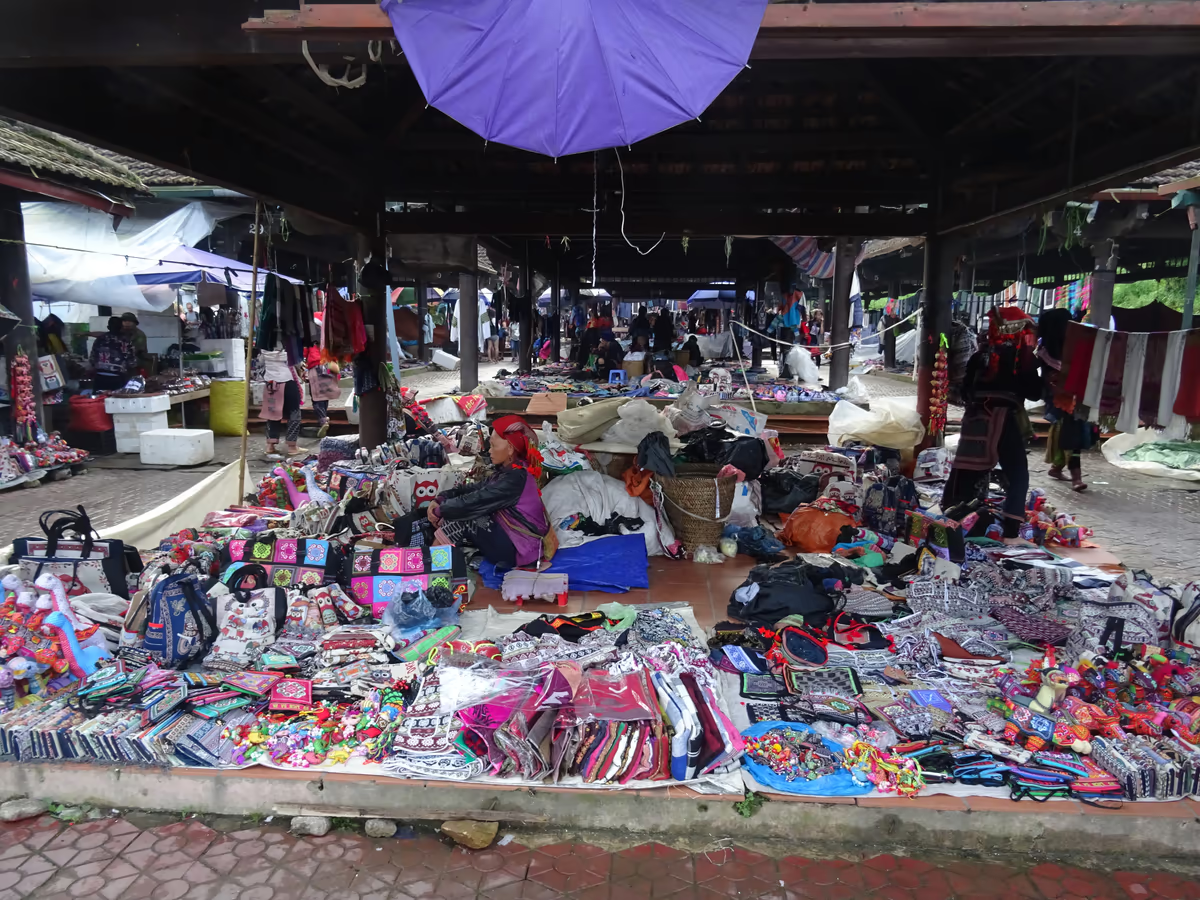
The market in the photo is the covered hall in Sapa town, where prices are not fixed and a little bargaining is normal. For hand-stitched pieces, pay what you would pay for hand work at home. Our trekking store guide covers what to buy where, and our scams guide covers the tricks to watch for.
Public Behaviour: Voices, Gestures and Saving Face
Staying calm is the rule that matters most. Cultural Atlas says shouting is seen as improper, especially for women, and anger should not be shown in public. If a hotel or restaurant makes a mistake, a quiet word and a smile get further than a raised voice, because an open dispute makes the other person lose face.
This is what Cultural Atlas calls saving face. Do not criticise someone directly in front of others, do not break a promise, and do not praise someone to excess. People often avoid a flat “no”, and a “yes” may only mean “I hear you”. So ask questions that have an answer other than yes or no, such as “what time does the bus leave?” rather than “does the bus leave at 7?”.
Point and beckon with an open hand, palm down. Cultural Atlas calls a single finger beckoning palm up offensive and threatening, vietnam.travel calls crossed fingers highly impolite, and hands on hips or crossed arms in conversation can read as rude. One source says the round OK sign means poor quality.
Couples usually avoid affection in public, and men and women often do not touch. Same-sex friends may hold hands. That is habit, not law.
Crossing the road is a skill. Local Vietnam says to walk at a steady pace, not run or stop, and cross near locals. That is blog-level advice, but it matches what we see on Sapa’s streets. Our guide to getting around Sapa covers motorbike taxis and walking routes.
Politics, the War, Drones and Military Sites
Do not criticise the government or Ho Chi Minh, and avoid political talk with strangers. The FCDO is direct: criticising the government, or advocating alternatives to Communist Party rule, is risky, and possessing political material can lead to an exit ban or prison. Authorities can review the content of your devices, and you should avoid protests.
On the war, Cultural Atlas advises being sensitive and not assuming people want to talk about it. Do not take a position on Western involvement, let them share their view, and do not speak of two Vietnams. Many southerners still say Saigon for Ho Chi Minh City.
Drones
Decree 288/2025/ND-CP took effect on 5 November 2025. According to the law firm Vietan Law and Tuoi Tre, the Ministry of National Defence grants flight permits, foreigners must meet the same conditions as citizens and need a Vietnamese guarantor, and a recreational drone under 0.25 kg flown outside restricted airspace and within line of sight needs no permit but does require the pilot to notify and get consent from the local commune or ward military authority. Fines run up to 40 million VND (about US$1,500) per case. DroneDJ reported on 17 March 2026 that drones had been seized from tourists in Da Nang, with fines above US$1,100.
We found no source that states the rules for a short-stay tourist clearly, so our advice is simple: do not fly a drone in Vietnam without written permission.
Military sites and borders
The FCDO says not to take photos near military bases, and that some border areas need a permit from the local authorities. If your Sapa trek goes near the border, your guide will know where the lines are. Ask before you raise a camera.
Ethnic-Minority Villages in Sapa and the Northwest
Ask before you photograph anyone, and do not give sweets or money to children. Those two rules cover most of what a visitor to a village needs. vietnam.travel says to ask before taking someone’s photo, and so does the 2026 sustainable-travel guide on the travel site MileHacker. A good way to ask is to smile, point at the camera and wait for a nod. If the answer is no, put it away.
On children, the ChildSafe Movement, a child-protection network, is direct: “Children pay a price for your generosity – don’t give to begging children.” Giving money, food or presents, or buying from children, encourages begging, keeps them out of school and continues the cycle of poverty. The page does not mention Sapa, but the advice applies wherever children sell to visitors. Sweets are a separate problem where dental care is hard to reach. If you want to give something, MileHacker suggests going through established schools, clinics or non-profits, not individuals.
What we could verify, and what we could not
We tried to check four customs that Sapa visitors read about. Wikipedia’s Hmong customs page says it is prohibited to walk between the household altar and a shaman during a ritual (medium). Nhân Dân (27 January 2014) says the hearth fire is the household’s soul and should not be blown on or have ash scooped out, but it describes the Hmong of Ha Giang, not Sapa (medium). A Nghe An provincial paper describes a rule about the central pillar, but the page would not open (low). For stepping over the fireplace or the threshold, and for shoes in a H’mong house, we found no H’mong-specific source, so follow your host. Our guides are the people to ask in Sapa. We would rather give you a source than a guess.
We found no source for a living “love market” in Sapa itself. The only documented one is Khau Vai in Ha Giang, held on the 26th and 27th of the third lunar month and recognised as national intangible cultural heritage in 2021 (Wikipedia; VietnamNet). Treat a Sapa “love market” on a leaflet as a tourist event. For what is really on, see our guide to the H’mong New Year and Gau Tao festival.
For where to go, see Ta Van village and the best villages near Sapa. When you buy from a seller, buy from artisans and do not bargain hard; MileHacker says the same.
Rules Visitors Break by Accident
Four laws catch visitors who did not know them: vaping, drugs, ID and hotel registration. Littering is cheap but real.
Vaping
E-cigarettes and heated tobacco are banned nationwide. Resolution 173/2024/QH15 banned their production, trade, import and use from 1 January 2025. A decree that sets the fines took effect on 31 December 2025: Tuoi Tre reported on 2 January 2026 that using one costs an individual 3 to 5 million VND (about US$114 to 190), and the device is destroyed. The FCDO confirms you cannot buy or bring them in. Older reports of a US$78 fine are out of date.
Drugs
The FCDO says penalties are severe, including for cannabis and regardless of quantity. Police may drug-test people at private parties or nightlife raids, and a positive result can lead to charges even if you took the drug before arriving. The death-penalty law is in flux: a June 2025 amendment removed it for illegally transporting narcotics, and a draft reported on 20 August 2026 proposes removing it for trafficking from March 2027. We could not confirm it has passed, so the safe summary is that drug offences carry very heavy penalties, up to life in prison or, for some offences, death.
ID and hotel registration
The FCDO says you must always carry photographic ID. A printed copy of the photo page of your passport and your visa is accepted. Do not leave your passport as a deposit, for example with a motorbike rental shop. Separately, accommodation providers must register the temporary residence of every foreign guest. Viet Nam News reported on 22 July 2026 that electronic filing must be done immediately on arrival, and paper filing within 12 hours, or 24 hours in remote or mountainous areas. The duty is the hotel’s, and the fine of 2 to 4 million VND under Decree 282/2025/ND-CP falls on the provider; your part is to hand over your passport at check-in.
Litter
Decree 45/2022 sets fines of 1 to 2 million VND for putting household waste on pavements or roads, and 100,000 to 150,000 VND for cigarette butts dropped in public. Later amendments may have changed the numbers. On a trek, carry your rubbish out; our Sapa packing list includes a small bag for it.
A Last Check Before You Leave the Hotel
On your first morning, check four things: a printed copy of your passport photo page and visa in your bag, a few 10,000, 20,000 and 50,000 VND notes, shoulders and knees covered if you plan to enter a pagoda, and no vape, drone or political leaflet in your luggage. Everything else is a question you can ask with a smile.
If you are planning a longer trip, our guide for first-time visitors covers the logistics around the manners, and the solo female travel guide covers safety. For food customs beyond the chopsticks, see what to eat in each region. For the most common questions about the money side of things we keep a separate answer in our is Vietnam safe guide.
Sources and the Dates We Checked Them
We read these pages on 31 October 2026. Where we could not open a page, the text says so and we did not rely on it.
- Cultural Atlas, Vietnamese greetings (2024), etiquette and communication (2016).
- vietnam.travel, etiquette for travellers, official tourism site, undated.
- UK FCDO, Vietnam safety and security, undated.
- Viet Nam News, temple etiquette, 26 March 2026.
- Viet Nam News, mausoleum closure, 10 August 2026; vietnamtourism.com, dress code, commercial site, 24 October 2026; Wikivoyage, Hanoi.
- Local Vietnam, etiquette (27 December 2024), with its tipping, bargaining and road-crossing pages; Vietnam Airlines, names and titles; Vietcetera, bargaining (2024).
- ChildSafe Movement, 7 tips for travellers; MileHacker, sustainable travel in Sapa (2026, no named author).
- Wikipedia, Hmong customs; Nhân Dân, fire in the Hmong home (27 January 2014); VietnamNet, Khau Vai heritage listing.
- Vietan Law, Decree 288/2025/ND-CP; DroneDJ, Da Nang seizures (17 March 2026).
- Tuoi Tre, e-cigarette fines (2 January 2026); The Star, proposed death-penalty changes (20 August 2026); Viet Nam News, guest registration (22 July 2026); LuatVietnam, litter fines (2022).
The Part We Do Sell
- Hanoi to Sapa transport — sleeper buses, limousines and the overnight train, bookable with your trek
- Hanoi to Sapa guide — what each option costs and how long it takes
- How to get to Sapa — the first leg, in detail
Rent at Our Office Before You Trek
 Gear Rental
Trekking Boots Rental
Waterproof ankle-support boots. Cleaned and checked before each rental. Available at 105 Thach Son Street.
 Gear Rental
Walking Poles Rental
Trekking poles available to rent at $2/day at our office, 105 Thach Son Street. Essential for descents.
Frequently Asked Questions
Show respect for age and keep calm. Greet the oldest person first, use a title such as anh, chị or em with a given name, hand things over with both hands or your right hand, and do not raise your voice in public. Cultural Atlas describes Vietnamese social life as built on respect for age and rank and on avoiding open conflict.
No. vietnam.travel, the official tourism site, says tipping is common for guides and spas, less so in restaurants, and that you have no obligation. Check the bill for a printed service charge first. Tour operators suggest roughly 50,000 to 150,000 VND per person per day for a group guide, but no official figure exists.
Cover your shoulders and knees: sleeves or a shawl, trousers or a skirt below the knee, nothing see-through. Take your hat off, and your shoes where asked. The UK FCDO and Viet Nam News give the same advice. The Ho Chi Minh Mausoleum also bans shorts, photos and phones inside.
Yes, almost always. vietnam.travel and Wikivoyage both say it is customary to remove shoes before entering a private home. In a homestay the rule usually covers the whole house, so look at the floor by the door: a row of shoes is your answer.
Yes. Cultural Atlas says upright chopsticks resemble incense burned for mourning, and Local Vietnam compares them to an offering for the dead. Lay them across your bowl or on the rest instead.
Ask first, every time. vietnam.travel and a 2026 Sapa sustainable-travel guide both say to ask before taking someone's photo. Smile, point at your camera and wait for a nod. Do not give sweets or money to children: the ChildSafe Movement says it encourages begging and keeps children out of school.
No. E-cigarettes and heated tobacco are banned nationwide under Resolution 173/2024/QH15, in force since 1 January 2025. Tuoi Tre reported on 2 January 2026 that personal use costs 3 to 5 million VND (about US$114 to 190) plus destruction of the device.
Not without permission. Decree 288/2025/ND-CP, in force since 5 November 2025, puts flight permits under the Ministry of National Defence, and fines go up to 40 million VND (about US$1,500) per case. We found no simple tourist rule, so we advise getting written permission first.