
 Sinh Giang
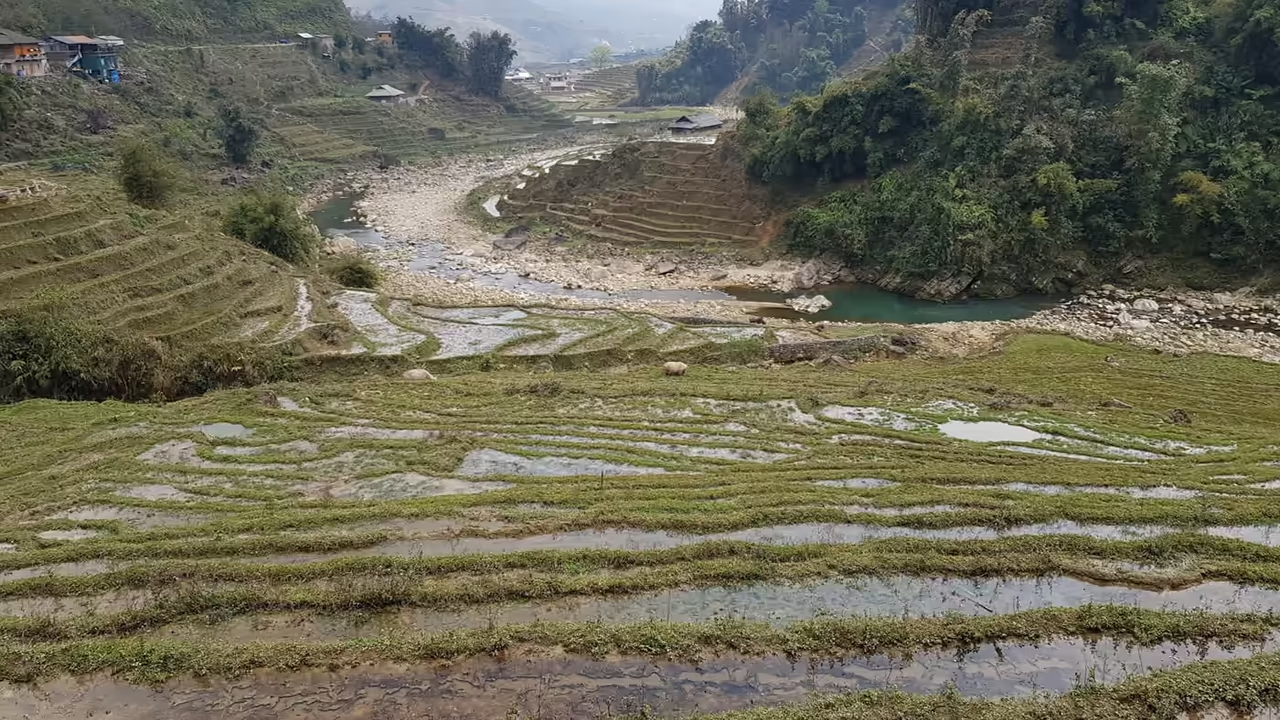
Near Sapa, the villages where H’mong families live are Cat Cat, Lao Chai, Y Linh Ho and Ma Tra, with Sin Chai usually counted among them. Ta Van is a mixed village, and two of the best-known villages around Sapa are not H’mong at all: Ta Phin is mainly Red Dao and Ban Ho is Tay. Most visitors reach these places on foot with a guide, by motorbike or in a half-day tour, and the single most useful thing to know is that Cat Cat is the only one with a ticket gate, at about 150,000 VND in 2026 listings. Further afield, the H’mong markets of Bac Ha and the plateau around Dong Van in Ha Giang are where you can meet other H’mong groups, such as the Flower H’mong.
We are a Sapa trekking company whose guides are Black H’mong women from the valleys you walk through, and we get the same question every week: “Which village should we visit, and is it okay to just walk in?” This guide answers both, and tells you how to behave so that your visit is welcome. We checked every number, ticket price and date on 31 October 2026 and name the source next to it. Where sources disagree, or we found nothing, we say so.
The Short Answer: Three Numbers and a Rule
These are the numbers that frame the rest of the guide.
The rule that matters more than any number: you are walking through places where people live, farm and raise children, not through an exhibit. Ask before you take a photograph of a person, and never go into a house without being invited. The section on respect below turns that into a short checklist.
Who the H’mong Are, in Plain Words
The H’mong (written Hmong in much international writing; the official Vietnamese name is Mông) speak a language of the Hmong-Mien family. The 2019 national survey counts 1,393,547 of them in Vietnam, according to a Nhan Dan special page that cites the Committee for Ethnic Minority Affairs and the General Statistics Office; Wikipedia gives the same figure. Nhan Dan lists their main provinces as Ha Giang, Son La, Dien Bien, Lao Cai, Lai Chau, Yen Bai, Thanh Hoa, Nghe An, Dak Lak and Dak Nong, using the names in force before the 2025 mergers.
Black, Flower, White and Green
H’mong people are usually described by sub-group, and the name often comes from clothing. Nhan Dan names four groups in Vietnam: Black, White, Green and Flower. The people around Sapa are Black H’mong, named for their near-black, indigo-dyed clothing, according to a Vietnam Tourism guide updated on 31 July 2026. The Flower H’mong are concentrated around Dong Van and Meo Vac in Ha Giang and in the Bac Ha area, and the White H’mong mainly in Ha Giang and Lai Chau. These are the sub-groups you are likely to meet on a northern trip. For the people themselves, their calendar and their craft, our longer piece on Black H’mong culture in Sapa goes much further than we can here.
Cloth, belief and the new year
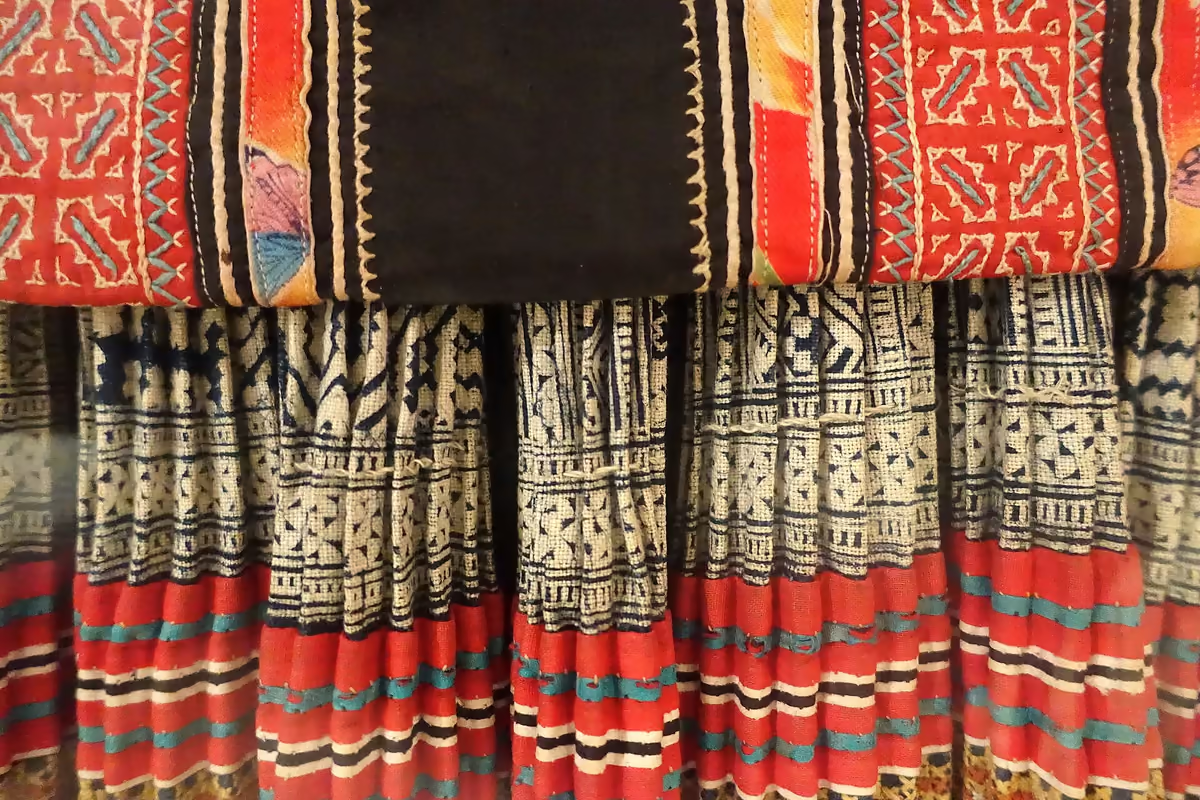
Cloth is central to how outsiders recognise H’mong people, so it helps to know what you are looking at. A Vietnam Tourism guide says hemp is grown on hillside plots, spun by hand and dipped in indigo repeatedly, in some cases 20 to 30 times. Patterns are drawn on the cloth with hot beeswax before dyeing, and embroidery is worked freehand. A journal article from the SPAFA research centre says the H’mong combine weaving, embroidery, appliqué and batik, and that the Vietnam Museum of Ethnology collects their textiles. We would say “hemp, and some cotton”, because a museum label in the photo below describes a skirt in three panels of hemp trimmed with batik, on a gown and apron of industrial cotton.
On belief, Nhan Dan describes H’mong religion as animist, with ancestor worship at its centre and Confucian, Taoist and Buddhist influences. Many H’mong communities mark their own new year from the start of the 12th lunar month, about a month before the national Tet. The spring festival Gau Tao is held between the 2nd and 15th days of the first lunar month and lasts two or three days, according to Local Vietnam (updated 15 May 2026); each village sets its own dates, so we say “first lunar month” and no more. Our guide to the H’mong New Year and the Gau Tao festival works through the dates.
Which Villages Near Sapa Are Actually H’mong?
This is the part most guides blur. “Hill tribe village near Sapa” can mean a Black H’mong hamlet, a Red Dao village, a Giay village or a Tay one, and each has its own clothing, language and customs. The table sorts them. Distances are approximate and sources differ by a few kilometres, so use them to compare, not to plan a taxi.
| Village | Who lives there | From Sapa town | How people visit | Honest note |
|---|---|---|---|---|
| Cat Cat | Black H’mong | About 2 km | Walk down, motorbike or taxi | Ticketed and built around visitors |
| Lao Chai | Black H’mong | About 7 to 9 km by trail | Muong Hoa valley trek | The most-trodden village route |
| Y Linh Ho | Black H’mong | On the same valley walk | Trek, usually with Lao Chai | Fewer visitors than Lao Chai |
| Ma Tra | Black H’mong | About 5 to 8 km | On foot or motorbike | Quieter; often paired with Ta Phin |
| Sin Chai | Black H’mong, per our guides | About 4 km | Walk or ride; start of a Fansipan trail | Some online listings disagree on who lives there |
| Ta Van | Mixed: Giay, H’mong and Red Dao | Under about 10 km | End of the valley trek | Do not call it a single-group village |
| Ta Phin | Mainly Red Dao | About 12 km | Tour, motorbike, trek | Not H’mong; herbal baths and brocade |
| Ban Ho | Tay | About 20 to 30 km | Tour or longer trek | Not H’mong; stilt houses |
Cat Cat: close, easy and busy
Cat Cat is a Black H’mong village about 2 km below Sapa town, and the easiest first visit because you can walk down and take a bike or taxi back up. It is also the most developed. Paved steps, craft stalls, a waterfall, old water wheels and regular cultural performances make it a place built around visitors as much as rice. We think it is worth an hour for the setting, and we wrote a full Cat Cat village guide, but it is not a good place to judge everyday village life.
Lao Chai and Y Linh Ho: the valley walk
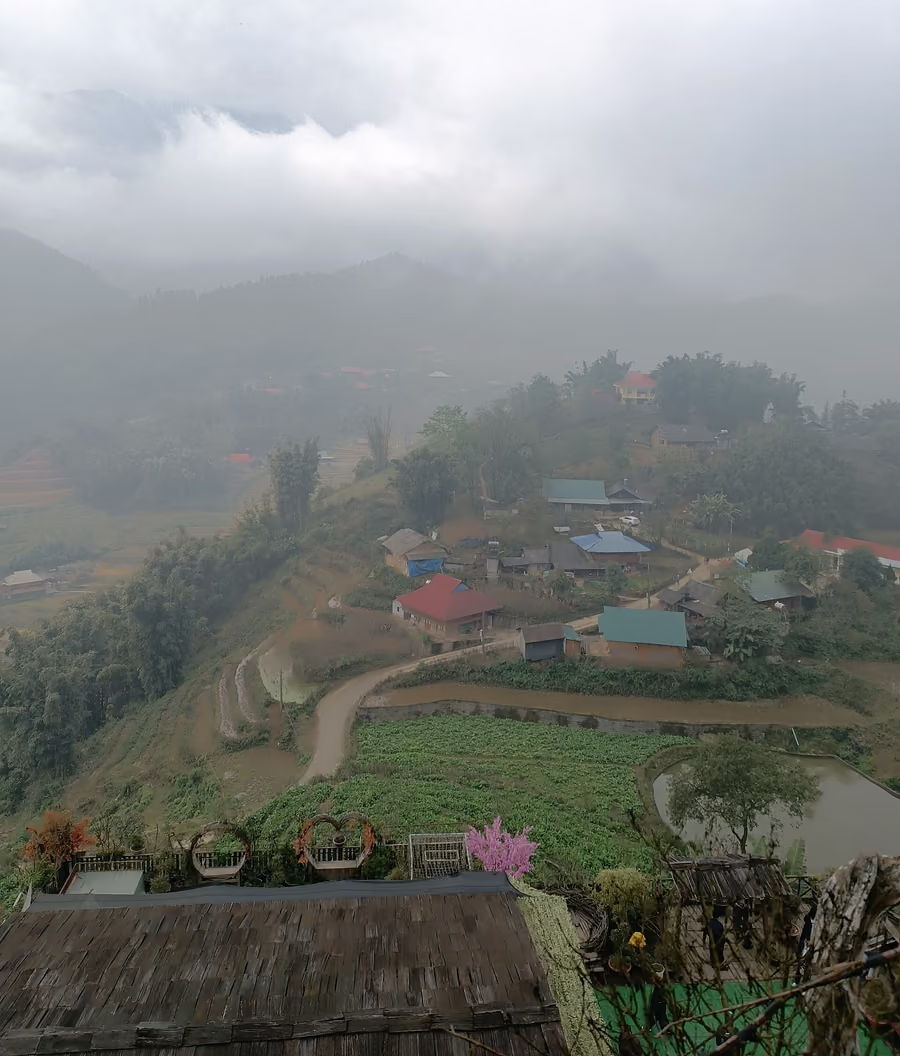
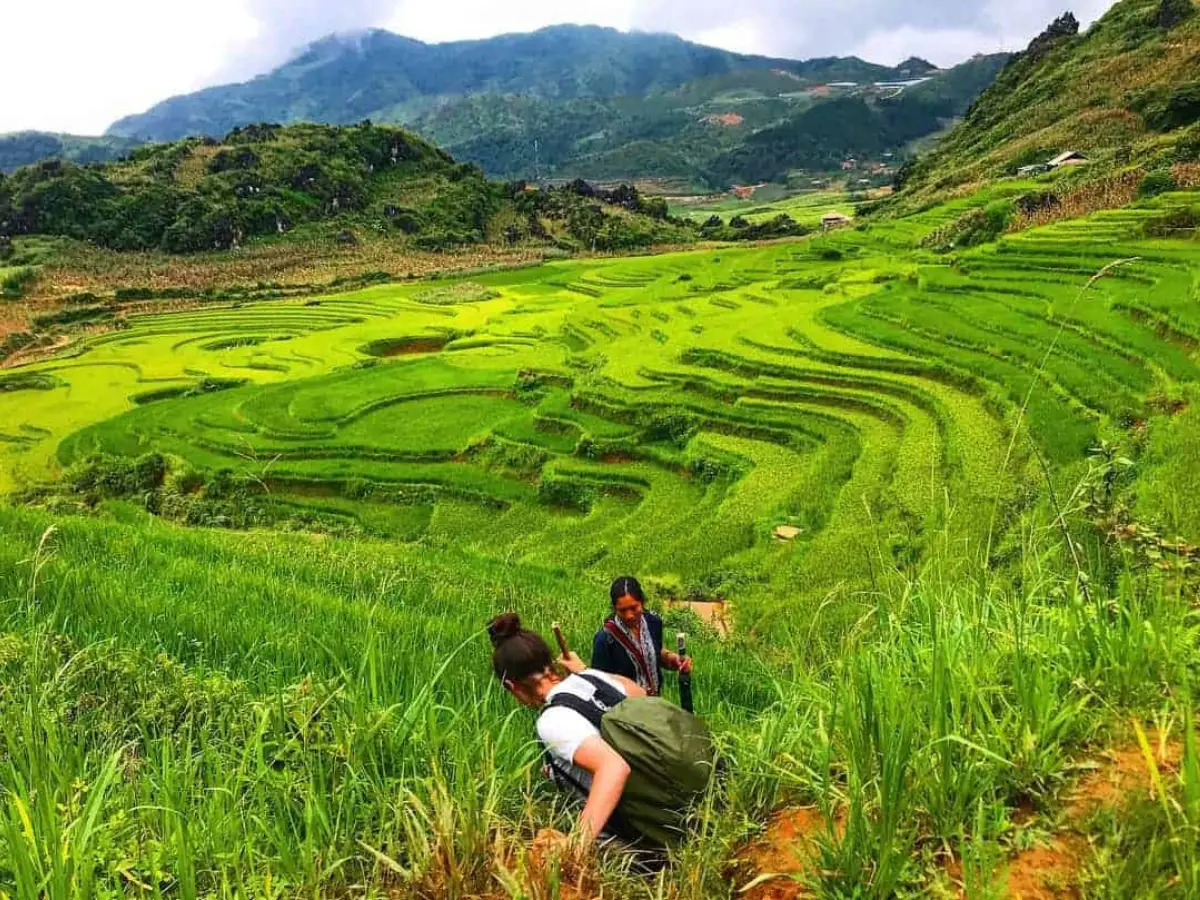
Lao Chai and Y Linh Ho sit in the Muong Hoa valley south-east of Sapa, and a walk through them is the classic way to meet a Black H’mong community on its own ground: terraced fields, houses on the slopes, paths between the paddies and a stream below. Distances from town are quoted from about 7 to 9 km depending on the route and the source, and a one-way hike to Ta Van runs from about 6 to 12 km, according to the operator pages we read. The best-known route links the villages in a single day, and our Lao Chai to Ta Van trek guide covers it step by step. Y Linh Ho is the quieter of the two, and our guide to the best villages near Sapa compares them with the others.
Ta Van: the mixed village
Ta Van is where the neat labels stop working. A Vietnam Tourism guide lists Giay, H’mong and Red Dao households there, and many outside guidebooks call it a Giay village. We include it in a H’mong guide because H’mong families live in and above it and most valley treks end there, but we would not tell a guest it is a single-group village. Our Ta Van village guide describes the homestays and trails.
Ma Tra and Sin Chai: quieter edges
Ma Tra is a Black H’mong village on a ridge, quieter than the valley and often combined with Ta Phin on one route, according to operator listings. Sin Chai lies below the Fansipan cable car line, and our Sin Chai village guide calls it a Black H’mong hamlet; some online listings name a different group, so ask your guide who lives where on the day. Trekking up Fansipan itself is separate: a Bao Lao Cai article of 26 October 2025 says a permit and a licensed guide are required, and unpermitted trails are not allowed.
Ta Phin and Ban Ho: worth visiting, different people
Ta Phin is mainly Red Dao, with herbal baths and brocade as its draw, and Ban Ho is a Tay village of stilt houses. Red Dao women are known for red headdresses; Black H’mong clothing is indigo. Our Ta Phin village guide covers the Red Dao side.
Ask your guide, or ask politely at a homestay, “Which group lives in this village?” People are glad to say. It is a better question than guessing from clothes, and it makes the visit a conversation, not a photo stop.
A Note on Names After the 2025 Mergers
Many online guides still use pre-2025 names, which can confuse a map search. Resolution 202/2025/QH15, dated 12 June 2025, merged Yen Bai and Lao Cai into a single province named Lao Cai (13,256.92 km², population 1,778,785), according to the English summary on Luat Viet Nam. Resolution 1673/NQ-UBTVQH15 of 16 June 2025 reorganised the commune level: Bao Lao Cai reports 99 commune-level units, 89 communes and 10 wards. Sa Pa is now a ward, and Vietnam Tourism places Cat Cat in Ta Van commune, formed from the former Hoang Lien, Muong Hoa and Ta Van units.
If a taxi driver or a map app uses a name you do not recognise, ask for the village by its familiar name, such as Lao Chai, Y Linh Ho or Ta Van. Local people and guides still use those names every day.
Cat Cat in Practice: Ticket, Hours and Who Collects What
The Cat Cat ticket is the one fee you will face on a village visit. An adult ticket was listed at about 150,000 VND (about US$6) in guides dated up to 24 October 2026 from Vietnam Tourism and Asia Mystika; a Sun Paradise Land piece of 21 September 2026 says 100,000 to 150,000 VND. Many older blogs say 70,000 VND, and some of our own earlier pages carried that figure, so we would plan on the higher number and confirm at the booth. Reduced prices apply to children, and children under 1 m enter free. We found no official price notice and could not confirm how long a ticket stays valid.
Two different charges can get mixed up. Bao Lao Cai reported on 9 July 2024 that a tourism company operates the Cat Cat waterfall area and that a scenic-site fee would be collected there. Under Lao Cai People’s Council Resolution 05/2024/NQ-HDND, effective 1 January 2025, the fee is 10,000 VND for ages 16 and over and 5,000 VND under 16, at the Cat Cat waterfall and the Fansipan summit area. We could not confirm whether the 150,000 VND ticket already includes it, so ask when you buy. Buy only at the official booth, and ignore roadside sellers.
Opening hours are listed from about 6:30 or 7:00 until 18:00 in most guides, though one says 6:00, so treat “daytime” as the safe description. Regular cultural performances are included with the ticket according to the guides, but they conflict on show times, so we give none. Arrive early: the stalls are quietest in the first hour.
Meet the Villages With a Black H'mong Guide
 1-Day Trek
Trekking Through Rice Terraced Fields
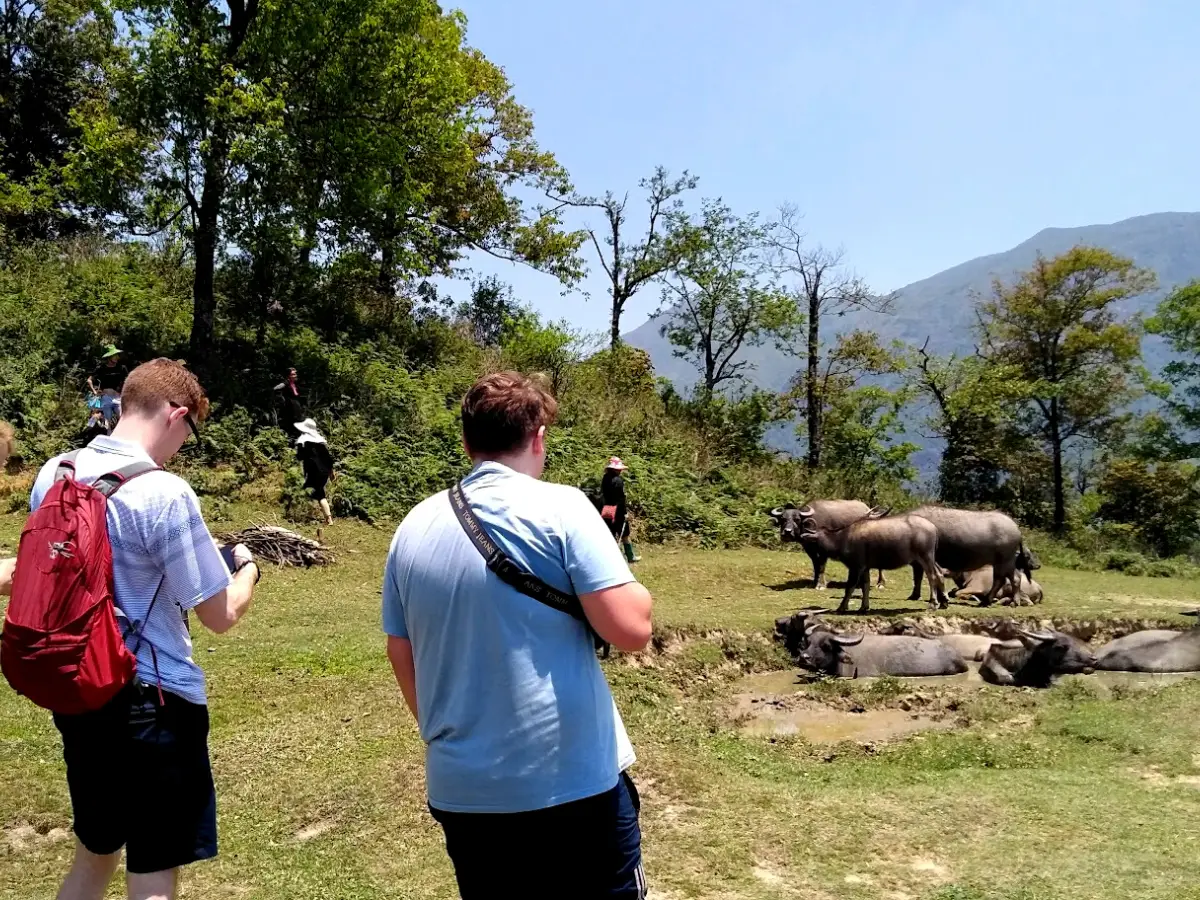
The Lao Chai to Ta Van valley day, with a local guide and a finish in Sapa town.
 Homestay
Rice Terraced Fields & Homestay
A night with a local family in the valley.
 Culture
Rice Paddies and Cultures – Easy Hiking
Flat valley walking through working rice paddies with stops at H'mong homes in Y Linh Ho.
Beyond Sapa: Where to Meet Other H’mong Groups
Sapa is the easiest place to meet Black H’mong people, but not the only one. Four places stand out on a northern route.
Bac Ha Sunday market
Flower H’mong- Where
- About 80 km (about 2.5 hours) from Sapa, Lao Cai province
- When
- Sunday morning; arrive around 7:00
- Why go
- Colourful Flower H’mong costume and a working market for the whole district
Other weekly markets
Lao Cai province- Can Cau
- Saturday market near the Chinese border
- Coc Ly
- Tuesday market
- Muong Hum
- Sunday market, about 50 km from Sapa, with Black H’mong traders
Dong Van plateau
Ha Giang- Where
- Dong Van and Meo Vac, now in Tuyen Quang province after the 2025 merger
- Who
- H’mong are the largest of 17 communities there, per one regional guide
- Note
- A long road trip; see our Sapa to Ha Giang guide
Mu Cang Chai
Terrace country- Where
- Now in Lao Cai province, on the former Yen Bai side
- Why go
- Some of the north’s best-known rice terraces
- Note
- We could not verify the ethnic mix, so we make no claim
The market days above come from a Vietnam Tourism guide on H’mong culture (updated 31 July 2026), a commercial information site, so confirm the day and the hours before you travel. Markets change with the lunar calendar and holidays. For roads, permits and sample routes to the plateau, our Sapa to Ha Giang guide is the place to start, and our rice terraces guide compares Mu Cang Chai with two other terrace areas. A market is an even more public place than a village, and the same respect rules apply: ask before you photograph a trader, and buy something if you spend time at a stall.
How to Visit a H’mong Village Respectfully
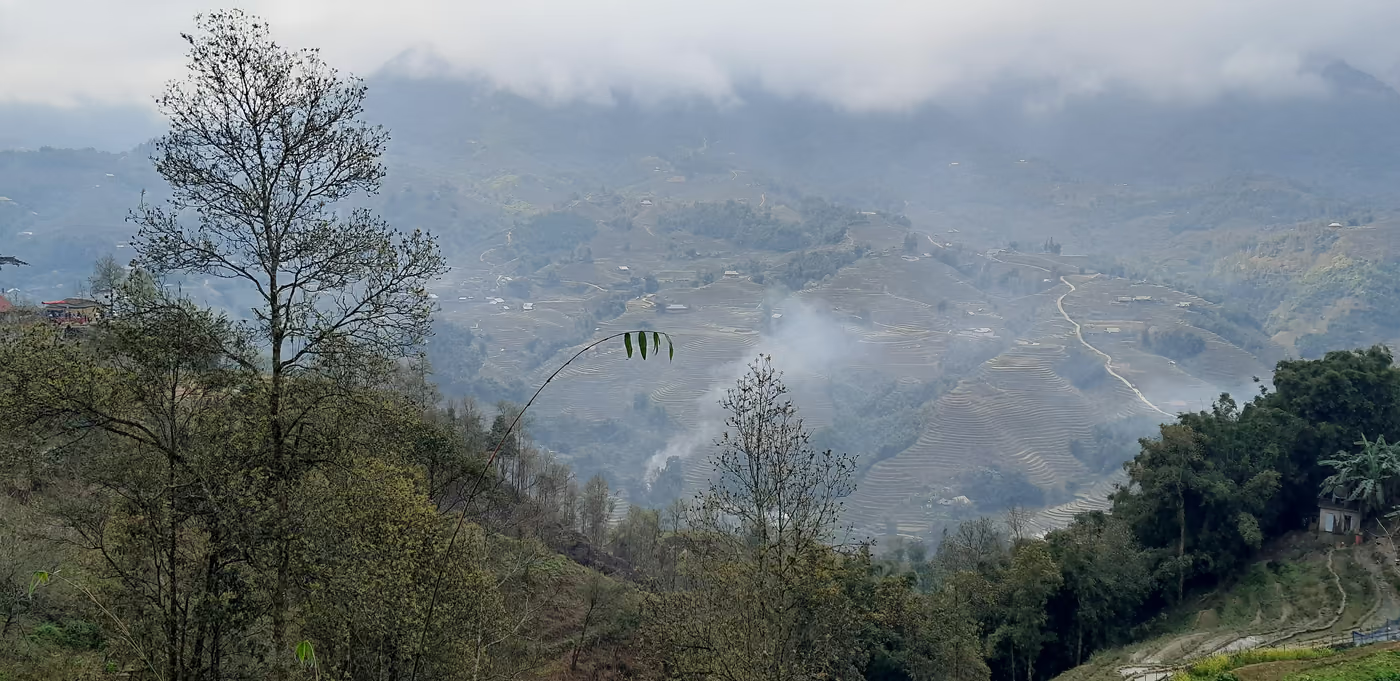
Most of the advice below is common courtesy, and most of it applies in any village anywhere. We set it out because tourism has been part of life in these valleys for three decades and people have seen every kind of visitor. The points are drawn from a Vietnam Tourism guide on H’mong culture (31 July 2026), a Frontier Travel Vietnam etiquette page (2016) and flyers for visitors written by non-profit groups working in Sapa, plus our own guides’ briefings.
Please do
- Ask before you photograph a person, with a smile and a gesture to your camera
- Stay on the paths and go round gardens and fields, not through them
- Take your shoes off at the door of a house when you are invited in
- Dress modestly: long trousers and covered shoulders in villages and homes
- Buy cloth and jewellery directly from the people who made it, at the asking price
- Sip the rice wine if it is offered, and say thank you in Vietnamese or with your guide’s help
Please do not
- Ask someone to change clothes or pose for a photo
- Hand sweets or money to children on the trail
- Walk into a house or a yard without an invitation
- Touch the household altar or sit by it uninvited; ask your guide first
- Bargain hard over handwork that took many hours
- Fly a drone over homes or people without permission
Photographs
The first rule is the simplest: ask. The Vietnam Tourism guide says H’mong people are not exhibits and should not be asked to change clothes for a picture, and Frontier Travel’s etiquette page says never to photograph local people without explicit permission or enter a home without an invitation. A smile and a gesture to your camera do the asking; accept a refusal without a fuss. Some people may ask for a small payment; that is their choice, and so is your answer.
Children, sweets and money
Visitors often want to give children something. Flyers for Sapa visitors by the non-profit Action Solidarité Nord Viêt Nam, uploaded in 2018, advise against handing out sweets, and the Vietnam Tourism guide advises against giving money to children. We could only read summaries of the flyers, so take this as the direction of the advice, not its wording. If you want to help, buy something from an adult who is selling, or ask your guide about a school or community project, and let the family decide. A gift handed over without a parent’s say-so is a decision made for the family by a stranger.
Cloth and craft
The cloth in this guide takes weeks of work, from growing hemp to the final stitches. If you buy a piece, ask who made it and how long it took, then pay the asking price or a little less. Sellers may walk with your group between villages, which is a long-established income stream; a polite “no, thank you”, said once and kindly, is enough.
Homestays
Treat a homestay as a visit to a home: take off your shoes, accept what is offered, help with the cooking if you are asked, and ask before taking photographs inside. Our rice terraces and homestay tour spends a night with a family in the valley.
A respectful visit in six steps
Choose your village for the right reason
Pick Cat Cat for convenience and the valley for a walk. Do not pick a village because someone promised an “untouched tribe”; nobody lives untouched in 2026.
Before you goGo with a local guide if you can
A guide who grew up in the valley can introduce you, explain what you see and tell you when to put the camera away.
At the trailheadGreet people first
A smile and a hello cost nothing. Start with a greeting, not a lens.
On the pathAsk before every portrait
One question per photograph, and a thank-you whether the answer is yes or no.
Every timeSpend money where it helps
Buy lunch, a handmade piece or a night in a family homestay, directly from the family.
At the stall or tableLeave nothing behind
Take your rubbish with you and leave gates as you found them.
On the way outWhy a Local H’mong Guide Changes the Visit
A guide from the valley changes three things. The first is access: a guide who knows the families can take you where a stranger would pass. The second is context: they can tell you which house is making indigo and what a pattern means. The third is manners: they know when a photo is welcome. Our guides grew up in Black H’mong families in these valleys, and our piece on Black H’mong culture describes how they came to guide. Whoever leads you, check that they hold the licence the route needs.
For an easy first step, see our Sapa trekking tours or our Sapa photography spots guide.
When to Go, and How Long to Allow
A visit to Cat Cat takes an hour or two, a valley walk through Lao Chai, Y Linh Ho and Ta Van takes most of a day, and a market trip to Bac Ha is a long day from Sapa. Gau Tao is held in the first lunar month and arranged by each village, so our festival guide gives estimated dates and says plainly when they are estimates. Allow time: the visits people remember are the ones where they sat down for ten minutes.
Getting to Sapa for a Village Trip
Most visitors start in Hanoi: our guide to how to get to Sapa compares the options, and Hanoi to Sapa covers times and prices.
Getting to the Villages From Hanoi
- Hanoi to Sapa transport — sleeper buses, limousines and the overnight train, bookable with your trek
- Hanoi to Sapa guide — what each option costs and how long it takes
- How to get to Sapa — the first leg, in detail
Quieter Trails and the Roof of Indochina
Rent at Our Office Before You Trek
 Gear Rental
Trekking Boots Rental
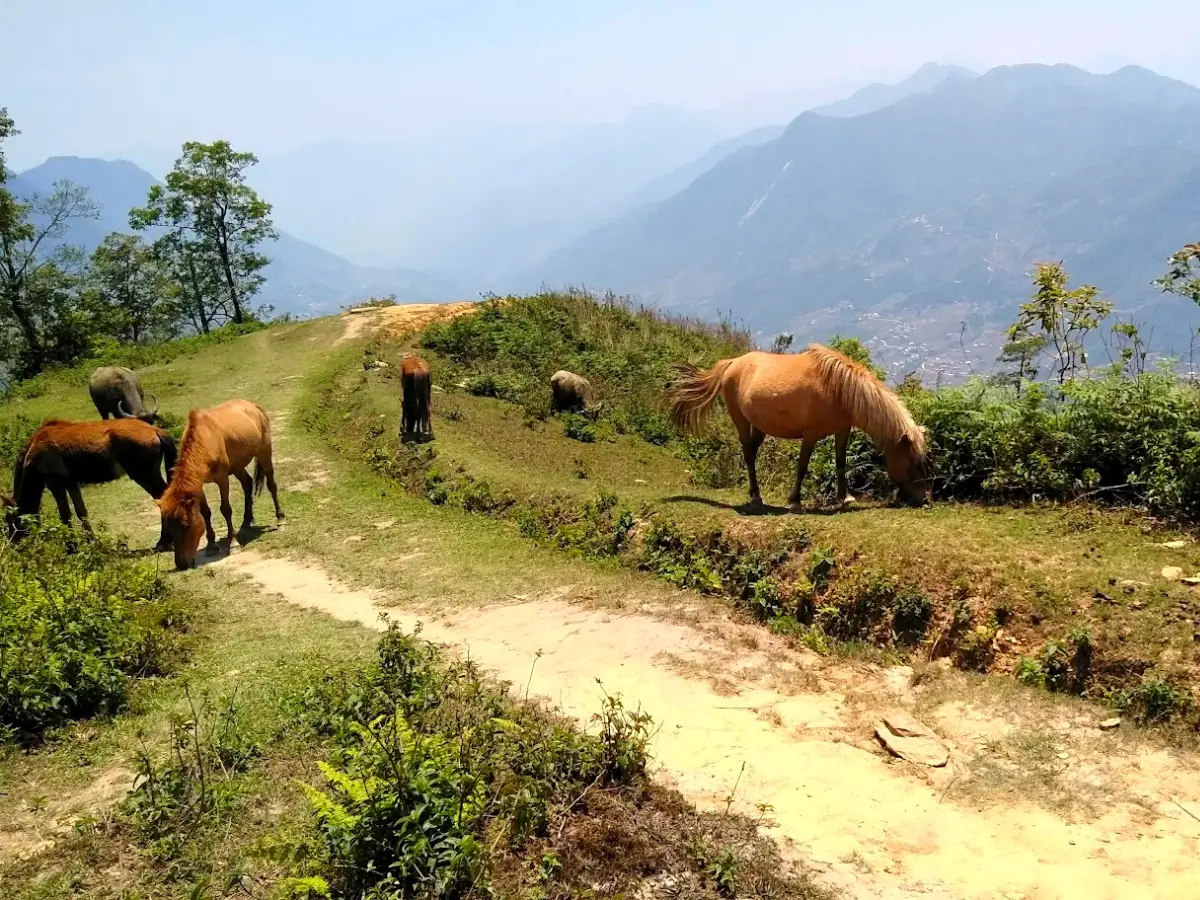
Waterproof ankle-support boots. Cleaned and checked before each rental. Available at 105 Thach Son Street.
 Gear Rental
Walking Poles Rental
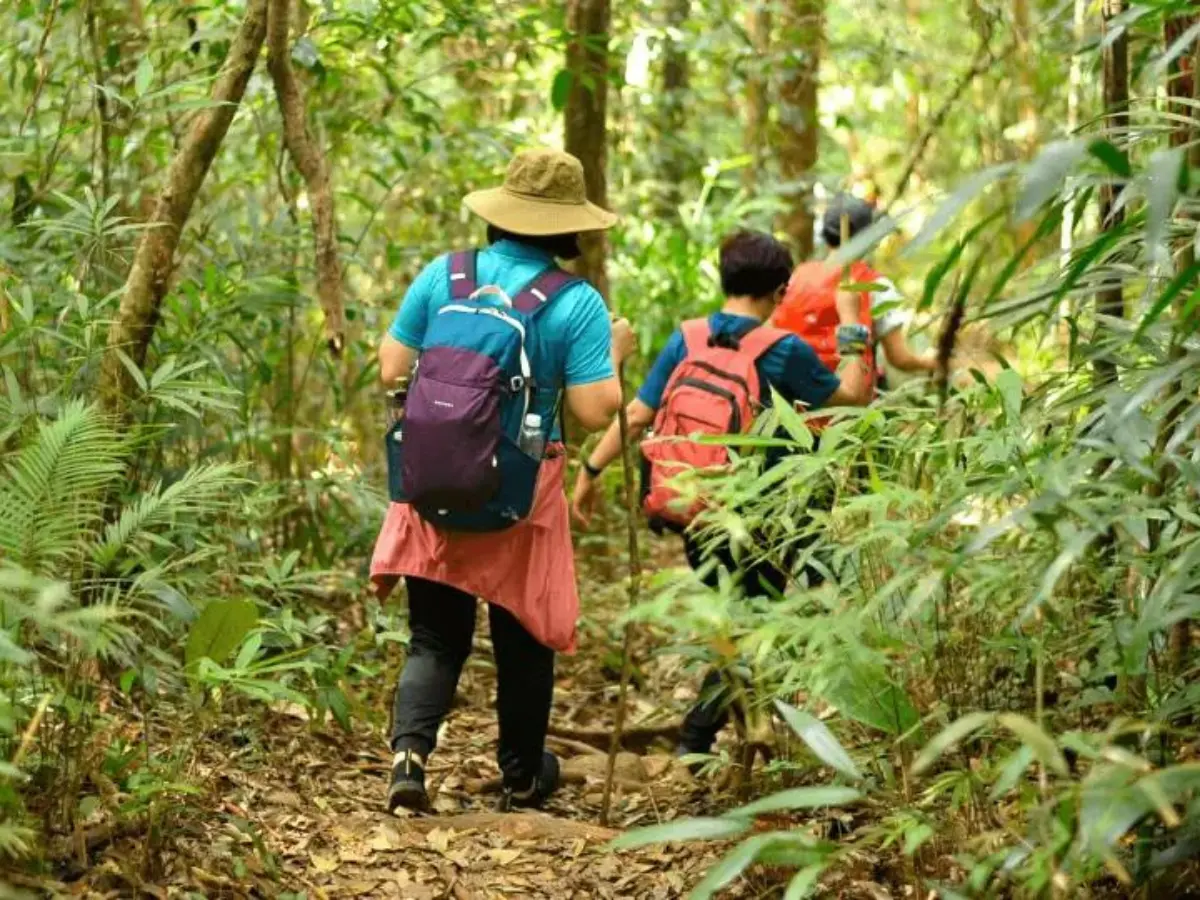
Trekking poles available to rent at $2/day at our office, 105 Thach Son Street. Essential for descents.
Sources We Checked
All pages were read on 31 October 2026 unless a date is given.
- Nhan Dan special page on the H’mong (2019 survey, provinces, sub-groups, belief); Wikipedia, “Hmong people”.
- Vietnam Tourism guides on H’mong culture (31 July 2026), Cat Cat tickets (24 October 2026) and Lao Cai travel (16 October 2026); Local Vietnam on Gau Tao (15 May 2026); Asia Mystika; Sun Paradise Land (21 September 2026).
- Luat Viet Nam on Resolution 202/2025/QH15; Bao Lao Cai on Resolution 1673/NQ-UBTVQH15, the Cat Cat and Fansipan site fee (9 July 2024) and the Fansipan permit (26 October 2025).
- SPAFA Journal on H’mong textiles; Frontier Travel Vietnam (2016); Action Solidarité Nord Viêt Nam flyer (2018).
Frequently Asked Questions
Cat Cat, Lao Chai, Y Linh Ho and Ma Tra are Black H'mong villages, and Sin Chai is usually counted among them, though some online listings disagree. Ta Van is mixed, with Giay, H'mong and Red Dao households. Ta Phin is mainly Red Dao and Ban Ho is Tay. Ask your guide who lives where on the day.
Guides dated up to 24 October 2026 list an adult ticket at about 150,000 VND (about US$6), and one guide of 21 September 2026 says 100,000 to 150,000 VND. Older blogs say 70,000 VND. We found no official notice, so confirm at the official booth. A separate scenic-site fee of 10,000 VND for ages 16 and over applies at the Cat Cat waterfall area.
The 2019 national survey of the 54 ethnic groups counts 1,393,547 H'mong people at 1 April 2019, according to a Nhan Dan special page citing the Committee for Ethnic Minority Affairs and the General Statistics Office. They live mainly in Ha Giang, Son La, Dien Bien, Lao Cai, Lai Chau, Yen Bai, Thanh Hoa, Nghe An, Dak Lak and Dak Nong, using pre-2025 province names.
Ask first, with a smile and a gesture to your camera, and accept a refusal. A Vietnam Tourism guide says H'mong people are not exhibits and should not be asked to change clothes for a photo. Frontier Travel Vietnam advises never photographing local people without their explicit permission. Landscape photos need no permission.
No. Flyers for Sapa visitors by the non-profit Action Solidarité Nord Việt Nam advise against handing out sweets, and a Vietnam Tourism guide advises against giving money to children. We could read only summaries of the flyers. Buy from an adult seller or ask your guide about a community project instead.
The Bac Ha Sunday market, about 80 km or 2.5 hours from Sapa, is known for Flower H'mong costume; arrive around 7:00. Muong Hum has a Sunday market with Black H'mong traders about 50 km from Sapa. The Dong Van plateau in Ha Giang, now in Tuyen Quang province, has H'mong as its largest group. Confirm market days before you travel.
Yen Bai and Lao Cai merged into one province named Lao Cai under Resolution 202/2025/QH15 of 12 June 2025, and communes were reorganised under Resolution 1673/NQ-UBTVQH15 of 16 June 2025. Sa Pa is now a ward, and Vietnam Tourism places Cat Cat in Ta Van commune. Local people and guides still use the familiar village names.
You can walk the paths without one, but a guide who grew up in the valley can introduce you, explain what you see and tell you when to put the camera away. Fansipan trails are different: a permit and a licensed guide are required, according to Bao Lao Cai on 26 October 2025.