 Sinh Giang

Ta Phin is a Red Dao and Black H'mong village about 12 km northeast of Sapa town, set in a wide, terraced valley that most day-trippers rush through on their way to a herbal bath. It is one of the closest ethnic villages to Sapa — a 30 to 40 minute drive, or a half-day walk over the hills — and yet it feels a world away from the souvenir stalls of the town centre. This is a working farming community where Red Dao women still embroider by hand, still gather medicinal leaves from the forest, and still fill a wooden tub with a steaming herbal bath that has warmed trekkers and new mothers alike for generations.
I have been walking guests into Ta Phin for years, and the question I hear most in the car is whether it is "too touristy." The honest answer, as with most of Sapa, is that it depends entirely on where you point your feet. Stay by the co-operative shop at the entrance and you will get the packaged version — a quick browse, a bath, a photo, back on the bus. Walk twenty minutes up the valley toward Ta Phin's scattered hamlets, sit with a family over a cup of tea, and you find the village that made me fall for this place. This guide is how we visit it properly: how to get there, what the Red Dao herbal bath actually is, what is worth buying, where the ruined French monastery and the cave sit, and the small courtesies that turn a stop into a welcome.
Ta Phin village at a glance
Before the how-to, here are the essentials that shape a visit. Ta Phin is close to Sapa, easy to reach, and famous for one thing above all — the Red Dao herbal bath — but there is far more to a good half-day here than a soak and a shop.
Ta Phin rewards the slow visitor. The bath houses and the co-operative sit right at the village entrance, so almost everyone stops there and never walks further. Give the valley an extra hour on foot — up toward the upper hamlets and the terraces — and you will meet the Ta Phin that the buses never see.
Where is Ta Phin, and who lives there?
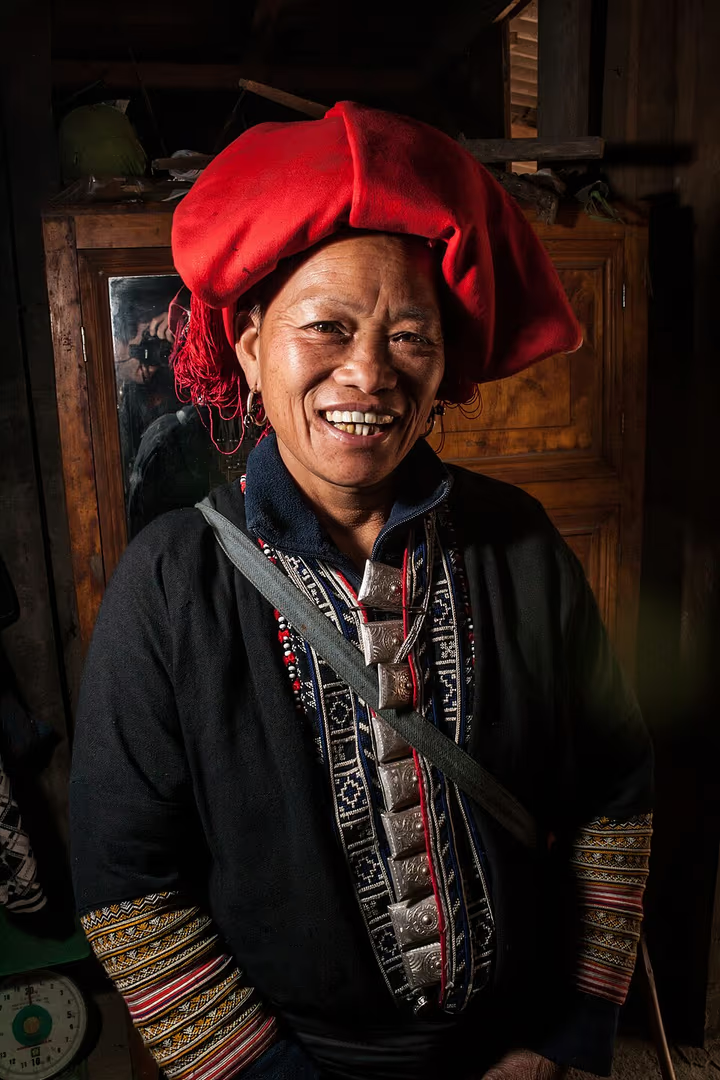
Ta Phin is a commune in the hills northeast of Sapa town, in Lao Cai province, reached by a paved road that turns off Highway 4D a few kilometres out of Sapa. It shares its valley between two ethnic groups who live side by side but keep distinct traditions: the Red Dao, who give the village its fame, and the Black H'mong, who farm many of the surrounding slopes. Walk the valley and you will read the difference in the clothing — the Red Dao in their unmistakable red-tasselled headscarves and heavily embroidered jackets, the Black H'mong in deep indigo.
The Red Dao (Dao Do) are the reason most visitors have heard of Ta Phin at all. Their culture is bound up with herbal medicine, intricate brocade embroidery, and a set of customs — from the shaved eyebrows and hairlines of married women to their coming-of-age ceremonies — that are quite different from the H'mong most Sapa trekkers meet first. If you want the full picture before you go, our companion guide to the Red Dao people of Sapa digs into their clothing, beliefs and daily life; Ta Phin is where you see all of it in one working valley. The two communities share the market, the school and the roads, but almost nothing of their dress, language or ritual — which is exactly what makes a slow morning here so rewarding.
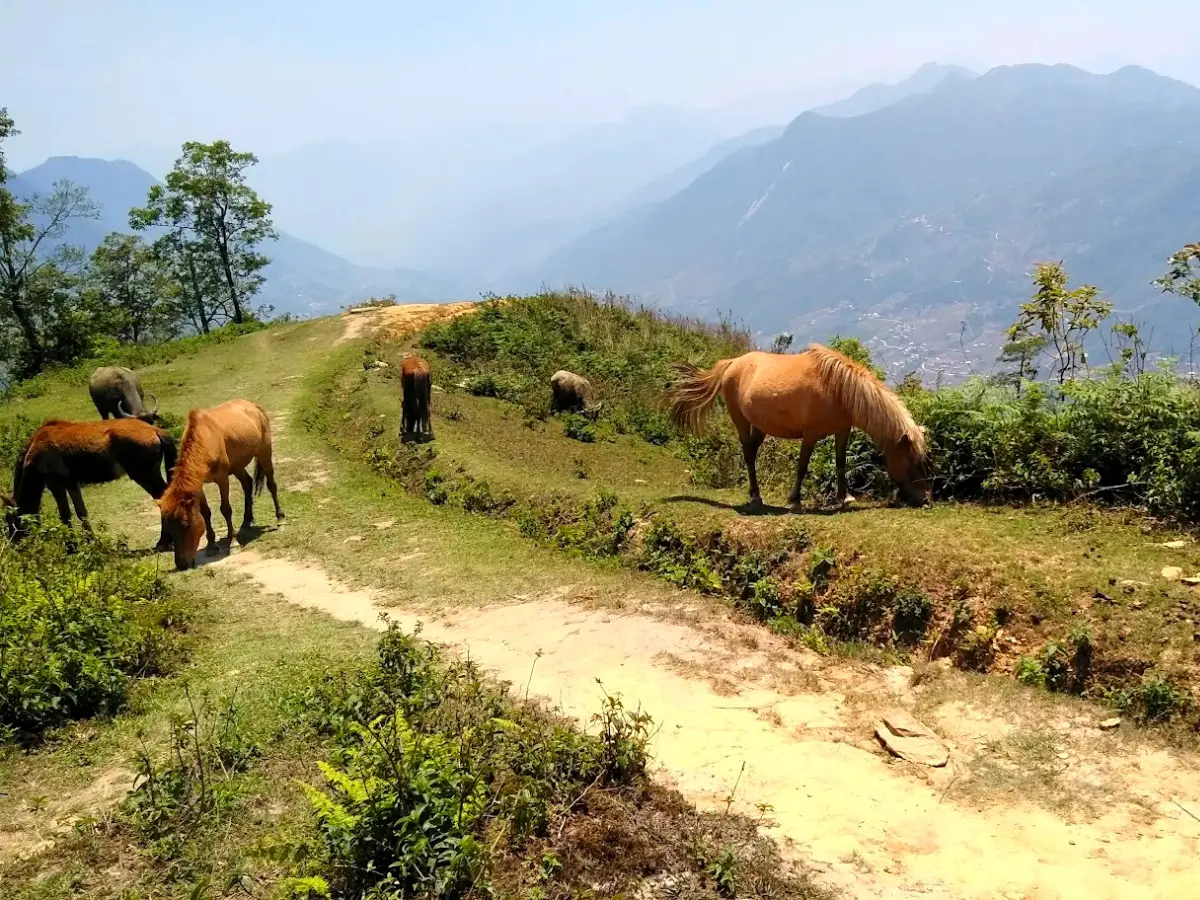
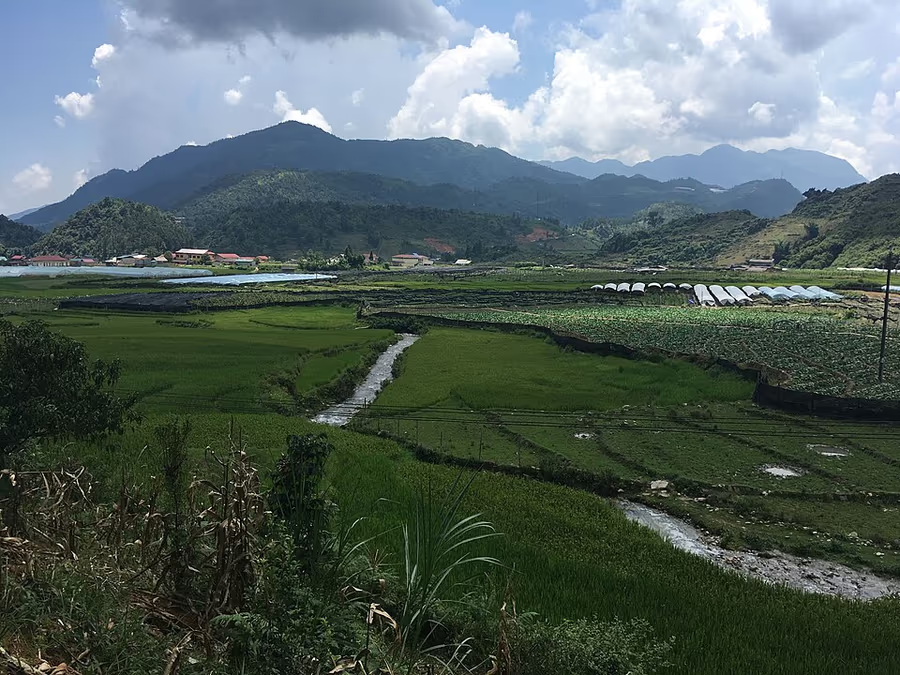
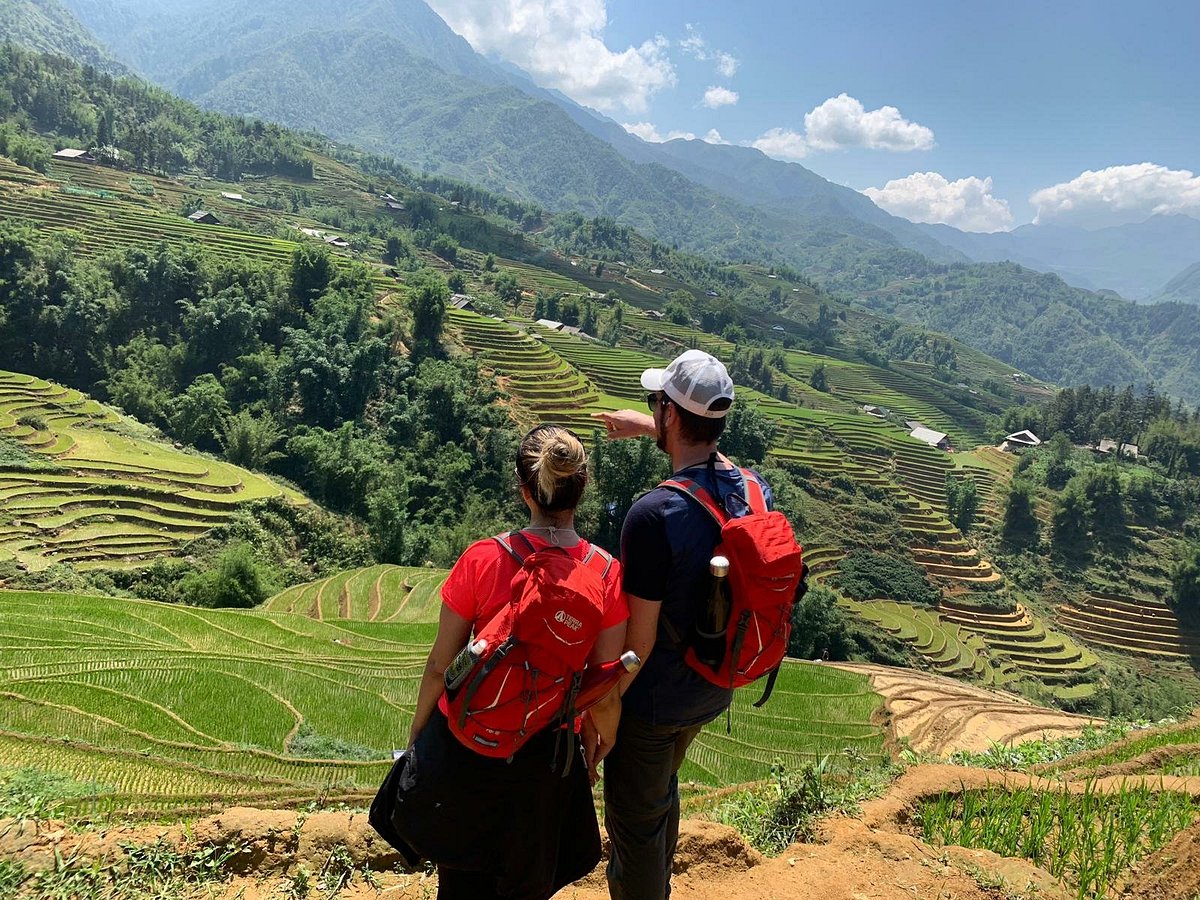
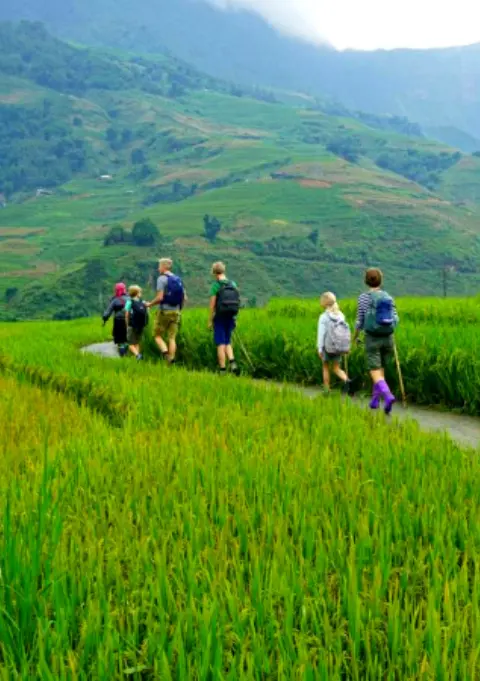
Geographically, Ta Phin sits at around 1,000 to 1,200 metres, lower and gentler than the high ridges above Sapa, in a broad valley of rice terraces that turn from bright green in June to gold in September. The commune is made up of several hamlets scattered across the hillsides, with the main cluster — the brocade co-operative, the bath houses and the market ground — near the road's end. It neighbours Ma Tra and Sa Seng, two smaller settlements that many walking routes stitch together on the way in from Sapa, so a trek to Ta Phin usually means passing through more than one community and watching the landscape shift from pine-dotted upper slopes down to wet paddy. Unlike Cat Cat, which sits almost inside Sapa town, or the well-trodden Lao Chai–Ta Van corridor in the Muong Hoa Valley, Ta Phin keeps a working, lived-in feel: fields being planted, buffalo on the lanes, and far fewer tour groups per square kilometre.
How to get to Ta Phin from Sapa
Getting to Ta Phin is genuinely easy — it is one of the few authentic villages you can reach from Sapa without a long, punishing drive. You have three sensible ways in, and many travellers combine them: drive one way and walk the other. Here is how each works in practice.
By car or taxi — 30 to 40 minutes
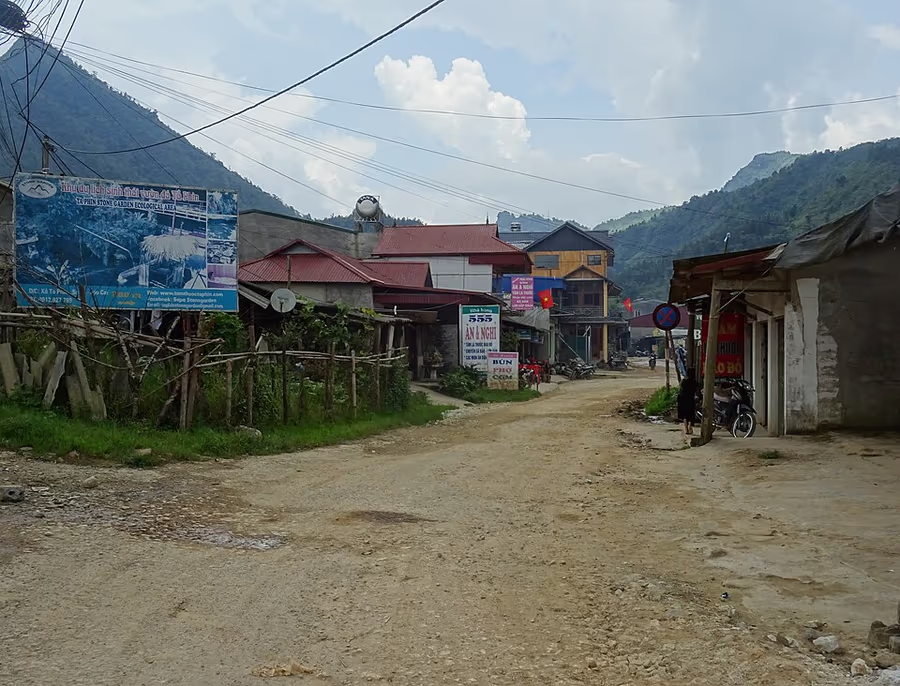
The simplest option. A car leaves Sapa town, follows Highway 4D east, then turns north on the paved Ta Phin road past the "Ta Phin Stone Garden" sign to the village entrance. Ideal if you are short on time, travelling with older parents or young kids, or want to pair Ta Phin with a herbal bath and be back in Sapa by lunch.
Easiest · all agesBy motorbike — the scenic self-drive
The Ta Phin road is sealed and gentle, making it one of the more manageable rides out of Sapa for a confident rider. You get to stop for photos over the valley and time your own arrival. Watch for fog and the odd loose buffalo, and skip it if the road is wet — highland tarmac gets slick fast.
IndependentOn foot — trek in from Sapa or Ma Tra
The best way, if your legs allow. The classic route walks out from Sapa through Ma Tra and Ta Phin, roughly three to four hours of gentle-to-moderate hill trail through terraces and hamlets, finishing with a herbal bath before a car carries you home. This is the version we most often guide — the walk is the experience.
Most rewardingIf you want a guided walk into Ta Phin, a car, or a herbal bath arranged for a specific day, message us at least two days before you travel. It lets us line up the right guide and driver and make sure a bath house is ready for you rather than turning up to a full one.
Still making your way up from Hanoi? However you reach Sapa, we can fold the transfer into your booking. These are the three ways our guests usually travel the Hanoi–Sapa leg before a village visit like this:
Hanoi to Sapa — Your Transport Options
 Most Popular
Sleeper Bus
Lie-flat berths, day and overnight departures. The easiest budget link from Hanoi to Sapa town.
 Fastest
Limousine Van
9-seat premium van, door to door. Departs 7 AM & 2 PM both ways — the quickest way up.
 Overnight
Overnight Train
King Sapa Train sleeper cabins to Lao Cai, then a 1-hour transfer up to Sapa. Sleep as you travel.
The Red Dao herbal bath: Ta Phin's star attraction
The Red Dao herbal bath is the single most famous thing about Ta Phin, and for once the fame is deserved. It is a traditional medicinal soak made from a mixture of forest leaves, roots and bark — sometimes a dozen or more plants, some of which the Red Dao will not fully name — boiled for hours until the water turns a deep reddish-brown, then poured steaming into a tall wooden tub. You climb in up to your chest, breathe the herbal steam, and let twenty minutes of aching legs and highland chill dissolve. After a full day of walking Sapa's terraces, it is close to miraculous.
This is not a spa invention dreamed up for tourists. The Red Dao have used thuoc tam for generations — to recover after heavy field work, to warm the body in the cold months, and, most importantly, for new mothers, who traditionally bathe within days of giving birth to regain their strength. Several family-run bath houses in Ta Phin now welcome visitors, and a bath usually costs somewhere around 100,000 to 150,000 VND. The best of them still prepare the water the old way over a wood fire rather than a modern boiler, and you can often buy sachets of the dried herb mixture to take home. If you do only one thing in Ta Phin, make it this — ideally at the end of a trek, when your body has earned it.
The herbs themselves are the reason the bath became famous well beyond Sapa. Red Dao families gather them across the surrounding forest — some grown in home gardens, others found only on the higher slopes — and the exact recipe varies from household to household, passed down and guarded like any family secret. Researchers from Hanoi have studied the mixture for its anti-inflammatory and circulation-boosting properties, and a handful of Vietnamese cosmetic brands now bottle a diluted version. But nothing bottled comes close to the real thing in a wooden tub with the wood smoke still hanging in the room. Ask the family what is in the water and they will name a few plants happily and smile at the rest; that half-kept secret is part of what you are paying for. A good bath house will give you a small pot of herbal tea to sip while you soak, and the whole ritual — steam, tea, the deep-red water, the quiet — is as much rest as remedy.
Go easy on your first bath — the herbs are potent and the water is hot, so a light-headed feeling is normal. Ten to fifteen minutes is plenty to start. Don't bathe on a completely empty stomach or straight after a big meal, hydrate well afterwards, and if you are pregnant or have a heart condition, ask us first and check with the family before you get in.
Brocade, embroidery and what to buy
Ta Phin's other great craft is textile. Red Dao women are among the finest embroiderers in the north, working intricate geometric patterns in red, white and yellow thread onto indigo cloth — you will see them stitching in doorways and on porches, often without a pattern to follow, the designs carried entirely in memory. The village runs a small brocade co-operative near the entrance where you can watch the work and buy directly, which keeps more of the money with the makers than a Sapa-town shop does.
The pieces worth buying are the handmade ones: embroidered panels, cushion covers, bags, indigo scarves, and the small silver ornaments the Red Dao wear. As at any highland market, machine-made cloth sneaks in alongside the real thing, and the tell is the same — genuine Red Dao embroidery has tiny irregularities, a back that shows the stitches, and colours that are rich rather than neon-perfect. Prices are gently negotiable, but the margins on hand-stitched work are slim; settling somewhere fair, with a smile, is both good manners and how you end up being invited in for tea. Buy a sachet of herbal-bath mixture while you are there, too — it is the most useful souvenir in Sapa.
Treks That Pass Through Ta Phin & Ma Tra


The ruined French monastery and Ta Phin Cave
Two lesser-known sights give Ta Phin more depth than a bath-and-shop stop. The first is the ruined monastery on the edge of the village — the roofless stone shell of a Catholic seminary the French built in the 1940s and abandoned after only a few years amid the upheavals of the era. Its bare walls and empty window arches, half-reclaimed by grass and framed by the terraces behind, are quietly atmospheric and a favourite with photographers. It takes ten minutes to walk over from the co-operative, and it is free.
The second is Ta Phin Cave (Hang Ta Phin), a limestone cavern in the hills a short way beyond the village. It is undeveloped — no lighting, no walkways — so you need a torch, sturdy shoes, and ideally a local who knows the way in, but for the adventurous it is a genuine off-the-map corner with stalactites and cool, damp chambers. Neither sight takes long, and together they turn Ta Phin from a quick errand into a proper half-day: monastery, cave, village, bath. That combination — history, landscape, living culture and a hot soak within a couple of square kilometres — is what makes Ta Phin punch so far above its size.
Is Ta Phin worth visiting? An honest look
Ta Phin is genuinely worth a visit, but it helps to go in with clear eyes. It is close, it is authentic, and it offers something — the herbal bath and Red Dao embroidery — that you will not find in the busier valleys around Cat Cat or Lao Chai. It also sees day-trippers, and the strip by the co-operative can feel a touch commercial at midday. Weigh it up honestly and you will get far more out of the day.
Why we love Ta Phin
- Close to Sapa — an easy half-day, no punishing drive
- The Red Dao herbal bath: a real tradition, not a spa gimmick
- Some of the finest hand embroidery in the north, bought direct
- Two ethnic cultures — Red Dao and Black H'mong — in one valley
- Extras few visitors bother with: the monastery ruin and the cave
- Quieter than Cat Cat if you walk beyond the entrance
What to know first
- The co-operative strip can feel commercial by mid-morning
- Vendors near the entrance can be persistent — a polite no is fine
- The cave is undeveloped; you need a torch and a guide
- Best experienced on foot — a drive-in-drive-out visit misses a lot
- Herbal baths are best pre-arranged on busy days
- Bring small cash; there is nowhere to change money here
My rule of thumb: if you have half a day and want culture over scenery-for-its-own-sake, Ta Phin is one of the best-value stops near Sapa — especially walked in, with a bath at the end. If you have only a couple of hours and want the classic terraced-valley view, the Muong Hoa route may suit you better. Many of our guests do both across a trip, and Ta Phin is the one they talk about afterwards.
Add a Homestay to Your Sapa Trek
When to go: the best time to visit Ta Phin
The best time to visit Ta Phin is September and October, when the rice terraces turn gold in the weeks before harvest and the whole valley glows, or April and May, when the paddies are flooded and freshly planted and everything is a brilliant green. These are the windows when the walk in is at its most beautiful and the weather is mild and mostly dry. Ta Phin can be visited all year, though, and each season has its own character.
Winter, from December to February, brings cold and thick mist to the valley — atmospheric in its own stark way, and the one time when the herbal bath feels less like a treat and more like a necessity. The summer months from June to August are warm, lush and green but bring the heaviest rain, which can make the trail muddy and the motorbike road slick; if you come then, a car and a guide make life much easier. Whatever the month, mornings are usually clearer than afternoons, so an early start gives you the best light and the best chance of the valley before the cloud rolls in.
Visiting Ta Phin respectfully
Ta Phin is a living village, not an open-air museum, and a little courtesy transforms the welcome you get. The Red Dao and Black H'mong here are used to visitors, but the families whose porches you walk past are going about an ordinary day — so the same small habits that serve you anywhere in highland Sapa apply. Ask before photographing people, especially older women; a smile and a gesture toward your camera is understood in any language, and a wave-off means move on, no offence taken.
If you buy, buy from the makers rather than only the loudest vendor, and accept that a fair price on hand embroidery is not a Sapa-market bargain. When a family invites you in for tea — and in Ta Phin they still do — a small purchase, or simply your genuine interest, is thanks enough. Carry your rubbish out, dress modestly if you visit the monastery or a home, and if you take a herbal bath, treat the wooden tub and the family's home as you would a guest's. None of this is complicated; it is simply the difference between passing through Ta Phin and being welcomed into it — and it is the reason the village still feels like itself after all these years of visitors.
Rent at Our Office Before You Trek
 Gear Rental
Trekking Boots Rental
Waterproof ankle-support boots. Cleaned and checked before each rental. Available at 105 Thach Son Street.
 Gear Rental
Walking Poles Rental
Trekking poles available to rent at $2/day at our office, 105 Thach Son Street. Essential for descents.
Frequently Asked Questions
Ta Phin is a commune about 12 km northeast of Sapa town, in Lao Cai province. By road it is a 30 to 40 minute drive through the hills, and it is one of the closest ethnic villages to Sapa. Ta Phin is home mainly to the Red Dao, with a Black H'mong community sharing the same valley.
You have three easy options. You can drive or take a taxi (about 30 to 40 minutes each way), ride a motorbike along the paved road via the Ta Phin junction on Highway 4D, or trek in on foot from Sapa or from Ma Tra, which takes roughly three to four hours through the terraces. Many travellers drive one way and walk the other. We can arrange a car, a motorbike or a guided walk.
The Red Dao herbal bath is a traditional medicinal soak made from a mix of forest leaves, roots and bark, boiled and poured into a wooden tub. The Red Dao of Ta Phin have used it for generations to ease sore muscles, warm the body and recover after work or childbirth. Several family-run bath houses in the village now welcome visitors, and it is the perfect end to a day of trekking. A bath usually costs around 100,000 to 150,000 VND.
The main draws are the Red Dao culture and brocade embroidery, the herbal bath, the ruined French monastery on the edge of the village, Ta Phin Cave, and the terraced valley itself. Most visitors come to walk the fields, meet Red Dao and Black H'mong families, buy handmade textiles at the village co-operative, and soak in a herbal bath before heading back to Sapa.
Yes, especially if you want a close, quieter alternative to the busy Cat Cat and Muong Hoa routes. Ta Phin is a genuine working village rather than a staged attraction, with strong Red Dao traditions, real handicrafts and a herbal bath you will not find elsewhere. It does see day-trippers, so walking a little beyond the co-operative rewards you with a calmer, more authentic experience.
September and October are the most beautiful, when the rice terraces turn gold before the harvest. April to May, when the paddies are flooded and planted, is also lovely and green. Winter (December to February) is cold and misty but atmospheric, and the herbal bath is at its best. Ta Phin can be visited year round, and mornings are usually clearer than afternoons.