
 Sinh Giang
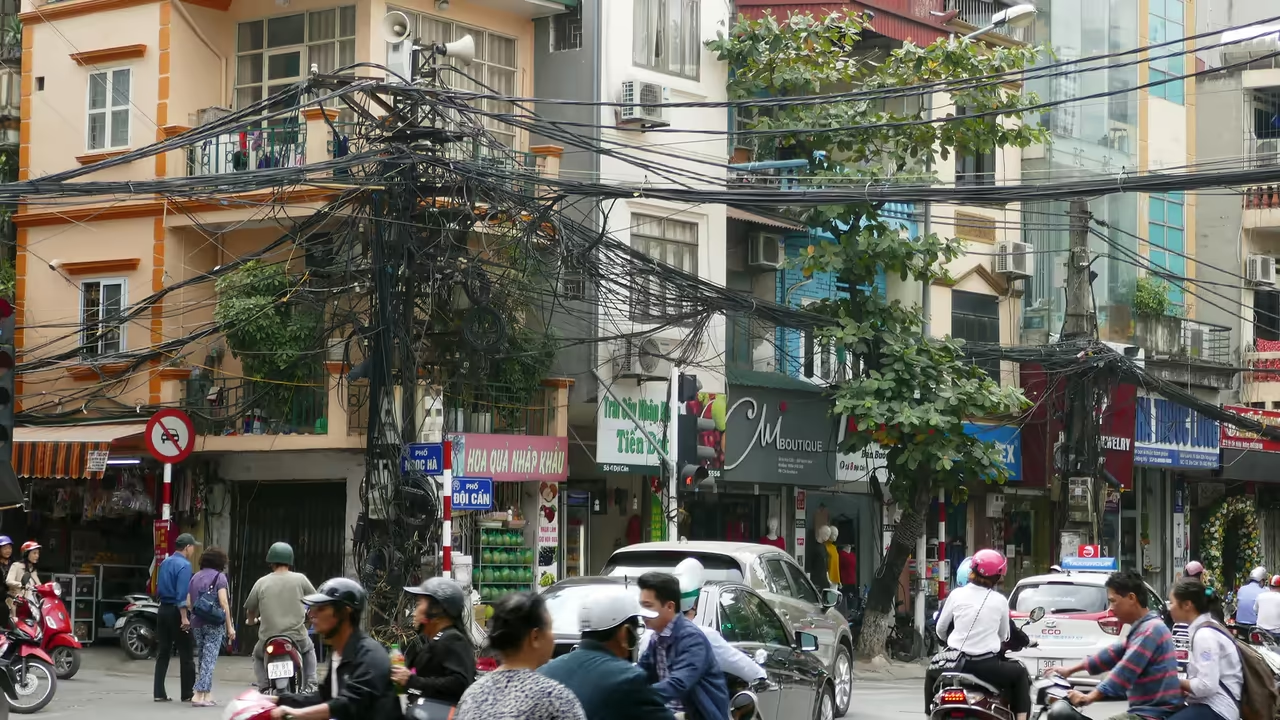
Vietnam’s sockets take the flat two-pin plugs of North America and the round two-pin plugs of Europe, and the power behind them runs at about 220 to 230 volts and 50 hertz. So a traveller from the United States can usually plug in a phone charger without an adapter, but should never plug in a 120-volt-only hair dryer. A traveller from the UK or Australia needs a plug adapter and nothing else, because the voltage matches. The one thing every traveller should bring is a power bank, and since 1 July 2026 it has to ride in your carry-on bag.
We are a Sapa trekking company, not an electrical retailer, so we checked every number below on 31 October 2026 against published sources and say which pages we could not open. Advice that comes from our own work is labelled as ours. For the Sapa end of the trip, our packing list for Sapa trekking and the homestay guide cover what to bring beyond cables.
Key Takeaways
- Vietnam uses 50 Hz and sockets that accept type A and type C plugs. WorldStandards (page updated 12 July 2025) gives 230 V; Wikipedia gives 220/380 V. A device labelled 100-240 V is safe either way.
- North Americans: two-pin plugs fit most sockets, but a 120 V-only device needs a voltage converter, and a plug with a round earth pin may not fit.
- UK, Irish and Australian travellers need a plug adapter only. German and French travellers can plug in directly, though earthed plugs lose their earth connection.
- From 1 July 2026, Vietnamese flights allow at most two power banks per passenger, in carry-on only, up to 100 Wh each, and no charging them in flight (Viet Nam News, 24 June 2026).
- In Sapa homestays, sockets are few and village power can flicker, so carry a charged power bank rather than relying on the wall.
The Short Answer, Country by Country
What you need depends on where your devices were made to run, not on how many gadgets you carry. The table uses the home mains figures from the WorldStandards country list (page updated 7 September 2025) and the Vietnam page of the same site (updated 12 July 2025). The “what to do” column is our reading of those figures, not a quotation.
| You are from | Your home mains | What to do in Vietnam |
|---|---|---|
| USA, Canada | 120 V, 60 Hz, plug types A and B | Two-pin type A plugs fit. A type B plug (round earth pin) fits only the earthed socket, which is not in every room. A device marked 120 V only needs a converter or should stay home. |
| UK, Ireland | 230 V, 50 Hz, type G | Plug adapter only. The voltage matches. |
| Australia, New Zealand | About 230 V (240 V in practice), 50 Hz, type I | Plug adapter only. |
| Germany, Netherlands | 230 V, 50 Hz, types C and F | Type C fits directly. A type F plug can be pushed into a hybrid socket, but then makes no earth contact. |
| France, Belgium | 230 V, 50 Hz, types C and E | Type C fits directly. Type E has the same earth caveat as F. |
The Wikipedia entry for Vietnam adds that type F plugs are “frequently plugged into hybrid sockets” and that this is “somewhat unsafe, as no earth contact is made.” If your device has a metal body and a three-pin charger, use an adapter that carries the earth connection, or accept that you are running it unearthed.
What Vietnam Actually Uses: Voltage, Frequency and Sockets
Vietnam supplies single-phase mains at about 220 to 230 volts and 50 hertz, through sockets that mostly accept type A and type C plugs. Sources differ on the exact voltage, which matters little: every modern phone and laptop charger copes with both.
WorldStandards says Vietnam runs at 230 V and 50 Hz, and states that “Vietnam’s electricity does not run at 120 volts.” Wikipedia’s table of mains by country gives 220/380 V, 50 Hz, and names the national standard TCVN 6188-1. A third site, WorldTradeRef, says 220 V. These are not rival measurements. The official nominal figure in Vietnam’s own system is 220 V, and 230 V is the harmonised label used internationally, with a tolerance around it. Circular 39/2015/TT-BCT of the Ministry of Industry and Trade, which we read as a copy on a legal-text site, sets 50 Hz as the nominal frequency, with a normal tolerance of ±0.2 Hz, and allows the voltage at a customer’s connection to swing by ±5% in normal operation.
The sockets are the part that actually confuses people. Our sources describe two kinds of socket and one habit, and you will meet all three.
Hybrid A + C socket
An unearthed outlet with slots that take both flat parallel pins (type A) and round pins (type C). WorldStandards says most outlets are hybrids of this kind.
Takes: A, C. No earth.
Earthed A + B + C socket
An outlet that also has an earth contact, so it takes a three-pin type B plug as well. WorldStandards says it is “not frequently installed in every location.”
Takes: A, B, C (and O).
The F and E squeeze
Type F and E plugs from continental Europe can be forced into a hybrid socket. Wikipedia warns that the earth contact is then missing.
Takes: yes, unearthed.
You will also see guides that say Vietnam uses type D or G. We could not confirm either in the standards sources we opened. A commercial site lists A, C and D, and neither it nor its look-alike domain is an official body. We kept those lists out of the table: a type D or G adapter will not hurt you, but you do not need to buy one for Vietnam.
One thing we could not check: the IEC’s own World Plugs page for Vietnam returned an access error, so we cannot tell you what the IEC lists.
How to Read Your Charger Label in 30 Seconds
The label on the back of a charger tells you whether it will survive Vietnam. Look for the word INPUT, then read the voltage and frequency range after it. A range such as 100-240 V and 50-60 Hz means the charger accepts mains anywhere in the world. A single figure such as 120 V means it does not.
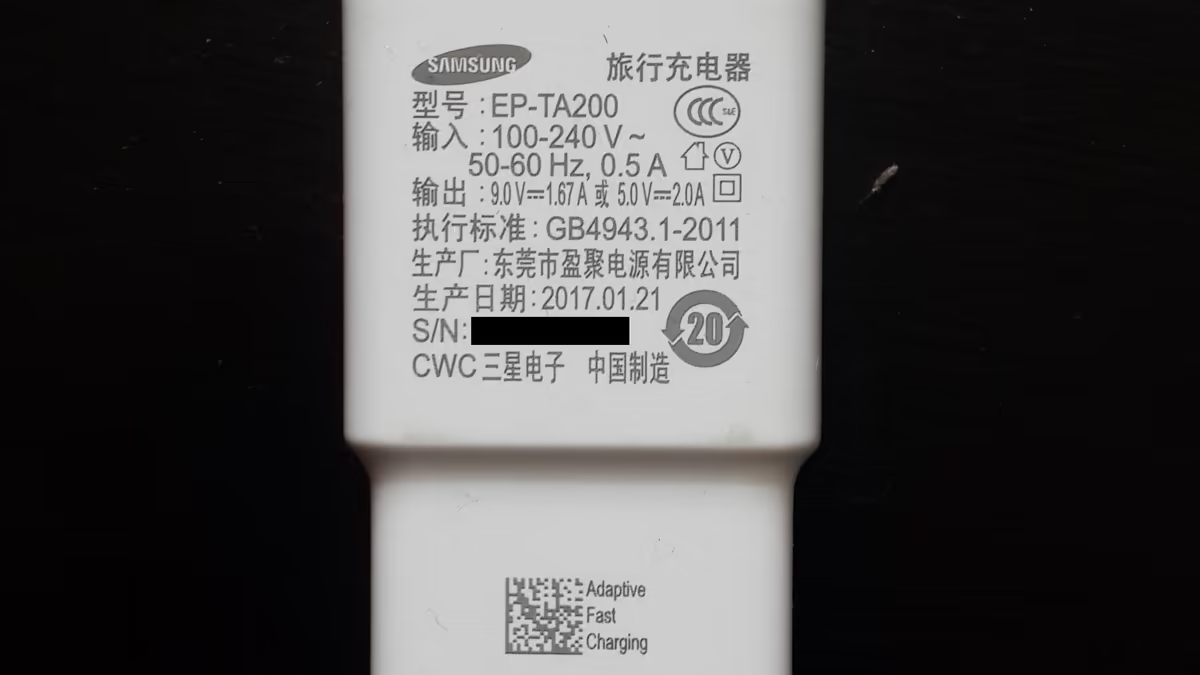
The charger in the photo shows the pattern: input 100-240 V, 50-60 Hz, 0.5 A, output 9 V at 1.67 A or 5 V at 2.0 A. That is a Chinese-market Samsung charger with flat pins, and it would run on Vietnamese mains with nothing more than a plug that fits the socket. The same three steps work for any device.
Find the INPUT line
It sits on the charger body or on the box on a laptop cable. Ignore the OUTPUT line: that is what the device receives, not what the wall delivers.
Check the voltage range
If the range includes 220 to 240 V (for example 100-240 V), the charger is safe in Vietnam. If it says a single value below 200 V, it is a single-voltage device.
Check the frequency
50-60 Hz covers Vietnam’s 50 Hz. A device marked 60 Hz only, usually something with a motor or a built-in clock, may run slowly or hot.
Match the plug, not the device
If the label passes and the plug does not fit, you need a plug adapter. If the label fails, a plug adapter will not help and can make things worse.
Step 4 matters because of arithmetic. A device built for 120 V and plugged into 230 V receives about 1.9 times its design voltage. That is our calculation, and it is why a plug adapter, which changes only the shape of the plug, is the wrong tool for a 120 V hair dryer: it makes the plug fit and protects nothing.
Device by Device: What Survives and What Does Not
Most things you pack are fine. The ones that are not fall into two groups: heat-making appliances and anything with a small motor and no multi-voltage label. The table covers what travellers actually carry.
| Device | Usually fine? | What to check |
|---|---|---|
| Phone and tablet chargers | Yes | Label says 100-240 V on almost every current charger. Only the plug shape changes. |
| Laptop chargers | Yes | The box on the cable carries the label. A three-pin laptop plug runs unearthed in a hybrid socket. |
| Hair dryers and straighteners | Often not | Many are built for the home market only. Look for a dual-voltage switch or a 100-240 V label. |
| Electric shavers and toothbrushes | Often yes | Many shaver supply units are marked 100-240 V. Confirm on yours. |
| CPAP and medical devices | Check yours | Read the label on the power supply and ask the maker or your clinic. We could not open manufacturer pages to quote them. |
We could not open any maker’s own advice on hair dryers, so read the label on the exact unit in your bag. If it has two voltage ranges and a switch, set the switch before you plug in. If it has one range, think twice. The same rule covers CPAP machines: read the label on the power supply, and confirm with the maker or your clinic before you fly.
Buying an Adapter: Price, Safety and Fakes
A plug adapter is a small, cheap object, and the cheap ones are where the risk sits. The main point first: buy one from a shop you can find again, with a visible fuse or shuttered sockets, and stop using it if it gets hot.
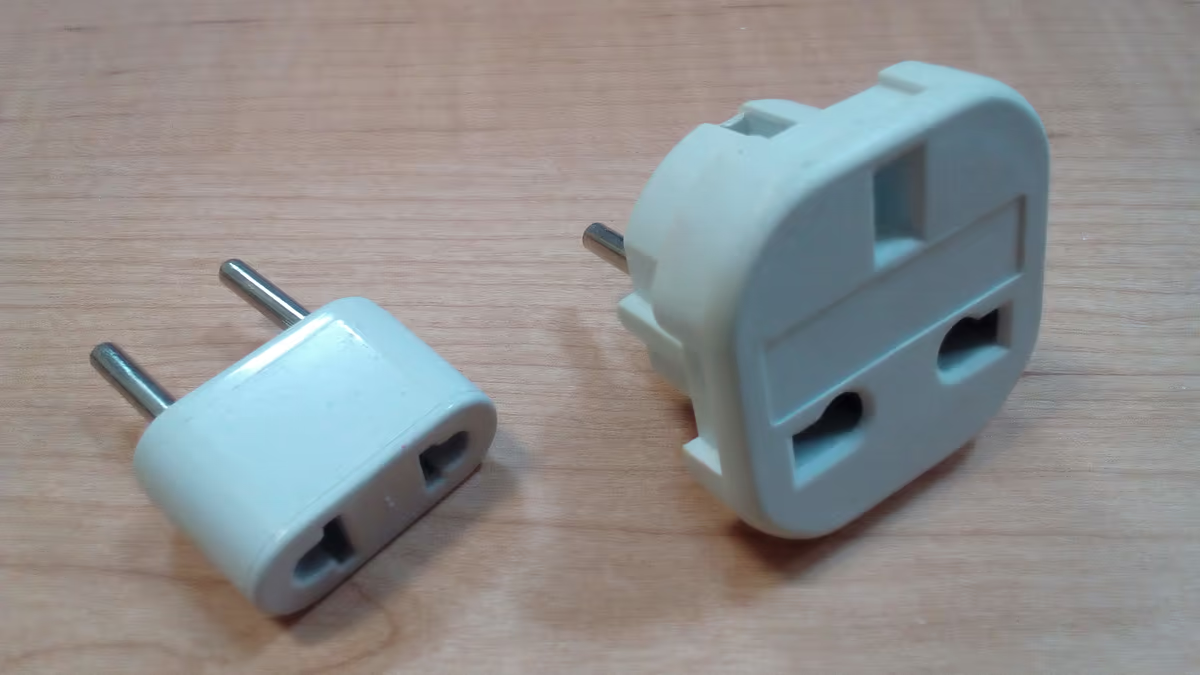
On price, we found one dated listing. On 31 October 2026 the chain Dien May Xanh listed a Dien Quang TV-01 travel adapter at 90,000 VND (marked down from 110,000) and a model with two USB ports and one USB-C port at 180,000 VND. Those are online chain prices, not Old Quarter stall or Sapa shop prices, and we found no sourced figure for those.
The safety evidence is from the UK, and it matters even if you buy in Vietnam. In a test reported on 29 July 2026, the charity Electrical Safety First bought 14 travel adaptors online and all 14 failed basic safety checks. In several universal models more than one set of pins could be live at once, exposing users to up to 240 V; some pins could snap off in a socket, some casings ignited or melted, and some models labelled “surge protection” had none. An earlier test, reported on 2 September 2025, found 15 dangerous models. The advice is simple: buy from a reputable retailer, look for a visible fuse and socket shutters, and stop using any adaptor that gets hot.
On fake chargers, the best figure we found is old: a 2016 UL study, reported by MacTrast, found that only three of 400 counterfeit Apple chargers bought online had enough insulation. Use it as a reason to buy chargers from the phone maker or a recognised shop, not as a current failure rate.
Power Banks and Flights: The 1 July 2026 Rules
Since 1 July 2026, each passenger on a Vietnamese flight may carry at most two power banks, only in carry-on baggage, and may not charge them or use them to charge other devices in flight. This is the rule that changed most recently, and it applies to the trip that matters most to a trekker: the flight to Hanoi, Da Nang or Saigon, and the domestic flight after it.
Three outlets reported the rule on 24 and 25 June 2026: Viet Nam News, VietnamPlus and Tuoi Tre. They agree on the points below. They describe a directive of the Civil Aviation Authority of Vietnam that follows guidance from the ICAO, and none of them gives a circular number we could cite.
- Number: a maximum of two power banks per passenger.
- Size: lithium-ion up to 100 Wh is allowed; 100 to 160 Wh needs the airline’s prior approval; lithium metal is limited to 2 g of lithium.
- Where: carry-on baggage only, never in a checked bag.
- In the air: no recharging the power bank, and no using it to charge a phone or laptop.
- Display: units must be taken out of the bag and kept in a visible place for the whole flight; VietnamPlus adds that each unit must be protected against short circuit with its original packaging, tape over the terminals or a separate pouch.
The ICAO adopted new restrictions on 27 March 2026 that match the same pattern, according to the Centre for Aviation (30 March 2026): two power banks per passenger and no charging in flight. We tried to read the ICAO document itself and could not extract its text, so we rely on the aviation-industry report for that date.
The earlier rules were different, and old guides still quote them. In March 2025 Vietnam Airlines told passengers to keep power banks visible and not use them in flight, and its notice, as reported by Tuoi Tre on 26 March 2025, allowed up to 20 units under 100 Wh. The 2026 limit of two replaces that figure. Airlines can set stricter rules, so check your carrier before you leave.
If your power bank shows only milliamp-hours, multiply by the cell voltage and divide by 1,000. A typical lithium bank has 3.7 V cells, so 10,000 mAh is about 37 Wh and 20,000 mAh is about 74 Wh. A bank near 27,000 mAh sits at about 100 Wh. This is our arithmetic, not an official table, so look for the Wh figure printed on the bank first.
Power Cuts: What Happened in 2023 and What 2026 Looks Like
Vietnam has had one major run of power cuts in recent years, in northern Vietnam in May and June 2023, and EVN, the national utility, reported no load-shedding in the first half of 2026. For a visitor, the realistic risk is a short local cut after a storm, not rolling blackouts.
- May to June 2023Widespread unannounced cuts mainly in the north. The Investor reported (23 October 2023) that EVN estimated a shortfall of 1,600 to 4,900 MW in May and June, and that the World Bank put the cost at about 1.4 billion US dollars, or 0.3% of GDP. A government probe, reported by Viet Nam News on 13 July 2023, blamed slow investment in generation and grids, turbine problems that left about 2,100 MW ungenerated, drought-lowered reservoirs and a dry-season protocol that was not followed.
- 8 June 2023A 110 kV breaker tripped at the Lao Cai substation at 19:36, probably from lightning, and cut power at three substations including Sapa. Power returned by 20:07, according to Bao Lao Cai: about 31 minutes.
- 12 to 14 September 2023A storm and landslides broke seven low-voltage poles and 70 metres of cable in Sapa town. Bao Lao Cai reported power restored to the whole of Sapa town by 11:30 on 14 September.
- First half of 2026EVN’s report of 7 July 2026 says there was no load-shedding, and that national peak demand reached 57,537 MW on 25 June 2026.
We found nothing reliable about outages in the north in 2024 or 2025, and no 2026 outage report for Hanoi or Sapa, so we have written nothing about those years. In practice, a cut of half an hour after a lightning strike is part of life in a mountain town. It is no reason to cancel a trip, and a good reason to charge your phone and torch while the power is on.
Charging in Sapa, on the Trail and in a Homestay
In Sapa town you will find sockets in hotels and in most cafes. In the villages of the Muong Hoa Valley you should assume a homestay has a few sockets in the main room and none beside your mattress. Sourced facts are thin here, so we label our own advice.

Our homestay guide says what we tell every guest: village electricity can flicker, the path to the bathroom is unlit, and there is rarely a socket next to your mattress, so bring a head-torch and a power bank. We found no independent source on wifi or charging points in Ta Van, Lao Chai or Hau Thao, and operator listings disagreed. Our SIM and eSIM guide covers the signal side and makes the same point: homestays range from no wifi to a usable connection in the main room, so ask when you book.
On the trail, battery life is a weather problem. A phone kept in an inside pocket lasts longer than one in a daypack in the cold and damp, as our Sapa packing list also says. That is our observation, not a laboratory figure. The light over the Muong Hoa Valley between 9 and 11 in the morning is the reason to start the day with a full battery.
Sapa Treks With a Homestay Night
 1-Day Trek
Trekking Through Rice Terraced Fields
Lao Chai to Ta Van with lunch at a family restaurant in Y Linh Ho.
 Homestay
Rice Terraced Fields & Homestay
Dinner and breakfast with a family in Ta Van, lunch on day one.
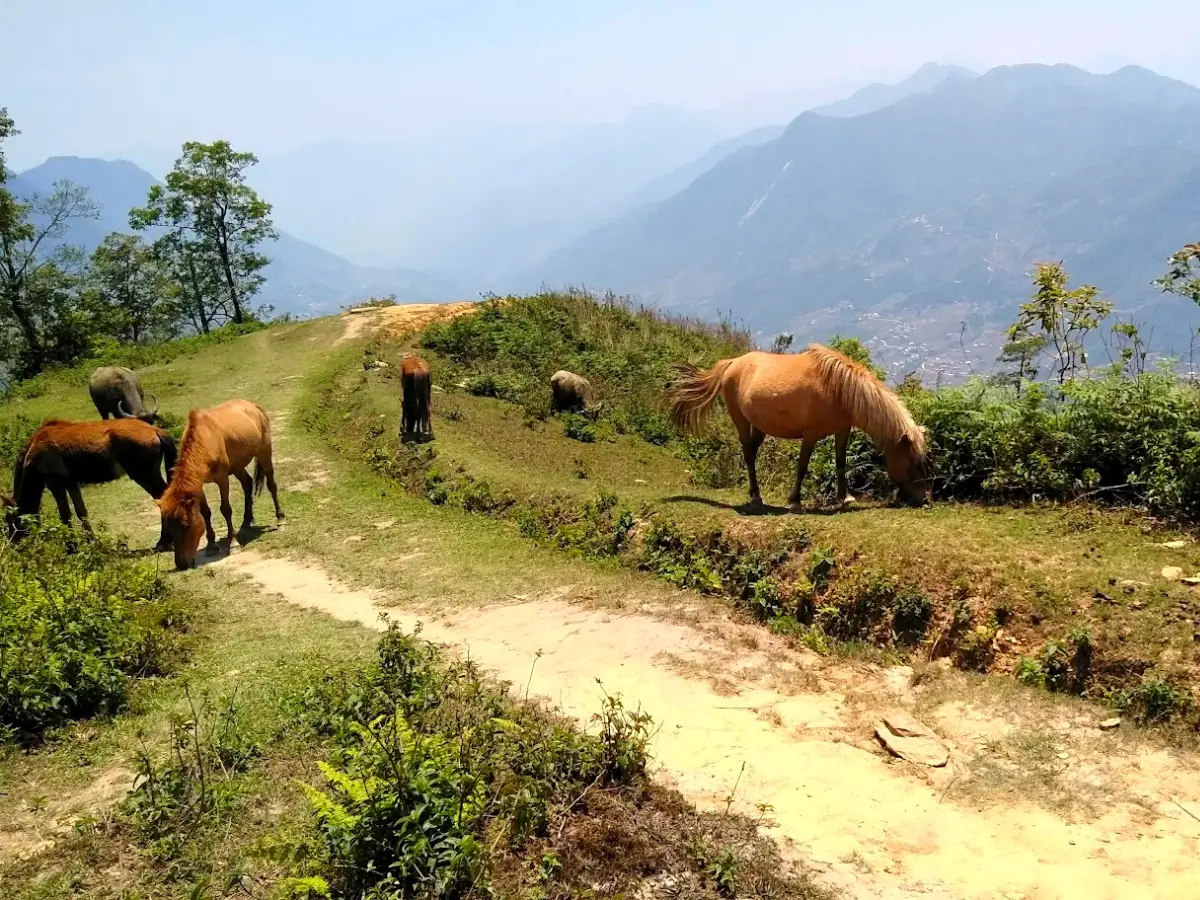 Local Favourite
Mountain Views and Villages Trek
Lunch at a restaurant run by local people in Hang Da village.
If you work remotely from Sapa town, the picture is better. Our remote-work cafe guide names the cafes that have outlets at most seats and tells you to arrive before 10 in the morning, before the day-tour groups claim them. It also says Vietnam uses type A and type C sockets, which agrees with what we found for this guide.
Charging on Sleeper Buses and Trains
Charging ports on Vietnamese buses and trains are common and unreliable, and the answer is to bring a cable for both USB-A and USB-C and a charged power bank. We found no operator that publishes a guarantee, only mixed reviews.
On sleeper buses, the mixed reports come from reviews in search results that we could not open: one said the USB-C port on a Hanoi to Sapa coach did not work but USB-A did, another said only USB-A was fitted, and one operator advertised both. We read that as variety, not as a verdict on any company. Our sleeper bus guide covers how those buses work, and the Hanoi to Sapa timetable lists departures. On the overnight train, a listing said Chapa Express cabins have outlets while one reviewer said the ports did not work on their trip; see our Chapa Express review and King Express review. We found nothing about outlets on the King Express.
A Packing List for Power
Six items cover almost every trip. Pack them in one small pouch so you can find them at 4 in the morning, when a night bus tends to arrive.
One fused plug adapter
Bought at home from a retailer you can name, matched to your home plug.
One power bank under 100 Wh
Wh figure printed on it, in your carry-on, terminals covered. A second bank is allowed; a third is not.
Short cables for both USB types
USB-A to USB-C and USB-C to USB-C, about 30 cm, so nothing tangles in a bus bunk.
A multi-port wall charger
One 100-240 V charger with two or three USB ports beats three chargers on one adapter.
A head-torch and a waterproof pouch
The torch keeps your hands free on an unlit homestay path; the pouch keeps charger, bank and cables dry.
Dual-voltage appliances only
Hair dryer, shaver, travel iron: label 100-240 V, or leave it at home.
If you are planning the wider trip, Vietnam for first-time visitors covers the rest of the logistics, and the weather by month and Sapa weather by month pages help you decide what to wear while the batteries charge.
Sources and the Dates We Checked Them
We read these pages on 31 October 2026. Pages we could not open are named in the text; we did not use their facts. The sources are in the order they first appear.
- WorldStandards, Vietnam plugs and voltage, page updated 12 July 2025.
- WorldStandards, plugs and voltage by country, updated 7 September 2025.
- Wikipedia, Mains electricity by country, undated; a secondary source.
- Circular 39/2015/TT-BCT, Article 4, frequency, a copy on hethongphapluat.com; circular of 2015.
- Viet Nam News, power banks must be kept in carry-ons, 24 June 2026.
- VietnamPlus, power banks in carry-on bags from July, 24 June 2026.
- Tuoi Tre, removal of power banks from carry-on bags, 25 June 2026.
- Tuoi Tre, Vietnamese airlines ban power bank usage, 26 March 2025.
- Centre for Aviation, ICAO adopts new restrictions on power banks, 30 March 2026.
- The Investor, EVN leaders face heat for power shortages, 23 October 2023.
- Viet Nam News, EVN’s breaches behind power cuts in the north, 13 July 2023.
- EVN, reliable power supply in the first half of 2026, 7 July 2026.
- Bao Lao Cai, outage fixed after the Lao Cai substation fault, 8 June 2023.
- Bao Lao Cai, Sapa power restored after the floods, 15 September 2023.
- Euro Weekly News, travel adaptors and fire risk, 29 July 2026.
- Business Companion, dangerous travel adaptors sold online, 2 September 2025.
- MacTrast, fake Apple chargers study, December 2016.
- Dien May Xanh, plug and socket category, prices as shown on 31 October 2026; the page shows no date.
The Part We Do Sell
- Hanoi to Sapa transport — sleeper buses, limousines and the overnight train, bookable with your trek
- Hanoi to Sapa guide — what each option costs and how long it takes
- How to get to Sapa — the first leg, in detail
Rent at Our Office Before You Trek
 Gear Rental
Trekking Boots Rental
Waterproof ankle-support boots. Cleaned and checked before each rental. Available at 105 Thach Son Street.
 Gear Rental
Walking Poles Rental
Trekking poles available to rent at $2/day at our office, 105 Thach Son Street. Essential for descents.
Frequently Asked Questions
Vietnam uses about 220 to 230 volts at 50 Hz. WorldStandards (updated 12 July 2025) says 230 V and plug types A, B and C, and Wikipedia says 220/380 V. Most outlets are hybrid sockets that accept both flat two-pin type A and round two-pin type C plugs.
Often not for two-pin plugs, because type A fits the common hybrid socket. A three-pin type B plug fits only the earthed socket, which is not installed everywhere, so we suggest one small adapter. Voltage is the bigger issue: a device marked 120 V only needs a converter.
Only for devices that are not multi-voltage. Look at the INPUT line on the charger. If it reads 100-240 V, you need only a plug that fits. If it reads a single value such as 120 V, the device receives about 1.9 times its design voltage on Vietnamese mains, which is our arithmetic.
Yes, in carry-on only. From 1 July 2026, Viet Nam News, VietnamPlus and Tuoi Tre reported a limit of two power banks per passenger, up to 100 Wh each (100 to 160 Wh with airline approval), no charging them in flight and no using them to charge other devices. Check your airline for stricter rules.
Not in 2026. The big run of cuts was in northern Vietnam in May and June 2023, and EVN reported no load-shedding in the first half of 2026. Local cuts after storms still happen: Sapa town lost power after storm damage on 12 to 14 September 2023 and had it back by 11:30 on 14 September.
Usually yes, but there are few sockets and rarely one beside the mattress. Village electricity can flicker, and we found no independent source on charging points. Charge everything at your hotel the evening before, and bring a power bank and a head-torch.
Be careful. In a test reported on 29 July 2026, Electrical Safety First bought 14 travel adaptors online and all 14 failed basic safety checks, including live pins and fake surge protection. Buy from a retailer you can find again, look for a fuse and socket shutters, and stop using one that gets hot.
Often, but not reliably. Reviews we saw in search results report USB-A ports that work and USB-C ports that do not, and one reviewer on the Chapa Express said the charging ports did not work. Carry a charged power bank and cables for both USB types.