
 Sinh Giang
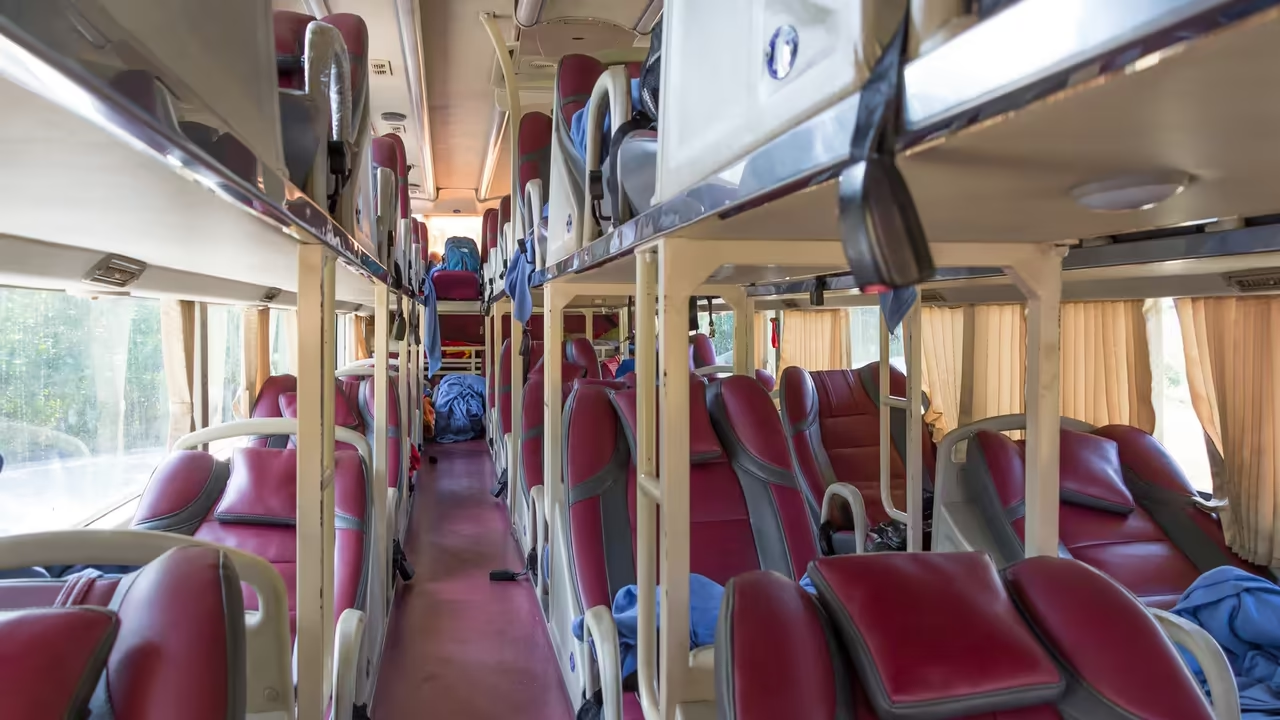
A Vietnamese sleeper bus is a double-deck coach with reclining berths instead of seats, built for overnight and long-haul trips: about 5 to 6 hours from Hanoi to Sapa, and 12 to 14 hours from Hanoi to Hue. You take your shoes off at the door, lie back in a bunk and usually find no toilet on board. It is the cheapest way to cover distance and a hotel night in one go, and it carries real risks that you should weigh before you book. Government advice says bus crashes are more likely at night, and two fatal sleeper-bus crashes in July 2026 prompted new official reviews.
We are a Sapa trekking company and we sell Hanoi to Sapa sleeper bus tickets on our Transport page, so weigh our views accordingly. This guide covers the whole country, and we kept the Sapa details short because our Hanoi to Sapa timetable has them. We checked every source on 31 October 2026. Some of the best price figures come from commercial booking sites, and we say so each time.
Key Takeaways
- Standard sleeper buses carry about 36 to 44 beds; VIP cabin buses carry about 22 to 24. Standard bunks are about 50 to 60 cm wide, and cabins about 60 to 70 cm (vietnamtourism.com, a commercial site, updated October 2026).
- Dated fares from October 2026: Hanoi to Sapa sleeper from VND 240,000, Da Lat to Saigon sleeper from VND 410,000, Hue to Hanoi standard berth VND 350,000 to 500,000.
- Most buses have no toilet. Stops come every 2 to 3 hours for 15 to 20 minutes, and you carry your own toilet paper.
- The UK government (advice updated 21 September 2026) says bus and coach crashes are “not uncommon” and more likely at night.
- For Sapa, the sleeper bus drops you in town, while the night train stops at Lao Cai and adds about 50 minutes by road.
What a Sleeper Bus Is and the Three Kinds
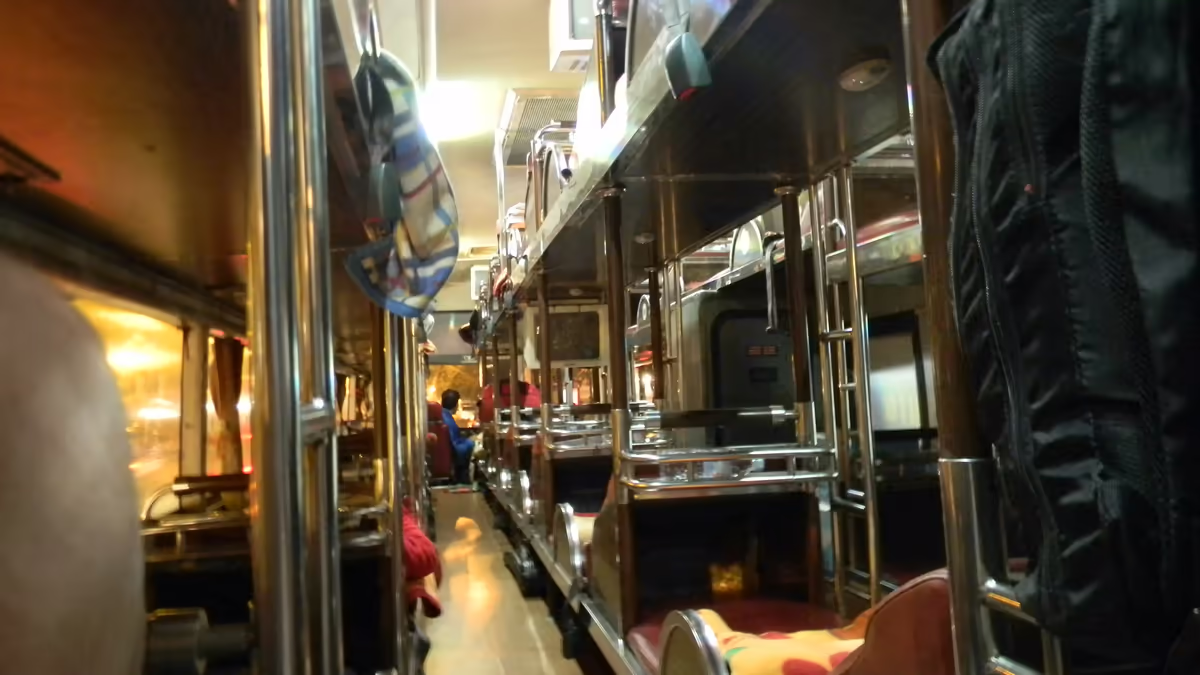
A sleeper bus has rows of reclining berths on a lower and an upper deck, two or three rows wide, with a narrow aisle. Travel writers describe the layout as “rows of two or three reclining seats, and these are on upper and lower levels like bunk beds.” The berth length is the number that matters: standard bunks suit people up to about 175 to 180 cm, and cabins run 180 to 190 cm long.
Standard sleeper
36 to 44 open berths on two decks, in rows of two or three. Bunks about 50 to 60 cm wide. Shared space, thin blanket and pillow.
Best for: budget trips and short overnights.
VIP cabin bus
22 to 24 passengers in single or double cabins about 12 m long. Single cabins roughly 60 to 70 cm wide, double cabins 100 to 110 cm. Some have a small chemical toilet at the rear.
Best for: solo travellers and couples.
Limousine van
9 to 28 leather reclining seats, not berths. Common on Hanoi to Ninh Binh and Nha Trang to Da Lat. Often hotel pick-up.
Best for: day trips under about 5 hours.
The sizes come from one commercial site, vietnamtourism.com, whose pages carry an affiliate disclosure and name 12Go as a ticketing partner, despite the national-sounding domain. Baolau, a booking site, gives a similar range: “double-deck coaches equipped with fixed berths and capacity for 30 to 40 passengers.” Route listings on 12Go-based pages also name models such as “Sleeper 41”, “Sleeper 44”, “Royal Cabin 22” and “Limousine Sleeper 32”, so berth counts vary by operator.
We looked for an enacted rule on bed size and could not find one. A Ministry of Transport draft circular of November 2023 proposed a gap of at least 1,650 mm between beds, a mattress at least 480 mm wide and 75 mm thick, an aisle of at least 400 mm, one person per bed, no more than two tiers and a seat belt for every bed. We do not know whether the draft was adopted, so read those figures as a proposal, not as the rule today.
A Night on the Bus, Step by Step
Almost every sleeper bus follows the same routine. The order below comes from travel writers, a regional guide and our own transport page, and it is the same whether you ride from Hanoi or Saigon.
Shoes off at the door
An attendant tells you to remove your shoes and hands you a plastic bag. Some buses give slippers, most do not.
Find your bunk
Your ticket shows a bunk number, though first-come choice happens on some buses. Upper bunks are tighter because the ceiling curves in.
Settle in
A thin blanket and a small pillow are usual, though quality varies and one travel writer notes that they are not guaranteed.
Rest stops
Long routes stop every 2 to 3 hours for 15 to 20 minutes at roadside stations with squat toilets and basic snacks. Toilet paper is rarely provided.
Arrival
The bus may stop at an office, a street corner or a petrol station instead of a station. Add 1 to 2 hours to any estimated time.
Toilets are where sources disagree, which is itself useful. One site says most standard and VIP sleeper buses have no toilet. Another says most VIP cabin buses have a small chemical toilet at the rear, and describes it as loud. A travel writer says toilets are “sometimes” on board “but they often don’t.” Our own Hanoi to Sapa overnight bus has no toilet stop, according to the notes on our Transport page, so we tell guests to use the facilities before boarding. Ask your operator before you pay.
Main Routes, Times and Dated Fares
Fares move with season and booking site, and most pages that quote them say so. The figures below are from named pages we opened on 31 October 2026, with each page’s own check date. Treat them as a way to compare routes, not as a quote.
| Route and time | Fare example | Source and date |
|---|---|---|
| Hanoi to Sapa, 5 to 6.5 h | Sleeper from VND 240,000; cabin from VND 390,000; limousine van VND 350,000 | vietnamtourism.com, checked 24 October 2026 |
| Hanoi to Ninh Binh by van, about 3 h | $17.70 to $19; the page lists only vans, no berths | goasia.cc (12Go data), updated 8 March 2026 |
| Hue to Hanoi, 12 to 14 h | Standard berth VND 350,000 to 500,000; VIP VND 550,000 to 900,000 | vietnamtourism.com, 25 September 2026 |
| Hanoi to Da Nang | None found for a sleeper bus; train VND 380,000 to 2,077,000 in 15 to 17 h | goasia.cc, updated 19 October 2026 |
| Hue to Hoi An, 2 to 4.5 h | $8 to $21 for a coach seat; $13 to $57 for a van seat | goasia.cc, updated 8 March 2026 |
| Da Nang to Nha Trang, 10 to 14.5 h | $30.73 to $38.94; FUTA about VND 430,000 | goasia.cc, updated 29 October 2026 |
| Nha Trang to Da Lat, 3.5 h | $12.44 to $13.80; all vans, no berths | goasia.cc, updated 29 October 2026 |
| Da Lat to Saigon, 6 to 8 h | Sleeper from VND 410,000; cabin from VND 420,000; limousine van from VND 480,000 | vietnamtourism.com, checked 24 October 2026 |
| Saigon to Mui Ne, 3 to 4.5 h | $9.58 to $16.05 | goasia.cc, updated 16 October 2026 |
| Saigon to Phnom Penh, about 5 to 8 h | $23.51 to $37.18; border crossing at Moc Bai | goasia.cc, updated 8 March 2026 |
Three notes on the table. First, Hanoi to Da Nang by sleeper bus has a gap: the only dated sources we found list the train and the plane. Second, several routes in the middle of the country are run by limousine vans rather than sleepers, so a booking page may offer a seat where you expected a bunk. Third, the Saigon to Phnom Penh listing says passengers get off with their luggage at the border for immigration, and that the border is not open 24 hours, so a night crossing is not a given.
On our own route, our Transport page lists a standard sleeper bus from Hanoi to Sapa from $17 per person one way for a trip of about 6 hours, a single cabin at $22 and a twin cabin at $42 (prices as listed on 31 October 2026). Those are US dollar prices from our own booking page, and the dong prices above are from a different site, so do not read the gap between them as a discount.
Sleeper Bus, Train or Plane
The sleeper bus wins on price and on routes the train does not serve. It loses on safety margin at night, and on sleep quality compared with a private train berth. The comparison below uses the Hanoi to Hue and Hanoi to Sapa corridors, because they are the ones guests ask us about.
| Trip | Sleeper bus | Train | Plane |
|---|---|---|---|
| Hanoi to Hue | 12 to 14 h; $15 to $30 | 12 to 14 h; soft sleeper VND 1,139,000 to 1,218,000 (seat61, June 2026) | About 1 h; $50 to $100 |
| Hanoi to Sapa | Direct to Sapa; from VND 240,000 | To Lao Cai, then about 50 min by road; VND 440,000 to 460,000 in a four-berth soft sleeper (seat61) | No airport in Sapa |
The Hanoi to Hue bus and flight figures come from a Vietnam Airlines guide with no date, and an airline is not a neutral source, so use them for the rough scale only. Seat61, a rail-travel site last updated on 10 June 2026, gives the train fares. For Sapa, the train numbers conflict between 2026 sources, so check a live timetable; see our Chapa Express review and King Express review for the private carriages. Our guide to getting to Sapa walks through all four ways.
Sapa Treks to Stretch Your Legs
 1-Day Trek
Trekking Through Rice Terraced Fields
Lao Chai to Ta Van with lunch at a family restaurant in Y Linh Ho.
 Homestay
Rice Terraced Fields & Homestay
Dinner and breakfast with a family in Ta Van, lunch on day one.
 Local Favourite
Mountain Views and Villages Trek
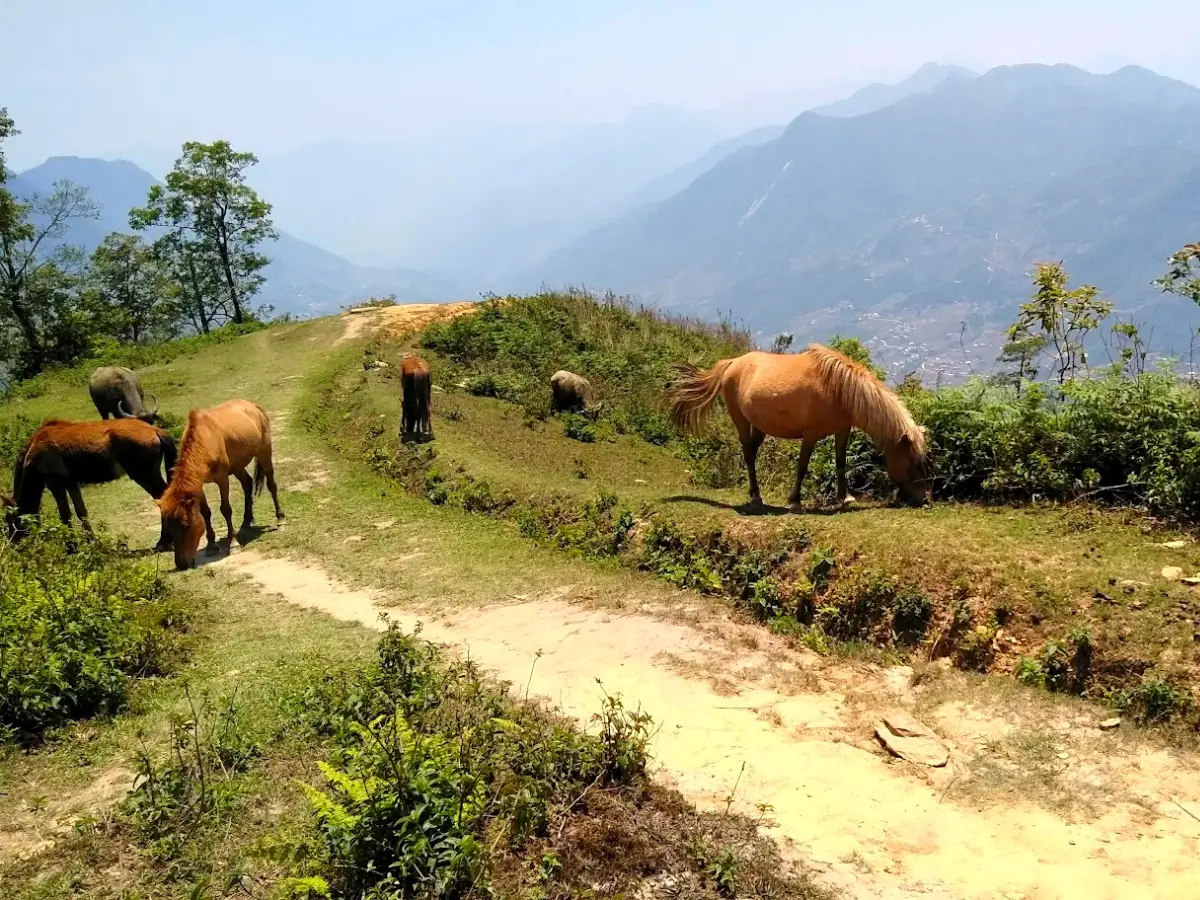
Lunch at a restaurant run by local people in Hang Da village.
How to Book and What to Check
You can book on an aggregator, with the operator, through your hotel or at the station. Online booking is easiest, and the thing to check first is the pick-up point, because it is often not the bus station.
- Vexere: a Vietnamese platform that, according to a commercial guide updated 21 October 2026, works with “over 500 operators” on about 3,000 daily routes, in Vietnamese and English. It accepts Visa and Mastercard and local methods, though foreign cards sometimes fail. The e-ticket shows the operator, a contact number, the pick-up point and a booking code.
- Baolau: its blog says reservations are open three months ahead and that the e-ticket PDF arrives within 24 hours of payment. It accepts the main cards plus Google Pay, Apple Pay and Alipay.
- 12Go Asia: a large aggregator. We could not read its booking pages, so we have not checked its payment or cancellation rules.
- Operators such as FUTA (Phuong Trang), Hoang Long and Sinh Tourist: we could not open their own sites, so we have no first-hand booking facts. FUTA appears as an operator on two route listings in the table above.
- Hotels and agents: a regional guide last updated on 2 January 2025 says you can book through a hotel or at the station, and that you should book well ahead for Tet.
Three checks save trouble. Read the pick-up address on a map, because a commercial guide warns that pick-up points can be “small offices, street corners, or gas stations.” Confirm what type of vehicle you are buying, because a limousine van, a cabin bus and a sleeper bus share a booking page. And read the cancellation terms yourself, because we found no operator that states them on a page we could open. For our own tickets, a full refund applies if you cancel at least 48 hours before departure, minus $2 per person, as stated on the Transport page.
Open tickets, which let you hop on and off along a route such as Hanoi to Saigon, are sold by Sinh Tourist and others. We found only secondary mentions, no operator page we could open, and one guide suggesting they are sold less often today, so we do not describe their terms. If you want one, read the operator’s own conditions first.
Safety: What the Sources Say
Sleeper buses are statistically risky at night, and 2026 brought new official scrutiny. We could not find national crash figures from an official source, so we do not quote a rate. What we can do is give the dated incidents and the government’s responses.
- 25 July 2025, Ha TinhAl Jazeera reported on 26 July that an overnight sleeper bus from Hanoi toward Da Nang left a national highway, struck roadside markers and overturned. It reported ten dead, including two children, and twelve people in hospital. A Vietnam News headline said nine killed and 16 injured, so reports differ on the toll.
- 21 July 2026, Dong NaiVietnam News reported that a sleeper coach from Khanh Hoa to Ho Chi Minh City hit a guardrail and burned at about 2 a.m. on National Highway 1. Seven people died. Police gave driver drowsiness and loss of concentration as the initial cause, and the driver tested negative for drugs and alcohol. AP reported the same toll the same day.
- 21 July 2026, government responseVOV reported that the Prime Minister issued Official Dispatch No. 51. The Ministry of Construction asked the Road Administration, Vietnam Register and local authorities to tighten oversight of night-running buses, and Vietnam Register was reviewing technical safety standards for sleeper buses, including emergency escape and passenger protection.
- 29 July 2026, HanoiDan Tri reported that the Hanoi Department of Construction ordered more checks on night buses and heavy trucks and said vehicles failing standards must not be put into service.
A French-language news site also reported a crash on the Hanoi expressway on 17 July 2026 with four dead. We read that only as a secondary summary and do not rely on it. The same article says a 2025 traffic law caps professional drivers at 4 hours of continuous driving, 10 hours a day and 48 hours a week. We did not open the law itself, so check it before quoting it.
There is also a public argument about banning sleeper buses. A Tuoi Tre opinion piece of 10 August 2025 argued against a ban, saying every sleeper bus has GPS and that enforcement is the answer. It is an opinion, not a regulation, and we found no confirmed national ban on registering new sleeper buses. Ho Chi Minh City has barred sleeper buses from its centre since 10 January 2023, according to a Dan Tri headline we saw in search results, which affects where you are picked up.
The Foreign Office travel advice for Vietnam, updated 21 September 2026, says bus and coach crashes are “not uncommon” and more likely at night, that vehicles are often poorly maintained and night drivers may be tired. It also warns of petty theft on buses and trains. Australia’s Smartraveller page timed out four times when we tried it, and the US State Department page returned an error, so we have not quoted either.
Our own view, which is an opinion and not a source: the daytime bus is a reasonable choice when the road is the point, and the overnight sleeper is a trade of safety margin for a hotel night. Choose an operator with many recent reviews, sit in a bunk with a working belt where one exists, and keep your valuables on you while you sleep.
Comfort, Motion Sickness and Tall Travellers
Mountain roads and a lying position make some people ill, and tall passengers do not fit every bunk. The advice below is general, from health agencies and travel writers.
The US CDC, in a page last reviewed 28 January 2022, says to sit in the front of a bus, to lie down or look at the horizon, and notes that common anti-nausea medicines, such as diphenhydramine and scopolamine, often cause drowsiness. The UK NHS page, last reviewed 19 June 2023, says to avoid heavy meals, spicy food and alcohol before travel, that ginger may help, and that pharmacies sell tablets, patches and acupressure bands. A commercial guide advises taking medication before boarding for the Hanoi to Ha Giang mountain road. On a sleeper bus you cannot sit at the front, so we suggest a lower bunk near the middle and a light dinner.
Tall travellers should plan on a cabin. Two commercial sources put the point of discomfort at 175 cm and 180 cm, and cabin length at 180 to 190 cm, so the sources do not agree to the centimetre. If you are over 185 cm, expect your feet to reach the end of a standard bunk.
On solo women, we found no sleeper-bus-specific advice from an official source. A travel blog says solo travellers need no more caution than anywhere else, and guides in search results suggest a lower bunk, keeping valuables on your body and using a reputable operator. Seat allocation can be first-come or by an attendant, so you may not choose your neighbour.
Pick-ups, Drop-offs and Night Arrivals
The bus rarely arrives where you expect and rarely on time. Vexere’s guide warns that drop-offs and pick-ups can be at small offices, street corners or petrol stations, and a commercial guide tells travellers to add 1 to 2 hours to any estimated time. Our Transport page lists the Hanoi departure for its bus at 5 Tran Nguyen Han Street in the French Quarter, and a departure schedule of 06:00, 07:30, 12:30, 21:00 and 22:00. A dawn arrival is therefore likely on night departures. We found no source that states a typical arrival hour, so that part is our inference.
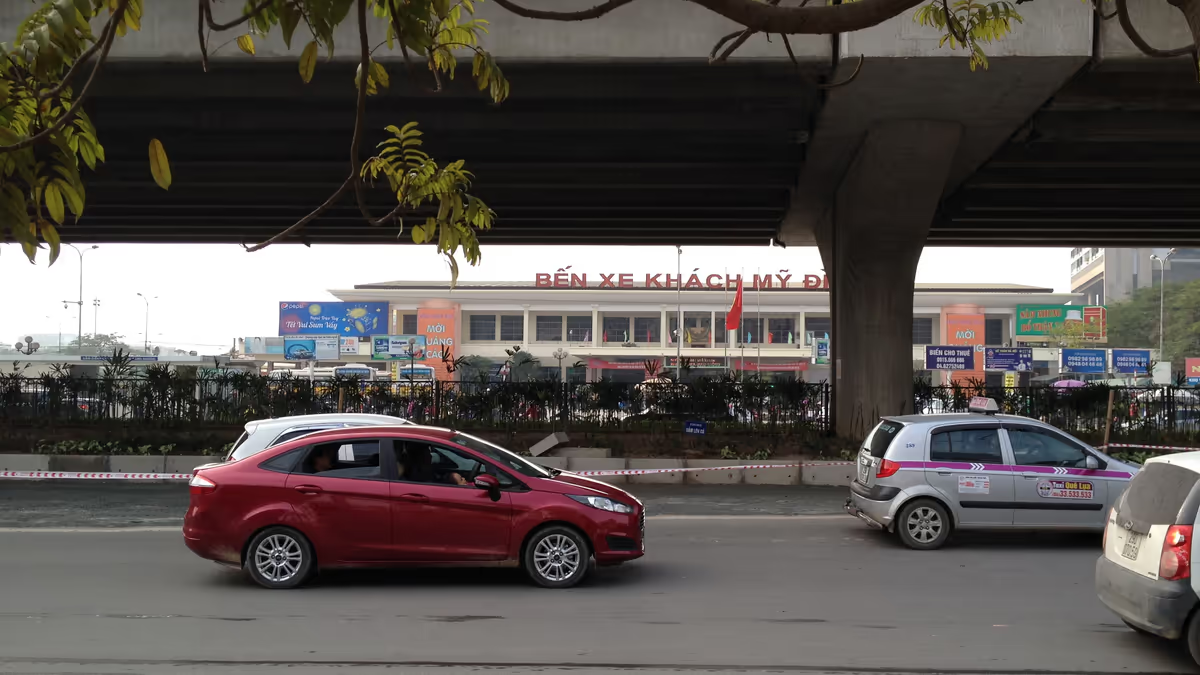
If you arrive in the dark, book a hotel that accepts early check-in or lets you wait in the lobby, and keep a screenshot of the address in Vietnamese. One regional guide suggests staying near a major bus station before an early departure or after a late arrival.
Taking the Sleeper Bus to Sapa
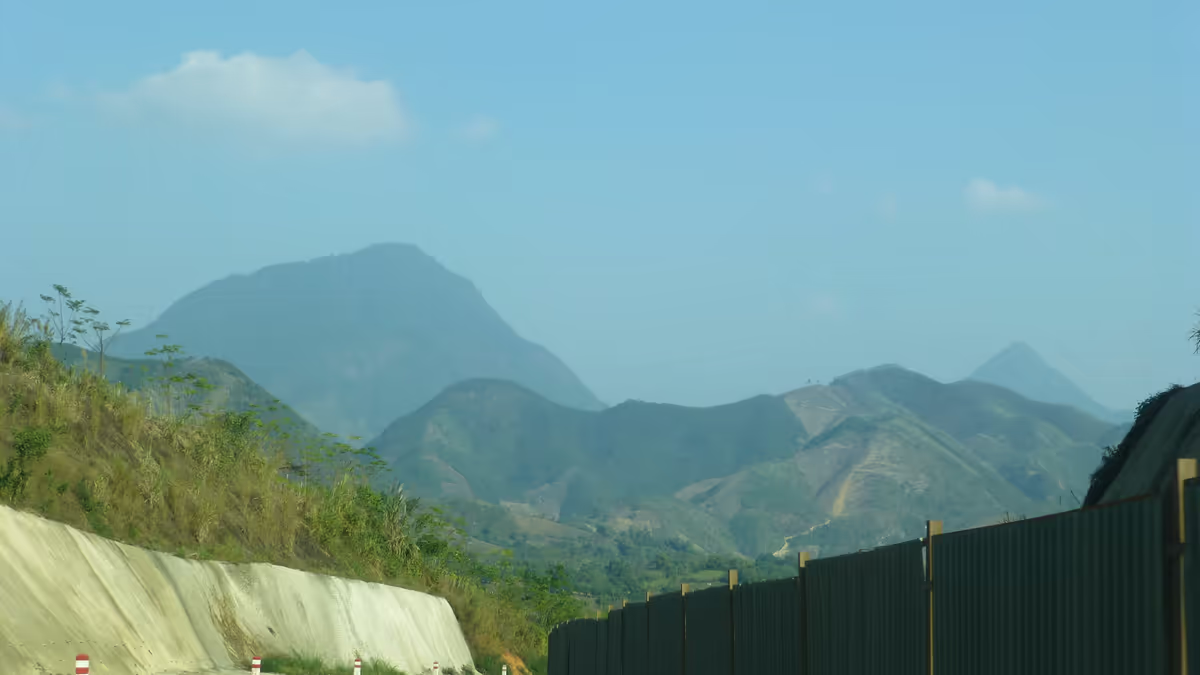
Of the overnight options, the sleeper bus is the one that drops you in Sapa town without a transfer. The overnight train stops at Lao Cai, 38 km from Sapa, and needs about 50 minutes more by shuttle or taxi. Our Transport page puts the sleeper bus at about 6 hours. A limousine van is faster by day and has no overnight option.
Our Transport page lists departures from Hanoi at 06:00, 07:30, 12:30, 21:00 and 22:00, and from Sapa at 07:30, 13:30, 16:00, 18:00 and 22:00. It also says the overnight bus has no toilet stop. The bus we sell is run by Inter Bus Lines. Many guests combine a round-trip bus with a one- to three-day trek, which keeps the logistics in one place, and we can time your arrival for your first trek day. If you would rather read first, our timetable guide and how to get to Sapa cover the road, the train and the van.
What to Pack
Six items make a sleeper bus easier, and most are small.
Slip-on shoes
You take them off at every boarding, and a lace-up pair makes that slow.
A warm layer
Air conditioning is set cold on many vehicles, as our Transport page also warns.
Toilet paper, sanitiser and small notes
For the roadside stop, which rarely supplies paper.
A power bank and both cables
Bus USB ports are unreliable; see our Vietnam power and plug guide for the airline rules on power banks.
Earplugs and an eye mask
Cabins have curtains, standard bunks often do not, and the engine and horn do not stop.
A small bag for valuables
Keep phone, wallet and passport on your body while you sleep; the UK government warns of theft on overnight transport.
For the rest of the trip, see our guides to first-time Vietnam, backpacking Vietnam and tourist scams in Hanoi and Sapa.
Sources and the Dates We Checked Them
We read these pages on 31 October 2026. Pages we could not open are named in the text, and we did not use their facts.
- vietnamtourism.com, VIP cabin bus guide, updated 14 August 2026; a commercial site.
- vietnamtourism.com, sleeper bus guide, updated 21 October 2026; a commercial site.
- vietnamtourism.com, Hanoi to Sapa transport, prices checked 24 October 2026.
- vietnamtourism.com, Ho Chi Minh City to Da Lat, prices checked 24 October 2026.
- vietnamtourism.com, Vexere guide, updated 21 October 2026.
- Vicky Flip Flop Travels, sleeper bus guide, published 7 June 2023 and updated 12 August 2025.
- Baolau, buses in Vietnam, undated.
- goasia.cc, route pages built on 12Go data, updated October 2026 or March 2026 as shown in the table; they say prices are indicative.
- LSVN, draft rules for converted sleeper buses, 14 November 2023.
- Al Jazeera, sleeper bus crash in Ha Tinh, 26 July 2025.
- Vietnam News, Dong Nai bus fire, 21 July 2026.
- VOV, review of sleeper bus safety standards, July 2026.
- Dan Tri, Hanoi night bus checks, 29 July 2026.
- Tuoi Tre, opinion on sleeper bus bans, 10 August 2025.
- UK government, Vietnam travel advice, updated 21 September 2026.
- Seat61, trains in Vietnam, updated 10 June 2026.
- CDC, motion sickness, reviewed 28 January 2022.
- NHS, motion sickness, reviewed 19 June 2023.
The Part We Do Sell
- Hanoi to Sapa transport — sleeper buses, limousines and the overnight train, bookable with your trek
- Hanoi to Sapa guide — what each option costs and how long it takes
- How to get to Sapa — the first leg, in detail
Rent at Our Office Before You Trek
 Gear Rental
Trekking Boots Rental
Waterproof ankle-support boots. Cleaned and checked before each rental. Available at 105 Thach Son Street.
 Gear Rental
Walking Poles Rental
Trekking poles available to rent at $2/day at our office, 105 Thach Son Street. Essential for descents.
Frequently Asked Questions
A double-deck coach with reclining berths on two levels, usually two or three rows wide, built for overnight and long-haul trips. Standard buses carry about 36 to 44 berths, and VIP cabin versions carry about 22 to 24 passengers (vietnamtourism.com, a commercial site, updated 2026).
They carry real risk at night. The UK government (updated 21 September 2026) says bus and coach crashes are not uncommon and more likely at night. A sleeper coach fire in Dong Nai on 21 July 2026 killed seven, and the Prime Minister ordered tighter oversight of night buses afterwards.
Often not. One source says most standard and VIP sleeper buses have none and stop every 2 to 3 hours; another says most VIP cabin buses have a small chemical toilet. Our Hanoi to Sapa overnight bus has no toilet stop, so use the facilities before boarding.
Yes. You remove your shoes at the door, and the driver or attendant gives you a plastic bag for them. Slippers are sometimes provided but usually not, so slip-on shoes make boarding easier.
About 12 to 14 hours, according to a Vietnam Airlines guide and vietnamtourism.com. A standard berth from Hue to Hanoi cost VND 350,000 to 500,000 and a VIP berth VND 550,000 to 900,000 in a page checked on 25 September 2026.
It depends on route and class. Pages checked in October 2026 gave a Hanoi to Sapa sleeper from VND 240,000 and a Da Lat to Saigon sleeper from VND 410,000. Our own Transport page listed a standard sleeper bus to Sapa from $17 one way.
Not always at a bus station. Vexere's guide warns that pick-up points can be small offices, street corners or petrol stations. Check the address on a map before you book, and add 1 to 2 hours to any estimated journey time.
The sleeper bus drops you in Sapa town. The train stops at Lao Cai, 38 km away, and adds about 50 minutes by road. Fares quoted in 2026 were about VND 440,000 to 460,000 by train in a four-berth soft sleeper and from VND 240,000 by sleeper bus.