 Sinh Giang
Lao Cai is the border city in the river valley about 35 km below Sapa, and it is where every Hanoi night train ends. You do not need to spend time there: most visitors step off the train or bus and go straight up the mountain. But since 1 July 2025 the name means something different on paper, a few things in the city are worth a few hours, and the border with China sits in the middle of town. This guide says what Lao Cai is today, what we could confirm about it, and when staying a night makes sense.
We checked the figures below on 31 October 2026, mostly in Vietnamese provincial sources, give the date of anything older, and say plainly where we found nothing. We run Sapa treks and Hanoi to Sapa transfers, so we know the station and the road up well; we do not run tours in Lao Cai city and we do not sell border crossings. For the journey from Hanoi, read our guide to getting to Sapa and the Hanoi to Sapa timetable. This page is about the place the journey passes through.
What "Lao Cai" Means Now
"Lao Cai" is three things at once, and the 2025 merger made that more confusing. It is the old provincial city on the Red River at the border, it is the railway station named after it, and it is the province that Sapa belongs to. The first of these no longer exists as a unit of government. Under National Assembly Resolution 202/2025/QH15, announced on 30 June 2025 and in force from 1 July 2025, Lao Cai province merged with Yen Bai province. The new province keeps the name Lao Cai, covers 13,256.92 square kilometres and has 1,778,785 people, according to the provincial party newspaper Bao Lao Cai.
The same newspaper reports that the political and administrative centre of the new province is in Yen Bai, at the far end of a 121 km expressway section, not in Lao Cai city. The province now has 99 commune-level units, 89 communes and 10 wards, and the wards include Lao Cai, Cam Duong and Sa Pa. In other words, the border city is now the "Lao Cai ward" (with Cam Duong ward beside it), and Sapa town is the "Sa Pa ward". We read Wikipedia as a pointer for the detail that the old city of Lao Cai was dissolved as a unit on 1 July 2025 and divided into those wards and two communes, so we treat that as likely rather than confirmed. Our Sapa to Ha Giang guide covers the same merger from the Ha Giang side.
For a traveller almost nothing changes. Tickets, signs, buses and the station still say "Lao Cai" and "Sapa". The change matters when you read official notices, search for a hotel by district, or notice that a source from 2024 calls Lao Cai a "city" and one from 2026 calls it a "ward". When we write "Lao Cai" below we mean the border city and station area unless we say "the province".
Our own guides say "Lao Cai" for the station and the valley town, and "Lao Cai province" for the whole region including Sapa, Bac Ha and the Fansipan massif. Old and new documents use the same words for different areas. If a number looks odd, check whether it describes the city, the ward or the province.
Lao Cai in Numbers
Here are the figures we could source, with how sure we are. Where we found nothing, the row says so; we would rather leave a gap than print a number that only looks official.
| Item | What we found | How sure |
|---|---|---|
| Province size and people | 13,256.92 km², 1,778,785 people after the 2025 merger (Bao Lao Cai, announcement of 30 June 2025) | Confirmed |
| Old city population | 130,671 at the 2019 census, before the city was dissolved (Wikipedia, as a pointer) | Likely |
| Lao Cai to Sapa | About 35 km (Vietnam Tourism, 2026); "over 30 km" on road NH 4D (Bao Lao Cai, 2023); about 40 km in Vietnamese Wikipedia | Range of 30 to 40 km |
| Sapa elevation | About 1,500 m (Vietnamese Wikipedia) | Likely |
| Lao Cai elevation | We found no reliable figure. Our Hanoi to Sapa page says the road climbs from "around 100 m" | Unconfirmed |
| Airport | None; the Sapa airport is planned, not built | Likely |
| Rail or cable link from Lao Cai to Sapa | None found | Absence of evidence |
| Hanoi to Lao Cai by road | 260 km in English Wikipedia, 286 km in Vietnamese Wikipedia; we use "about 320 km to Sapa" from our own transfer pages | Sources disagree |
The gap between 260 and 286 km is a good example of why we do not trust a single page. Our transfer guides give about 320 km from Hanoi to Sapa town, which includes the climb, and about 38 km from Lao Cai station up to Sapa. Those two numbers sit comfortably with a 35 km city-to-Sapa distance, because the station and the city centre are not the same point on the map.
Stay a Night or Go Straight to Sapa?
Go straight up in most cases. Lao Cai sits low in a hot, busy river valley, Sapa sits at about 1,500 m among the terraces, and the reason people come to this region is the mountains. The cards below sort the cases where that default changes. The judgement is ours, built on how we run our own transfers, not on a published source.
Go straight up
Default- Best for
- Night-train arrivals and anyone with only a few days
- Time
- About 1 hour from the station to Sapa town, plus a short wait for a shared van
- Catch
- Hotels in Sapa often cannot give a room at dawn, so ask about luggage storage before you arrive
A few hours in the city
Short stop- Best for
- A midday arrival, a long wait for a connection, or curiosity about the border
- What fits
- The river bridge, Coc Leu market and Thuong Temple, all in the same part of town
- Catch
- Hot, humid air in summer; bring water and leave big bags somewhere safe
Sleep one night
Situational- Best for
- Catching a very early train, a border crossing, or the Bac Ha Sunday market the next morning
- Time
- One evening and one morning
- Catch
- You lose a night in the mountains; we would only do it for a reason
Cross into China
Paperwork- Best for
- Travellers on a way through to Hekou and Yunnan
- What to check
- Gate hours, your visa or visa-free status, and an onward ticket
- Catch
- The rules change often; see the border section below
The honest case against staying a night is simple: the terraces, the villages and the cool air are in Sapa, and every night you spend in the valley is a night you do not spend there. The honest case for it is an early start. If an onward train or bus leaves very early, or if you want the Bac Ha market on a Sunday, sleeping close to the station can save you a rushed night in Sapa town.
If You Have a Few Hours: What to See
Lao Cai is not a sightseeing city, and no one should pretend otherwise. But three things sit close together and reward a short walk, and all three are described by Vietnamese state newspapers, which is more than most guides can say. We found no reliable ticket prices or opening hours for any of them, so confirm on the day.
The river and the Coc Leu bridge
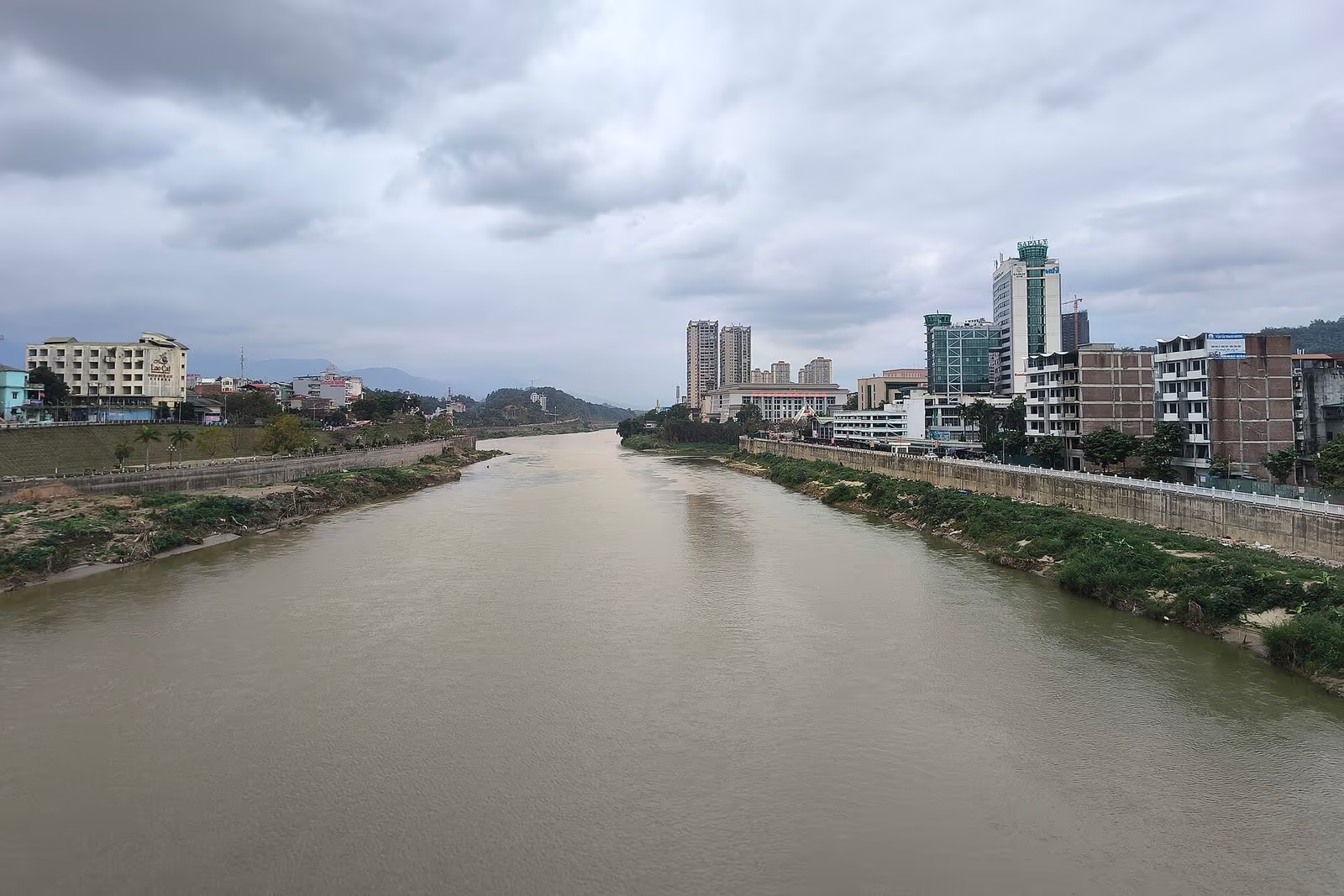
The Red River marks the border here. A Commons caption for a similar view from the bridge says that near the bridge both banks are in Lao Cai, but that farther upstream the left bank is Hekou, in China. It is a plain, wide view and a useful one: it shows in ten seconds why this place is a gateway, and the photograph at the top of this page was taken from the same bridge.
Coc Leu market
Bao Lao Cai reported on 9 June 2026 that Coc Leu is the oldest market in the city, that it was recognised as a tourist site in 2025, and that it has more than 600 stalls and about 8,000 tourist visits a week. We found no opening hours. We found no description of what the stalls sell beyond their number, so we will not guess; the point of a visit is to see a border trading market at work. If you want the colourful hill-tribe markets of this region, those are at Bac Ha and Can Cau, which we cover below.
Thuong Temple
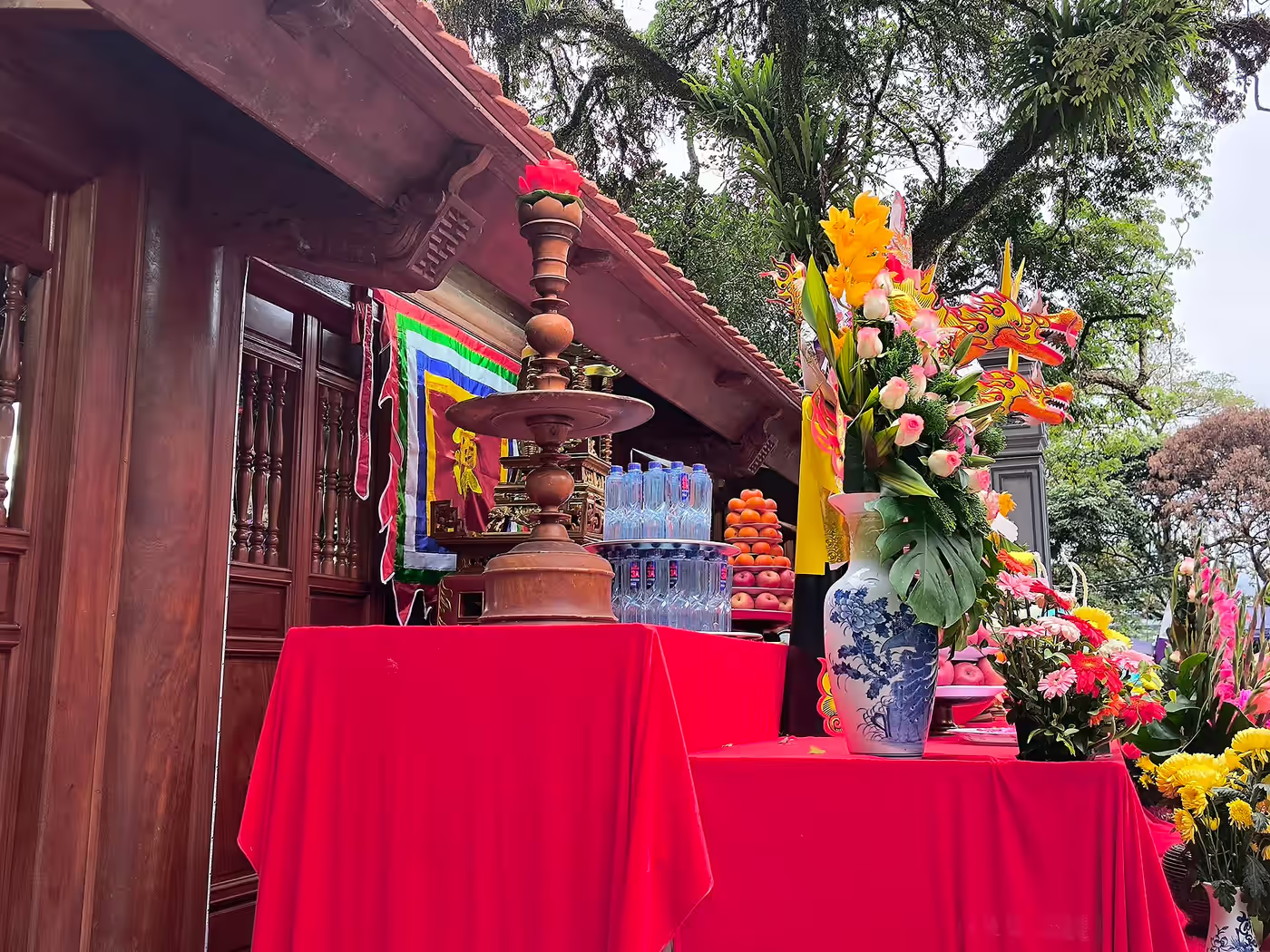
Thuong Temple, the "Upper Temple", stands on Mai Linh hill beside the Nam Thi river and honours the thirteenth-century general Tran Hung Dao (Hung Dao Dai Vuong). Bao Lao Cai says it has been a national relic since 1996, and its festival falls on the fifteenth day of the first lunar month. The same article names two other temples near the border, Mau Temple (a national relic since 2011, beside the border gate near marker 102) and Cam Temple (a national relic since 2001). We visited none of them for this guide and we found no sourced entry fees, so treat them as places to walk to and look at, and dress for a religious site: cover shoulders and knees, and be quiet inside.
Where to eat
We cannot recommend a particular restaurant, because we have no sourced list and we will not make one up. Ask your hotel, or look for a busy local place near the river and the market. If your train is early or late, that part of town is the one to be in, because the station, the bridge and the market are all in the same corner of the city.
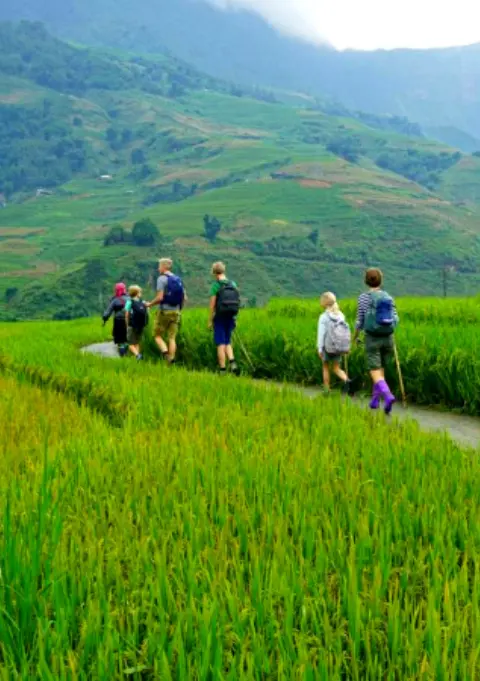
Walk the Terraces, Not the Station Forecourt
 1-Day Trek
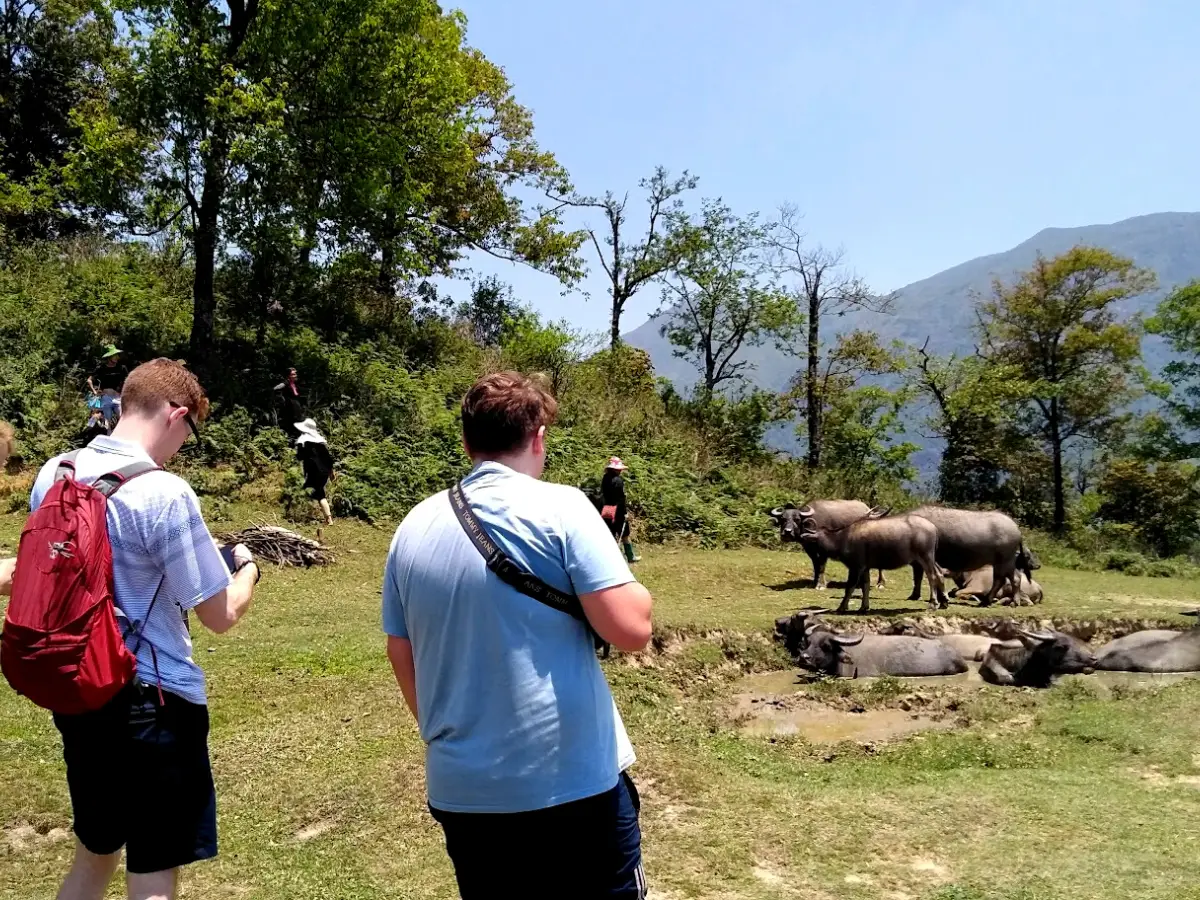
Trekking Through Rice Terraced Fields
The Lao Chai to Ta Van valley day with a local guide, ending in Sapa town.
 Homestay
Rice Terraced Fields & Homestay
A night with a local family in the Muong Hoa Valley.
 Local Favourite
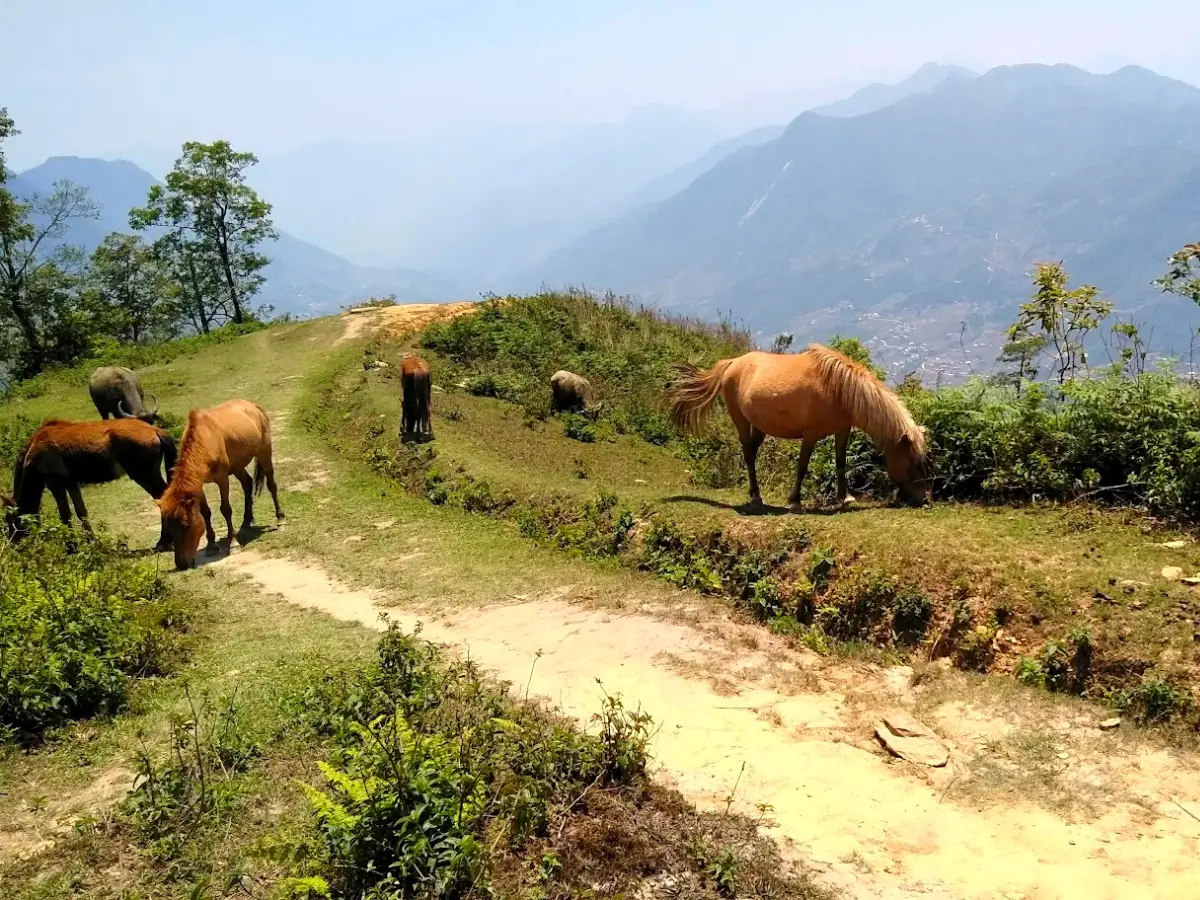
Mountain Views and Villages Trek
A quieter ridge and village route for a half-rested day.
The Border With China
The passenger crossing is the Lao Cai to Ha Khau (Hekou) road gate. A Vietnamese international news site reported that it reopened on 8 January 2023 with hours of 07:00 to 22:00 Hanoi time; we found no 2026 notice, so treat those hours as a likely guide and check before you go. Kim Thanh II is a separate gate used for freight: Bao Lao Cai reported on 4 September 2026 that it handles more than 600 goods vehicles a day, and that the gates together recorded 3.09 million entry and exit trips in the first half of 2026. The gate has closed after floods before, so do not plan a tight connection around it.
There is no passenger train over the border at Lao Cai that we could find. The cross-border services that resumed in May 2025 are Hanoi to Nanning (from 25 May) and Hanoi to Beijing (from 27 May), and Bao Lao Cai reports that both run via Dong Dang, not Lao Cai. The station here sits at kilometre 293+586 of the old Hanoi to Lao Cai to Kunming line, which the French built between 1903 and 1936 and which Bao Lao Cai lists as a first-grade international connecting station; but a Lao Cai to Hekou passenger service is not running, and a standard-gauge link is still only proposed.
We did not find Vietnam's own rules for foreign tourists leaving and re-entering at this gate, so ask the Vietnamese immigration office or your hotel before you plan a day trip across. Our Vietnam visa guide covers the e-visa and the land gates, including Lao Cai, for your return.
We also could not confirm whether Hekou is a designated port for China's 240-hour transit scheme.
On the Chinese side, the rules change by passport and by year. China's foreign ministry announced on 15 February 2026 that citizens of the United Kingdom and Canada could visit China visa-free for up to 30 days from 17 February to 31 December 2026. The 30-day visa-free scheme for France and Germany was extended to 31 December 2026, according to a mirror of the official notice on a Hunan government site, which we count as likely rather than confirmed. We found no unilateral visa-free scheme for the United States, and we could not confirm one for Australia. The United States does appear on China's 57-country 240-hour visa-free transit list, which needs an onward ticket and a designated port, on the National Immigration Administration page dated 20 August 2026. All of these schemes carry end dates. Ask the Chinese embassy or consulate for your country, and trust it over any blog, including this one.
From Lao Cai Up to Sapa
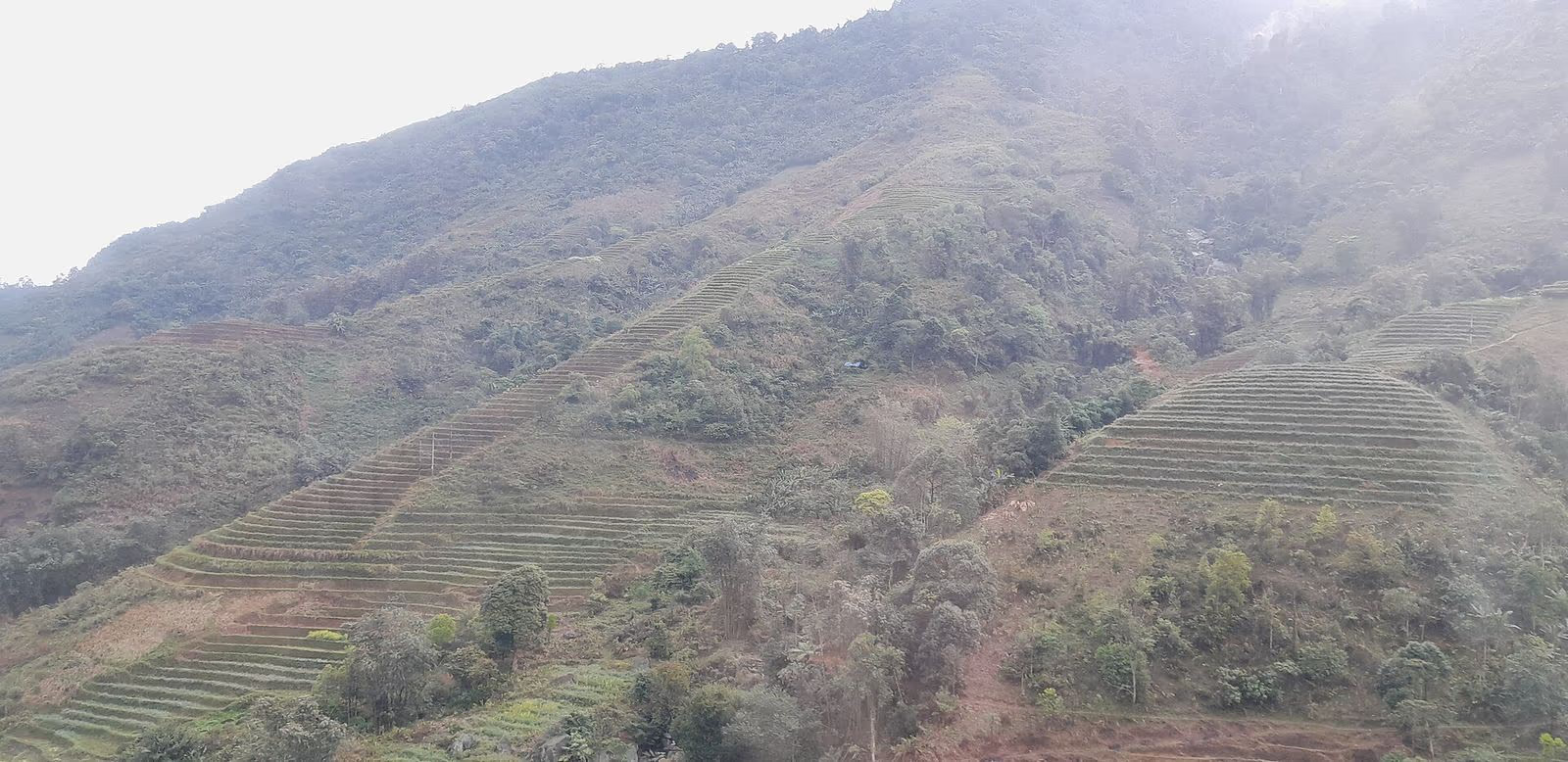
The mountain road starts at the edge of the city and climbs from the valley floor to Sapa's roughly 1,500 metres in about an hour. Since 22 September 2023 the whole connector from the Noi Bai to Lao Cai expressway up to Sapa, with its Mong Sen viaduct, has been open with no load or time limits, Bao Lao Cai reported. It is a toll connector road, not a separate "Lao Cai to Sapa expressway", and we found no source describing one.
The expressway you arrive on is also changing. Bao Lao Cai reported on 9 June 2026 that the 121.33 km section from Yen Bai to Lao Cai is being widened from two lanes to four, at a cost of about 7.7 trillion dong, with substantial completion targeted for 2026. We found no sourced journey time for the Lao Cai to Sapa road, so we give ours: about an hour from the station, and longer in fog or heavy rain. Shared vans leave from outside the station when trains arrive; our Chapa Express guide puts the shared shuttle at about 5 USD, and we arrange the transfer for guests who book through us. Read the Chapa Express review or the King Sapa train review for the train side.
Lao Cai to Sapa, Sorted Before You Land
- Hanoi to Sapa transport — sleeper buses, limousines and the overnight train, bookable with your trek
- Hanoi to Sapa guide — what each option costs and how long it takes
- How to get to Sapa — the first leg, in detail
Day Trips From Lao Cai: Bac Ha and Beyond
The one day trip we can source is Bac Ha. Bao Lao Cai wrote in 2024 that the Bac Ha market runs on Sunday mornings and that the town is about 70 km from Lao Cai; other pages say 66 km or 80 km, so plan for 70 and allow extra on mountain roads. A local bus takes about two hours according to a travel guide we read, not an official page. Our Bac Ha market guide has the detail on what to expect. If you want Bac Ha on a Sunday, the best plan is usually to sleep near the station on Saturday, or to base in Bac Ha itself; do not try to fit it between an early train and a late checkout.
We found no sourced distances or times for Y Ty or Cam Duong, so we leave them out. Cam Duong is one of the wards that came out of the old city, and Y Ty is a high border commune that travellers visit for terraces and cloud views. If a hotel or a driver offers either as a half-day from Lao Cai, ask for the road time in writing before you agree.
The Weather Gap Between Lao Cai and Sapa
Pack for two climates. The monthly means for Lao Cai city run from 16.0 °C in January to 28.5 °C in June, with a yearly mean of 23.4 °C. That comes from Wikipedia citing the Vietnam Institute for Building Science and Technology, not from the national weather service, so we count it as likely. For Sapa, the same kind of source gives a yearly mean of about 15.3 °C, a record low of minus 6.1 °C and a record high of 30.0 °C. We found no reliable monthly table for Sapa, and our Sapa weather by month page is the better guide.
What this means in practice is simple and is our own advice. Get off a June train in a damp valley and you will want a T-shirt; step out in Sapa the same morning and you will want a fleece and a rain shell. In winter the gap is even sharper. Keep warm layers in your day bag, not in the luggage the van packs on the roof. Our altitude guide explains why Sapa feels so different without being high enough to cause altitude sickness, and the best time to visit Sapa guide covers the seasons.
Three Ways to Plan Your Lao Cai Hours
These plans are examples built on our transfer times, not sourced timetables. Check your own train and van times first.
Night train, straight up
Arrive between about 04:30 and 06:45, find your van outside the station and be in Sapa town by mid-morning. Ask your hotel in advance about early luggage storage and breakfast.
Day bus, a short stop
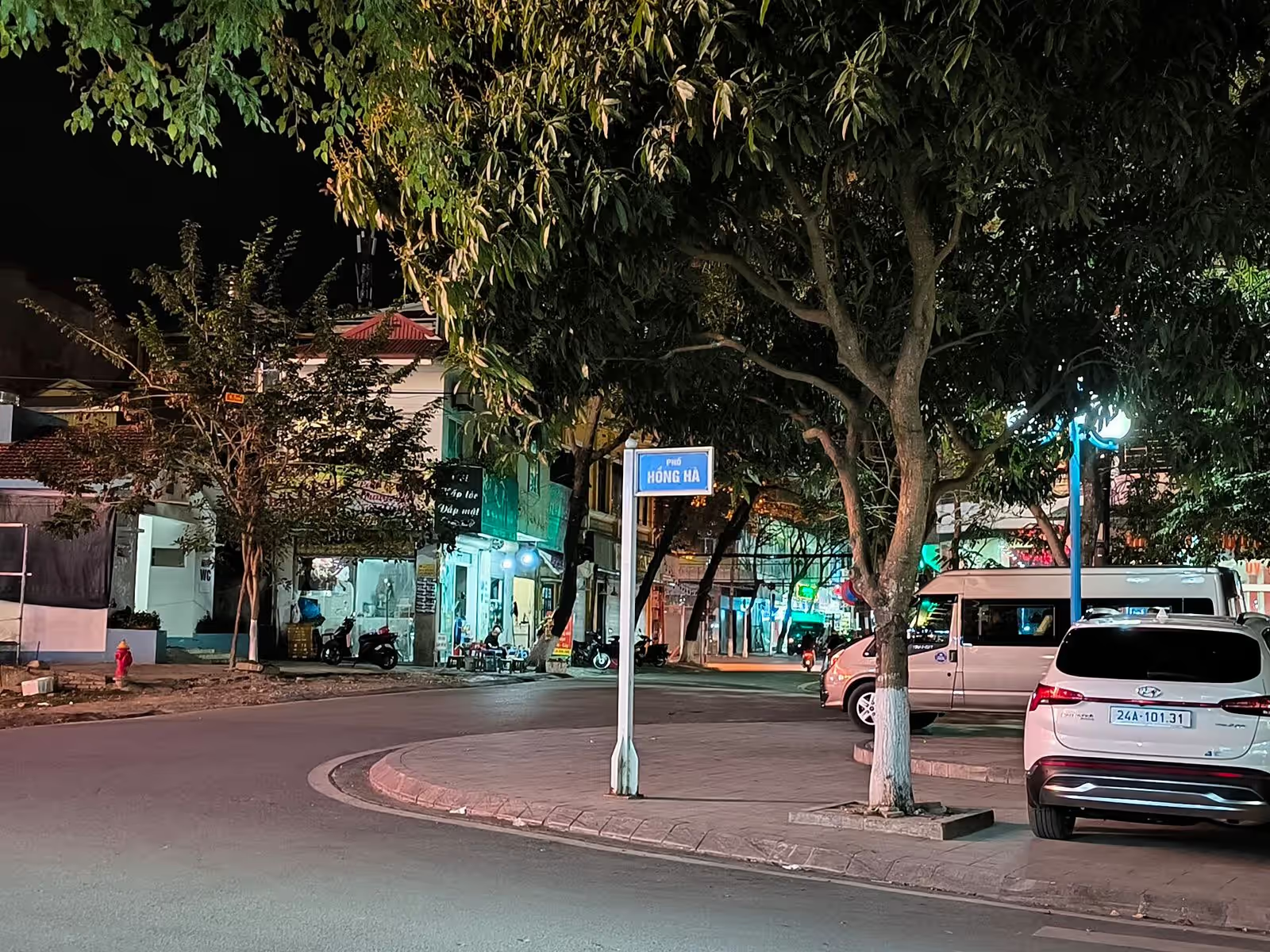
If your connection leaves in the afternoon, walk to the river bridge, look at Coc Leu market, visit Thuong Temple and eat on Hong Ha street before the shared van up.
Early train home
If you leave Lao Cai before dawn, sleeping near the station can beat a night-time drive down from Sapa. Book the van or a car the day before.
Border day
Check the Vietnamese and Chinese rules before you leave Sapa, carry your passport and onward tickets, and leave a margin for the gate closing early or late.
Practical Tips for the Station Area
The following are our own advice, not a published source. We found nothing reliable on left-luggage services, ATMs or SIM cards at the station, so ask your hotel in Sapa to hold bags and withdraw cash in Hanoi or Sapa town before you travel. Carry small notes in dong for the van, because drivers rarely have change for large ones. Keep your phone charged for the ride, since a pre-booked driver will message you at the station. Agree the price of any van before you board, and if you booked ahead, look for your name board or message the number you booked with.
Rent at Our Office Before You Trek
 Gear Rental
Trekking Boots Rental
Waterproof ankle-support boots. Cleaned and checked before each rental. Available at 105 Thach Son Street.
 Gear Rental
Walking Poles Rental
Trekking poles available to rent at $2/day at our office, 105 Thach Son Street. Essential for descents.
What We Can and Cannot Help With
We can help with the Sapa end: the trek, the homestay and the Lao Cai to Sapa transfer, which we arrange with our Hanoi to Sapa transport bookings. We do not run tours inside Lao Cai city, book border crossings, sell Bac Ha day trips from the station, or advise on Chinese visas. If you tell us your train time, we can say which van fits it and what to do with your luggage. Our northern Vietnam guide places Lao Cai, Sapa, Ha Giang and Hanoi on one map.
Frequently Asked Questions
For a few hours, yes: the river and bridge, Coc Leu market and Thuong Temple sit close together. For a night, only with a reason, such as a very early train, the Bac Ha Sunday market or a border crossing. The terraces, villages and cool air are in Sapa, about 35 km up the mountain.
About 35 km between the city and Sapa on Vietnam Tourism's 2026 page, with other sources giving 30 to 40 km. Our own transfer guides use about 38 km from Lao Cai station to Sapa town, and about one hour by road. We found no official journey time.
Yes. Under Resolution 202/2025/QH15, in force from 1 July 2025, Lao Cai province merged with Yen Bai province and kept the name Lao Cai. Sapa is now the Sa Pa ward in that province, and the province's administrative centre is in Yen Bai, not Lao Cai city.
We found no train or cable link. The road connector from the Noi Bai to Lao Cai expressway up to Sapa, with the Mong Sen viaduct, opened fully with no load or time limits on 22 September 2023, but it is a toll connector road and not a separate Lao Cai to Sapa expressway. There is no airport in Sapa or Lao Cai.
Look at the Red River from the Coc Leu bridge, walk through Coc Leu market, which Bao Lao Cai says has more than 600 stalls, and visit Thuong Temple, a national relic since 1996. Mau Temple and Cam Temple are also near the border. We found no sourced ticket prices or opening hours, so check on the day.
There is a passenger road gate, Lao Cai to Ha Khau (Hekou), reported open 07:00 to 22:00 in 2023, and no passenger train crosses here. We could not confirm Vietnam's rules for tourists. China announced 30-day visa-free entry for UK and Canadian citizens from 17 February to 31 December 2026; check your own passport with the Chinese embassy first.
No. Most visitors go straight to Sapa, which takes about one hour from the station. A night near the station makes sense only for a very early onward train or bus, for the Bac Ha market on a Sunday, or for a border crossing. This is our judgement, not a sourced rule.
Bac Ha market runs on Sunday mornings, according to Bao Lao Cai in 2024, and the town is about 70 km from Lao Cai, though some pages say 66 or 80 km. A local bus takes about two hours according to a travel guide we read. Plan a night in Bac Ha rather than a rushed day trip.