 Sinh Giang
The rice fields nearest to Hanoi are flat paddies of the Red River Delta, and you can reach them in under two hours: Duong Lam, about 44 to 50 km west of the centre, and Tam Coc in Ninh Binh, about 95 km south. Stepped terraces start further out. Mai Chau is roughly 135 km away, and Pu Luong, Mu Cang Chai and Sapa each ask for a night or more. The best weeks are the same everywhere: the last days of May into June, and September into October. This guide ranks the places by the time you have, shows what the fields look like month by month, and says plainly when a day trip is enough.
We are a Sapa trekking company, so we lean toward the north-west, and we handle that in the open: every distance comes with its source, we say where sources disagree, and we tell you when the closer place is the better choice. We checked the facts on 19 November 2026. We already have a page that compares Pu Luong, Mai Chau and Mu Cang Chai and one on rice terraces across Vietnam. This page starts from the other end: you are in Hanoi, you have a number of hours, and you want rice.
Key Takeaways
- Within about two hours of Hanoi you get flat, patchwork paddies, not stacked terraces.
- The delta is harvested twice a year, so its golden weeks are the last days of May to June and September to October. Sapa grows one crop a year because its winters are cold.
- In late May and June the delta is golden and being cut while the mountain terraces are flooded and being planted.
- Mai Chau is the nearest terraced valley, about 135 km and 3 to 3.5 hours; Mu Cang Chai and Sapa are about 300 km away.
- If the picture in your head is a mountainside of curved steps, only the north-west will give it. If you want fields, buffalo and an easy day, Ninh Binh and Duong Lam are enough.
The Short Answer: Match the Rice to Your Hours
With half a day, go to the paddies on Hanoi’s own edge; with one day, go to Ninh Binh; with one night, go to Mai Chau or Pu Luong; with two to four days, go to Mu Cang Chai or Sapa. Each step buys a bigger landscape and costs more road. These four distances are the ones to remember.
- Half a dayHanoi’s edge: Quoc Oai, My Duc, Duong Lam. Flat paddies, village lanes, buffalo at harvest. No ticket, no stay, and no scale.
- One dayNinh Binh and Tam Coc. Paddies under limestone cliffs, a rowing-boat ride, a climb for the view. The best landscape you can see and still sleep in Hanoi.
- One nightMai Chau, or two nights at Pu Luong. The first real valley terraces, with a homestay and a slower pace.
- Two to four daysMu Cang Chai or Sapa. The big stacked terraces of the north-west, at their best in two short windows a year.
Why the Fields Near Hanoi Look Different
Near Hanoi rice grows on flat land in a delta that farmers harvest twice a year; in the mountains it grows on hand-built steps and is harvested once. That one difference explains almost everything you will see, and it is why no field within 100 km of the capital can give you the mountainside-of-curves picture.
The Red River Delta covers some 15,000 square km, is held in by dikes and devotes most of its land to rice, according to Wikipedia. The same article calls it the second most important rice-producing area in Vietnam, about 20 percent of the national crop, grown with double-cropping on plots of only 0.3 to 0.5 hectares per household. Small plots make the patchwork: many shades of green, harvest dates a week or two apart.
The mountains work the other way. In the Mu Cang Chai area, Wikipedia says, Hmong farmers levelled the slopes into layers 1 to 1.5 m wide across about 2,200 hectares and moved water from step to step through split bamboo; La Pan Tan, Che Cu Nha and Ze Xu Phinh became a national heritage site in 2007. Sapa’s cold winters limit it to one crop a year, grown in the rainy season, according to the Wikipedia entry on the town. One crop means one gold season and one flooded season; the delta gets two of each.
So the delta is close, easy and quietly beautiful, for a traveller who wants fields, buffalo and village life. The terraces are far, steep and dramatic, for one who wants the poster. They are different trips, and mixing them up is how people end up disappointed in a two-hour drive.
Month by Month: Two Calendars
Lowland rice follows a spring crop that is harvested in May and June and a summer crop that is harvested in September and October; mountain terraces follow a single crop that is flooded in late May and June and golden in September and October. The grid is our reading of the sources, not a forecast; weather and local planting dates move the edges by a week or two.
Bare or stubbleYoung riceFull greenFlooded for plantingGolden, harvest
The delta row has two gold blocks; the two mountain rows have one. And in June the delta is gold while both mountain rows are blue, so the same week offers two opposite pictures a few hours apart.
December to February: stubble, sowing and the first green
The fields near Hanoi are at their plainest. The spring crop is sown through the winter: a pickyourtrail guide gives December and January, an FAO country brief says planting in the north runs until March, and in 2022 a deputy minister asked Red River Delta provinces to finish sowing before 28 February. The Duong Lam photograph further down was taken on 20 February 2016 and shows young, bright-green rice. In the mountains the terraces are bare and brown, which our Sapa rice harvest guide gives as the state from November to April.
March and April: green, and not yet the season
This is our reading, not a quoted window: after sowing, the delta greens steadily until the grain turns. It suits a bicycle ride along the dikes, but it is not what people photograph. Terraces stay bare until the water arrives.
Late May and June: gold in the delta, water on the hills
This is the one fortnight when you can plan around two landscapes at once. A Hanoi Times report from 2021 says that in the last days of May the paddies of Sai Son commune, Quoc Oai district, turn golden yellow, and guides give Tam Coc the same weeks. At the same time the north-west is being planted: Mu Cang Chai’s terraces are flooded from late May to mid-June in the sources we read, our Sapa guide calls May and June the mirror season, and Pu Luong guides give late May to early June.
July and August: green, hot and wet
Summer crops are young and then fully green, the heat is heavy, and Sapa’s Wikipedia entry says most of its rain falls between April and September. A green field is still a good field, and the cycling around Duong Lam is at its lushest, but do not build a rice trip around these months.
September and October: the second gold
The summer crop is harvested in September and October, and Tripoto describes a second golden season at Tam Coc then. In the north-west the gold is the main event: mid-September to mid-October at Sapa in our guides, mid-September to early October at Mu Cang Chai in the sources we read (with a harvest festival in early October, per Wikipedia), and September to November at Mai Chau according to the national tourism portal on our decision page. It is the busiest month, so book rooms early.
November: bare again
By November the delta is stubble and the terraces are brown. If you want rice in November, you have missed it.
Half a Day: Hanoi’s Edge
The quickest rice you can see is inside the Hanoi city limits, and the best-documented spot is Quoc Oai district in the west, followed by My Duc and, a little further out, Duong Lam. These are working farm fields with no gate, which is both their charm and their limit.
The Hanoi Times report from 2021 describes Sai Son commune in Quoc Oai turning golden in the last days of May, with farmers harvesting in the sweltering heat. A DTiNews photo story from June 2018 shows the fields of My Duc ripening, with farmers cutting and buffalo in the scene. We found no dated report for other suburbs, so we do not name them. Go in late May or early June and ask in the nearest village which plots are being cut.
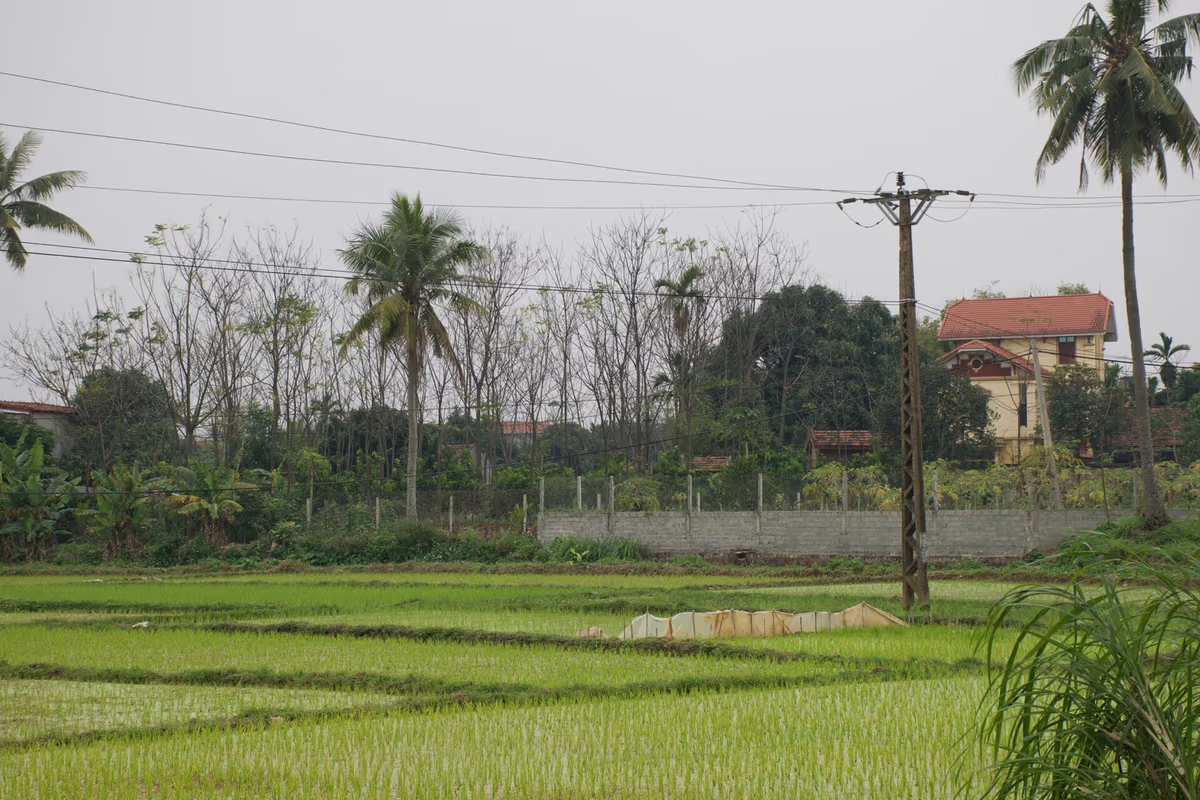
Duong Lam sits in Son Tay, west of the capital: 44 to 50 km from the centre in most sources, 40 to 60 km in all of them. Our day-trip guide gives about 1.5 hours and lists it as an ancient village. Operators run cycling tours of about 15 km in two hours, and one site lists a 34.5 km day ride. A Golden Trail Travel guide says the fields turn lush green in summer and that you can cycle through them and visit the ancient houses. The photograph above shows the delta out of harvest time: flat and green, edged with palms, houses and power lines.
Treat this rung as a morning, not a destination. Do it if you have a free half-day, like cycling, or want to see farming as it is. Skip it if you want a scenic photograph: it is the weakest rung.
One Day: Ninh Binh and Tam Coc
Ninh Binh is the best single day of rice scenery from Hanoi, because its paddies sit at the foot of limestone karst and a boat takes you through them. Wikipedia places the province in the Red River Delta and lists Tam Coc, Trang An and the Mua Caves among its sights.
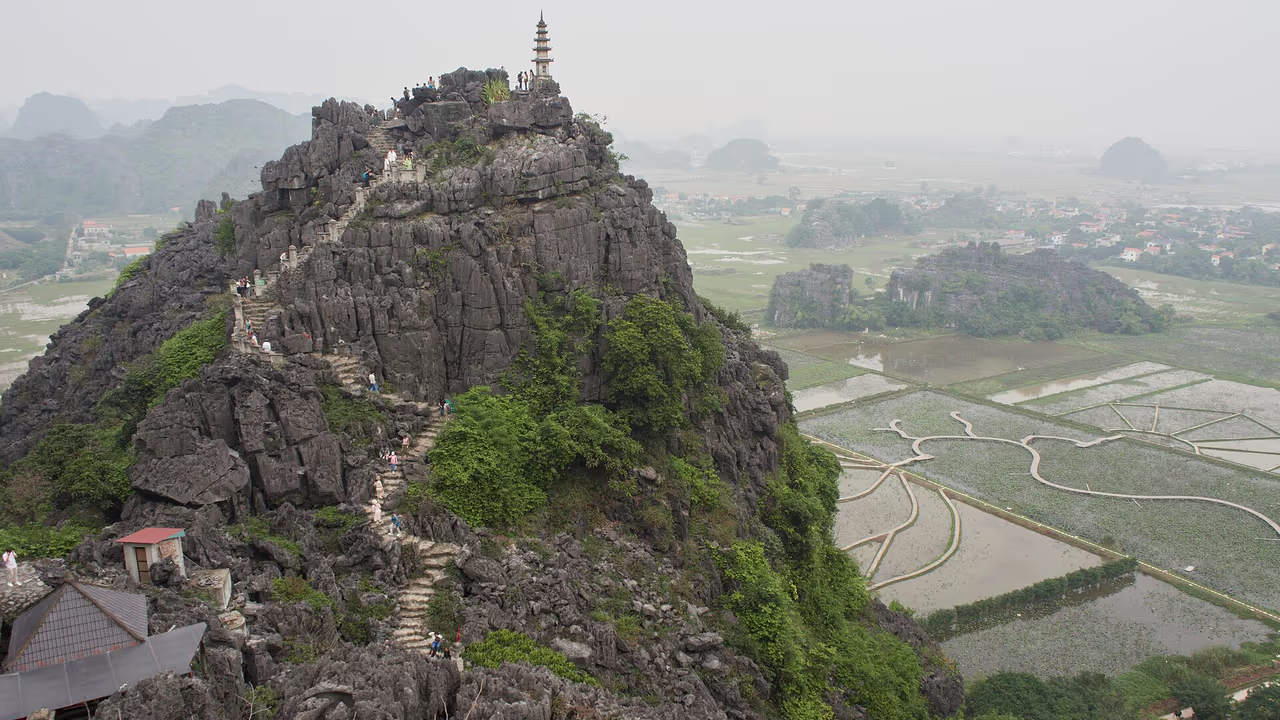
Our Ninh Binh guide gives about 95 km and about two hours from Hanoi. Other sources put Tam Coc at roughly 90 to 113 km, depending on whether they quote a road or a straight line; one routing site gives 104 km by road. Several guides, and our own, say the valley turns gold in the last days of May and the first weeks of June, and Tripoto and our guide add a second window in the autumn. The classic day is a rowing-boat ride at Tam Coc, the climb up about 500 steps to the Mua Cave viewpoint, then a cycle through the paddies. The photograph at the top is that view.
Two cautions. The gold weeks are the busiest, and our guide rates Tam Coc busy at midday and magical at dawn, so go early or late. And Tam Coc’s fields are flat paddies framed by cliffs, not terraces. If you are choosing between this and the north-west for the rice itself, Ninh Binh wins on ease and loses on drama. Our Ninh Binh travel guide has the full itinerary.
One Night: Mai Chau and Pu Luong
Mai Chau is the nearest place with real valley terraces, and Pu Luong is the next step out. Wikipedia puts Mai Chau about 135 km from Hanoi, our day-trips guide gives 3.5 hours by road and the national tourism portal, as quoted on our decision page, gives about three. A day trip is possible but means about seven hours on the road, so most people stay one night in a White Thai stilt house.
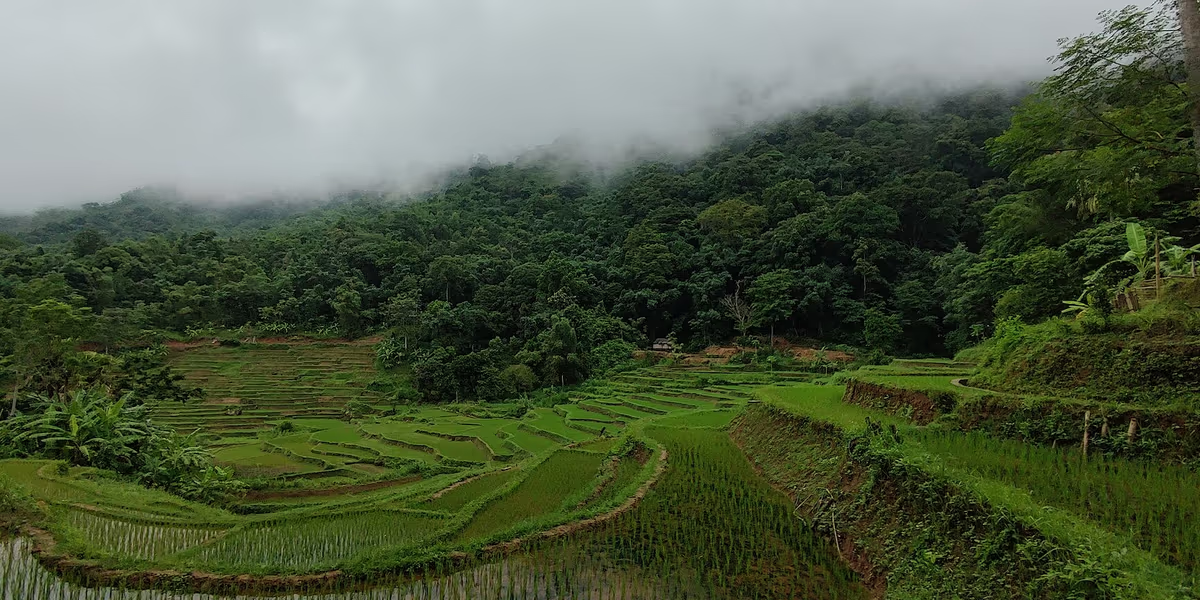
Pu Luong is further and slower. One Vietnam Airlines guide gives 140 to 180 km by three different roads, another site gives 180 km and 4 to 4.5 hours by bus, and operators say 4 to 5 hours by car. Sources agree it is best in late May to early June and September to October, and several describe terraces mixed with forest and water wheels rather than one big viewpoint. Our comparison page says Pu Luong rewards two nights.
Pick this rung if you want terraces and a homestay without a nine-hour round trip, in September or October for Mai Chau or late May to early June for Pu Luong. Skip it in the bare months. We run no tours here; the decision page has the detail.
Two to Four Days: Mu Cang Chai and Sapa
Only the north-west gives you the large stacked terraces, and Mu Cang Chai and Sapa are the two places most travellers choose. Both are about 300 km from Hanoi, need at least one night and peak in the same two windows.
Mu Cang Chai has the biggest terraced hillsides of the three areas on our decision page, about 2,200 hectares according to Wikipedia. The sources we read put it 280 to 320 km from Hanoi and 6 to 8 hours by road, and warn that rain and landslides can add time. The flooded season runs from late May to mid-June and the gold from mid-September to early October.
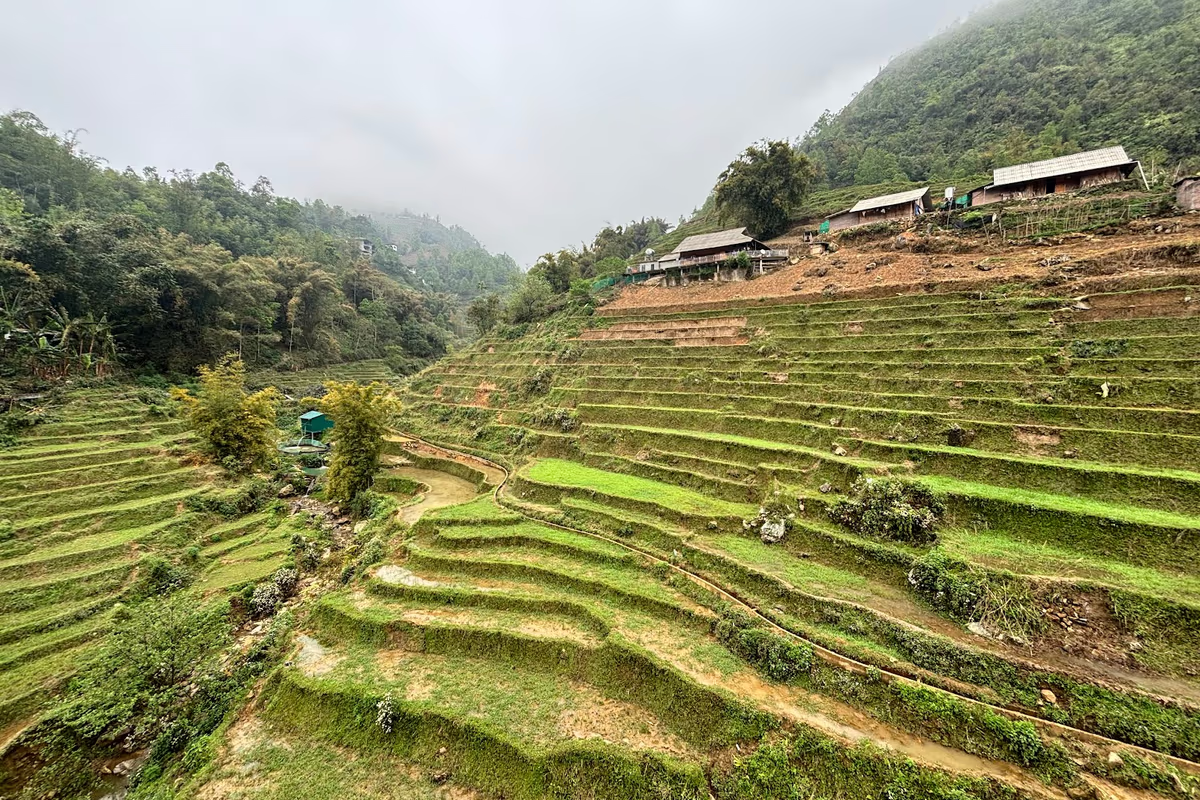
Sapa is about 300 km north-west of Hanoi, according to Wikipedia, and 5 to 6 hours by road in our day-trips guide. Most of its terraces sit in the Muong Hoa Valley, a corridor about 17 km long, and our guides give the mirror season as May and June and the gold as mid-September to mid-October, with the terraces bare from November to April. Sapa offers the widest choice of ways to see them, from a roadside view to a homestay trek.
Three Ways to Walk the Sapa Terraces
 1-Day Trek
Trekking Through Rice Terraced Fields
13 km and 5 hours past Y Linh Ho, Lao Chai and Ta Van with a Black H’mong guide.
 1-Day Trek
Rice Paddies and Cultures — Easy Hiking
An easy day to Black H’mong and Red Dao villages, with Ta Phin Cave and brocade weaving.
 Homestay
Rice Terraced Fields & Homestay
Two days and 26 km through the Muong Hoa Valley, Ta Van and Giang Ta Chai, with a night in a H’mong homestay.
If you can only see one of the two, the choice is time and style. Mu Cang Chai asks for a longer drive and gives a photographer the biggest scale. Sapa is closer, has an overnight train and bus network from Hanoi, and lets you walk down into the fields. Our Sapa rice terraces guide and harvest season guide go deeper.
When a Day Trip Is Enough, and When It Is Not
A day trip is enough if you want to see rice growing, not a mountainside of terraces. For the mountainside no day trip works: the nearest stacked terraces are about three hours away and the famous ones are six.
A day trip is enough if…
You have one day or less and want fields, buffalo and village lanes, not a landmark view.
You travel in late May to June or September to October, when the delta is golden.
You want rice plus a boat ride, a cave or a pagoda, which Ninh Binh does well.
Only the north-west will do if…
The picture you want is a hillside of stacked curves, flooded or golden.
You have two days or more and can accept a 3 to 6 hour road each way.
You want to walk down among the fields and meet the families who farm them.
| Place | From Hanoi | Time to allow | What the fields look like | Best weeks |
|---|---|---|---|---|
| Quoc Oai, My Duc | Inside Hanoi | Half a day | Flat working paddies | Late May to June |
| Duong Lam | About 44–50 km, about 1.5 hours | Half to one day | Flat paddies, old village | Late May to June; green all summer |
| Tam Coc, Ninh Binh | About 90–113 km, about 2 hours | One day | Paddies under limestone cliffs | Late May to early June; Sep–Oct |
| Mai Chau | About 135 km, 3–3.5 hours | One night | Valley paddies, some terraces | Sep–Nov |
| Pu Luong | About 140–190 km, 4–5 hours | Two nights | Terraces with forest | Late May to early June; Sep–Oct |
| Mu Cang Chai, Sapa | About 280–320 km, 5–8 hours | Two to four days | Large stacked terraces | Late May to June; mid-Sep to mid-Oct |
Getting There
The first two rungs need no long journey: Duong Lam and Quoc Oai are on the western side of the Hanoi road network, and Ninh Binh is about two hours south. Our day-trip guide covers getting to each; we run no trips there.
Mai Chau, Pu Luong and Mu Cang Chai are reached by road, and a car with a driver is faster than a public bus. For Sapa you can take a sleeper bus, a limousine van or the overnight train, and that end of the trip is the one we handle. Our Hanoi to Sapa timetable and how to get to Sapa guide give the options, and the box below links to the booking page.
The Part We Do Sell
- Hanoi to Sapa transport — sleeper buses, limousines and the overnight train, bookable with your trek
- Hanoi to Sapa guide — what each option costs and how long it takes
- How to get to Sapa — the first leg, in detail
Visiting Working Fields
These fields are somebody’s income, so a few habits matter more than any photo. Ask before you photograph a farmer, and put the camera down if the answer is no. Stay on the paths and the bunds, the low earth walls between plots; stepping into a paddy tramples the rice. Do not walk through a plot being cut. In the mountains, buy a drink or a meal from the family whose land you are looking at, and give way to anyone carrying a load on a narrow dike. Our Sapa terraces guide has more for the north-west.
Rent at Our Office Before You Trek
 Gear Rental
Trekking Boots Rental
Waterproof ankle-support boots. Cleaned and checked before each rental. Available at 105 Thach Son Street.
 Gear Rental
Walking Poles Rental
Trekking poles available to rent at $2/day at our office, 105 Thach Son Street. Essential for descents.
Frequently Asked Questions
Yes. The Red River Delta around Hanoi is mostly rice land. Quoc Oai and My Duc have working paddies inside the city, Duong Lam is about 44 to 50 km west, and Tam Coc in Ninh Binh is about 95 km south. These are flat paddies; stacked terraces start at Mai Chau, about 135 km away.
The delta is harvested twice a year. The spring crop turns golden in the last days of May and June, the autumn crop in September and October. A Hanoi Times report put Quoc Oai at the end of May, and guides give Tam Coc as late May to early June.
Mai Chau, about 135 km west of Hanoi and 3 to 3.5 hours by road. Pu Luong is next at 4 to 5 hours, and Mu Cang Chai and Sapa are about 300 km away. For large stacked terraces, plan on at least one night.
Only at Mai Chau, and it is tiring: about seven hours on the road for a few hours in the valley. Pu Luong, Mu Cang Chai and Sapa need a night or more. For a day trip with rice but no terraces, choose Ninh Binh and Tam Coc.
Yes, if you accept flat paddies under limestone cliffs rather than terraces. Tam Coc is about 95 km and 2 hours from Hanoi, the valley turns gold in late May and early June, and you can add a rowing-boat ride and the climb to Mua Cave. Go early to avoid crowds.
Mu Cang Chai has the biggest terraced hillsides of the areas we compare, about 2,200 hectares, but it is 6 to 8 hours from Hanoi. Sapa is 5 to 6 hours away and lets you walk down into the fields on a day trek. Both flood in late May and June and are gold from mid-September.
Plain. After the autumn harvest the fields are stubble, and the spring crop is sown from about December to February, so by February the plots are young and green. Mountain terraces are bare and brown from November to April.
Spend a day at Duong Lam or Ninh Binh in Hanoi, then take a sleeper bus, limousine van or the overnight train to Sapa, 5 to 6 hours away. In late May to June or September to October you can see a delta and a terrace landscape in one trip.