 Sinh Giang
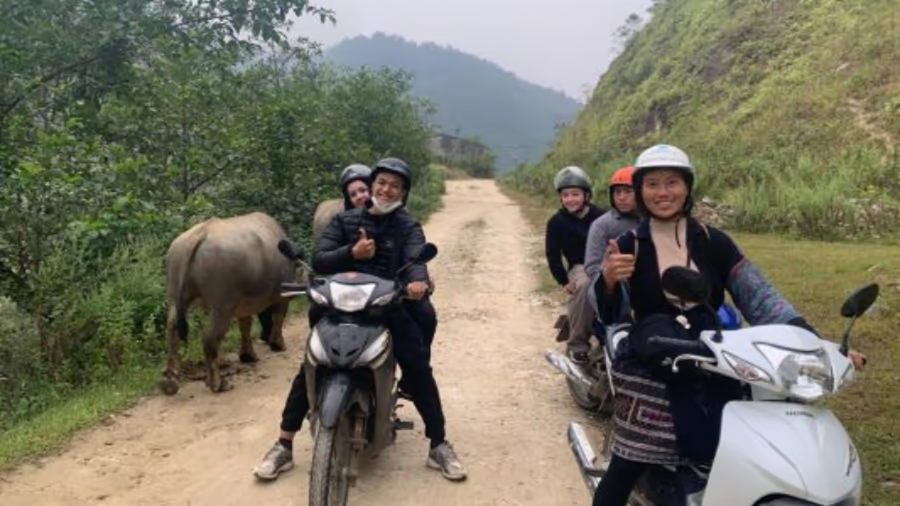
Yes, you can ride a motorbike from Hanoi to Sapa, and plenty of travellers do — but it is a serious 315 km / 195 mile mountain ride, not the quick highway hop that cars and buses make, because the fast Noi Bai–Lao Cai Expressway is closed to motorbikes. That single fact changes everything: while a limousine van covers the distance in about five and a half hours on the expressway, a motorbike is legally forced onto slower national highways that wind through the mountains, turning the trip into a full nine-to-eleven-hour day of riding, or better, a two-day adventure. Done right, riding to Sapa is one of the great road trips in northern Vietnam — over high passes, past the Mu Cang Chai terraces, ending on the legendary O Quy Ho climb. Done wrong, it is a long, exhausting, and occasionally dangerous slog. This guide, written by a local Sapa operator, lays out the honest picture: the routes, the distance and time, the risks, what you need, and — for most travellers — the smarter way to get the riding experience without the 300 km commute.
I am Sinh Giang, and our team at Trekking Tour Sapa is based at 105 Thach Son Street in Sapa town. We are not a Hanoi motorbike-rental shop, so we have no reason to talk you into a ride that does not suit you. We run guided motorbike tours within Sapa and arrange transfers up from Hanoi, which means we see both sides: the travellers who loved riding here, and the ones who arrived shattered and wished they had put the bike on easier roads. Here is what we would tell a friend.
Can You Really Ride a Motorbike from Hanoi to Sapa?
Yes — riding a motorbike from Hanoi to Sapa is legal and popular, but only on the national highways, never on the expressway, and that constraint is the first thing to understand. The direct Noi Bai–Lao Cai Expressway (CT.05) is the road that makes the car and bus trip so fast, yet motorbikes are banned from it outright, along with pedestrians and bicycles. Riders must instead take the older national roads, which are slower, more mountainous, and far more tiring — but also far more beautiful.
What this means in practice is that a motorbike trip to Sapa is a genuine expedition, not a transfer. You are looking at the better part of a day in the saddle on the fast option, or a proper two-day journey if you take the scenic route and actually stop to enjoy it. The riding is on real mountain highways shared with trucks and buses, through fog, rain and the occasional landslide in the wet season. None of that should scare off an experienced rider — it is exactly what makes the trip memorable — but it is completely the wrong choice for a nervous beginner or anyone short on time. If you have never ridden a manual or semi-automatic bike on a mountain road before, Hanoi to Sapa is not the place to learn.
How Far Is Hanoi to Sapa by Motorbike, and How Long Does It Take?
Hanoi to Sapa is about 315 km by the shortest legal motorbike route and around 380–400 km if you take the scenic way through Mu Cang Chai, translating to roughly nine to eleven hours of actual riding on the direct route or two days on the scenic one. The distance sounds modest by highway standards, but "highway standards" do not apply here, because the roads you are allowed to use climb and twist the whole way.
On the direct route (QL70), a fit, experienced rider who leaves Hanoi early can reach Sapa in a single very long day — but "can" is doing a lot of work in that sentence. Nine to eleven hours of concentration on mountain roads, plus fuel and food stops, means you arrive after dark, drained, and in no state to enjoy your first evening in Sapa. Most sensible riders split even the direct route with an overnight in Lao Cai or Yen Bai. On the scenic route (QL32 via Nghia Lo and Mu Cang Chai), two days is the minimum and three is more comfortable, because the whole point of that road is to stop — for the Mu Cang Chai terraces, for the passes, for photographs you will not take at 60 km/h. Compare that with the five-and-a-half-hour limousine van or the overnight train, and you can see why the choice of "how" matters as much as "whether."
The Two Routes from Hanoi to Sapa
There are two realistic motorbike routes from Hanoi to Sapa: the direct QL70 via Yen Bai and Lao Cai, which is the fastest legal option, and the scenic QL32 via Nghia Lo, Mu Cang Chai and the O Quy Ho Pass, which is longer but far more spectacular. The expressway that cars use is closed to bikes, so both routes stick to national highways.
Think of it as a trade between time and scenery. The QL70 route is the "get there" road — reasonably direct, mostly following the valley and rail line up towards the Chinese border at Lao Cai, then climbing the last stretch to Sapa. The QL32 route is the "the journey is the point" road — it swings west into the mountains of Yen Bai and Lai Chau, delivering the Mu Cang Chai rice terraces and a run of high passes before rejoining the road to Sapa over O Quy Ho. Many riders go up one way and, if they ride back at all, return the other. Below we break down each.
The Direct Route: QL70 via Yen Bai and Lao Cai
The direct route follows Highway QL70 northwest from Hanoi through Phu Tho and Yen Bai to Lao Cai city, then climbs the final 35 km up to Sapa — about 315 km and nine to eleven hours of riding. It is the road to choose if your priority is reaching Sapa in the least time a motorbike legally can.
Leaving Hanoi, you clear the flat, busy outskirts and industrial towns of the Red River delta before the land begins to rise around Phu Tho and Yen Bai. QL70 is a working national highway, which means two things: it is reasonably surfaced and direct, but it is also shared with a steady stream of trucks, coaches and local traffic, so it demands constant attention rather than relaxed cruising. The scenery improves steadily as you climb, with tea hills and river valleys, but this is fundamentally a route about covering ground. The final section from Lao Cai city up to Sapa is a proper mountain climb of around 35 km, gaining well over a kilometre of altitude on switchbacks — a fine end to the day if you are fresh, a punishing one if you have already ridden for nine hours. This is exactly why we tell riders taking QL70 to consider breaking the trip overnight in Yen Bai or Lao Cai rather than gutting it out in a single push.
The Scenic Route: QL32 through Mu Cang Chai and O Quy Ho
The scenic route swaps speed for spectacle, running west on QL32 through Nghia Lo, over the Khau Pha Pass to the Mu Cang Chai rice terraces, then north via Than Uyen and Tam Duong to climb the O Quy Ho Pass into Sapa — roughly 380–400 km best ridden over two or three days. This is the trip riders dream about, and it deserves the extra time.
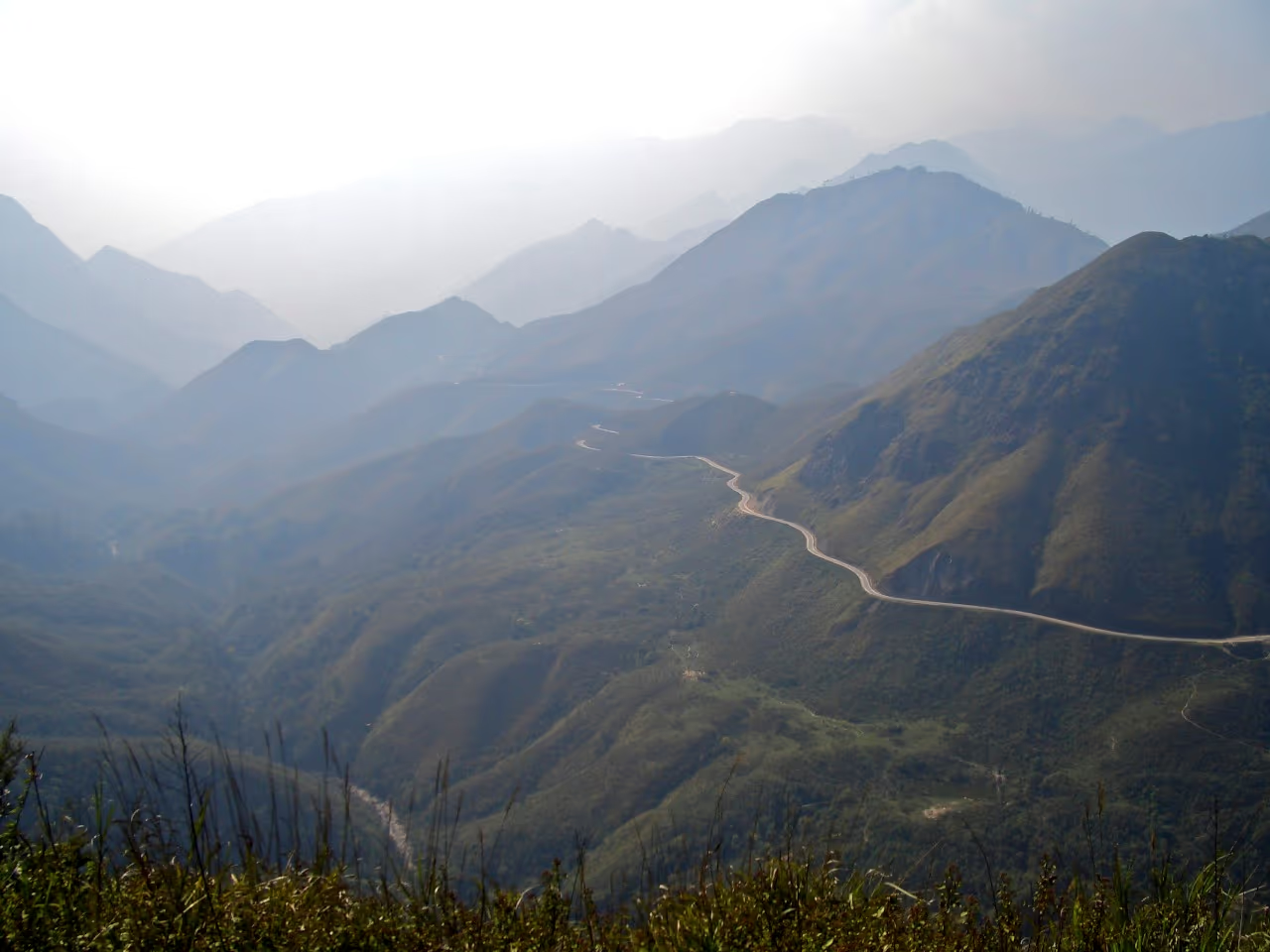
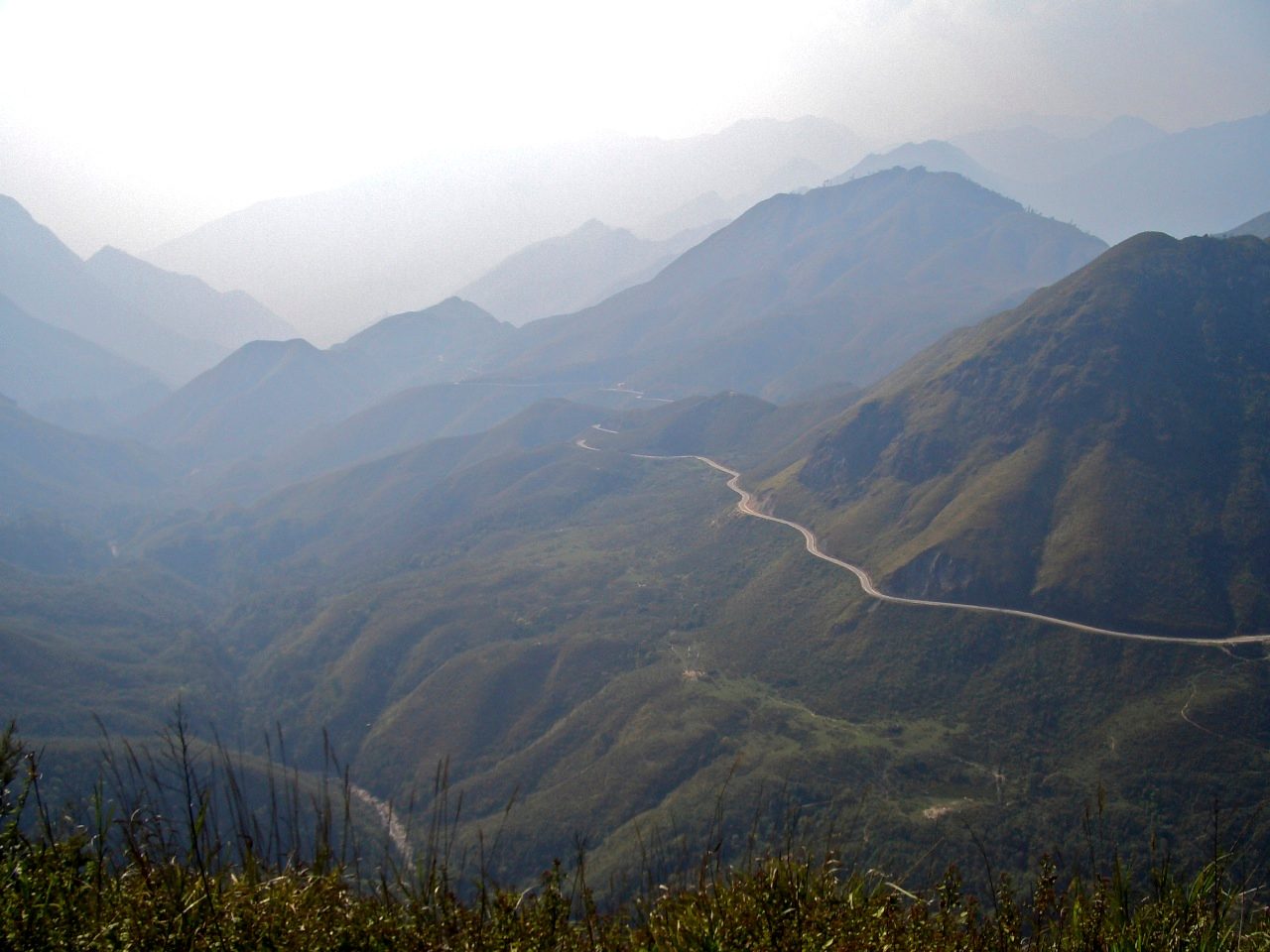
From Hanoi you head towards Son Tay and Thanh Son before the road tips up into the hills of Yen Bai. The first great reward is the Khau Pha Pass, one of northern Vietnam's celebrated mountain passes, which delivers you to Mu Cang Chai — a district whose staircased rice terraces are among the most beautiful in the country and a national monument in their own right. Riders routinely spend a night here, timing the trip for the green of spring or the gold of the September–October harvest. Beyond Mu Cang Chai the route runs through Than Uyen and Tam Duong before the grand finale: the O Quy Ho Pass on Highway QL4D, often called the "King of Passes," which tops out near 2,000 m on the border of Lai Chau and Lao Cai and drops you straight into Sapa. On a clear afternoon O Quy Ho is one of the finest stretches of road in Vietnam; in the fog and cold that often shroud it, it is genuinely dangerous, with sheer drops and limited visibility. Ridden with time and respect, this route is unforgettable. Rushed, it is a mistake.
Is Riding a Motorbike from Hanoi to Sapa Safe?
Riding from Hanoi to Sapa is as safe as your experience, your bike and the weather allow — it is well within reach of a seasoned rider on a sound machine in the dry season, but it carries real risks that grow quickly for beginners, on bald tyres, or in fog and rain. Northern Vietnam's mountain highways are not forgiving, and this is not the ride on which to discover that.
The specific hazards are consistent and predictable: heavy trucks and buses that use the same national roads you do; tight switchbacks with limited sightlines, especially on the Lao Cai–Sapa climb and the O Quy Ho Pass; fog that can cut visibility to a few metres on the high passes even in otherwise fine weather; and, in the May-to-September rainy season, slick surfaces, mud and the occasional landslide. Fatigue is the quiet danger on the direct route — concentration fades after many hours in the saddle, and most incidents happen late in a long day. None of this is a reason not to ride if you are genuinely experienced; it is a reason to be honest with yourself about whether you are. Weigh it up plainly:
Why riders love it
Why many regret it
The pattern we see is simple: riders who treat Hanoi to Sapa as the destination in itself — with time, the right bike, and mountain experience — come away thrilled. Riders who treat it as a cheap way to get to Sapa for a trek usually wish they had taken the train and kept the riding for Sapa itself.
Renting a Motorbike in Hanoi for the Trip
If you decide to ride, you rent your motorbike in Hanoi, where the choice of bikes and one-way drop-off options is far better than in Sapa, and you must be legally licensed to ride it. This is the step most travellers get wrong, and it matters both for your safety and for your insurance.
To ride legally in Vietnam as a foreign visitor, you generally need a valid motorcycle licence from home together with an International Driving Permit issued under the 1968 Vienna Convention, covering the engine size you are riding. Riding without the correct licence is not only illegal but usually voids any travel or medical insurance if you crash — a risk that is simply not worth taking on roads like these. For the bike itself, choose something you can actually handle on mountain roads: a semi-automatic or manual with decent power and, above all, good tyres and brakes is worth far more here than a stylish scooter. Reputable Hanoi rental companies offer one-way rentals where you ride up and drop the bike in Sapa or Lao Cai rather than doubling back, though this usually carries a drop-off surcharge; always inspect the bike, photograph any existing damage, confirm what the rental includes, and make sure you leave with a helmet that actually fits. We deliberately do not quote third-party rental prices here, because they vary by company, season and bike — get a current quote directly from the rental shop.
What You Need to Ride Hanoi to Sapa
Beyond the bike and the paperwork, riding to Sapa safely comes down to protective gear, wet-weather kit, and a realistic plan — the mountains are colder, wetter and higher than Hanoi, and Sapa itself can be genuinely cold. Turning up in shorts and a t-shirt, as some do, is a fast route to misery or worse.
A properly fitting full-face or good open-face helmet is non-negotiable, and honestly better than the flimsy ones many shops hand out. Bring or buy real riding protection — a jacket with armour, gloves, and sturdy closed shoes — because road rash from even a low-speed slide on gravel is no joke. Pack full waterproofs regardless of the forecast; mountain weather turns fast, and being wet and cold on the O Quy Ho Pass is dangerous, not just uncomfortable. Add warm layers for Sapa's altitude, sunglasses and sunscreen for the exposed passes, a phone mount with offline maps downloaded in advance (signal drops in the mountains), and a small tool kit or at least the number of a rental company that offers roadside help. Keep your luggage light and secured low on the bike, carry cash for fuel in small towns, and plan your fuel stops — stations thin out on the scenic route. If any of this feels like a lot to organise for a journey you could sleep through on the train, that is worth sitting with before you commit.
Rent at Our Office Before You Trek
 Gear Rental
Trekking Boots Rental
Waterproof ankle-support boots. Cleaned and checked before each rental. Available at 105 Thach Son Street.
 Gear Rental
Walking Poles Rental
Trekking poles available to rent at $2/day at our office, 105 Thach Son Street. Essential for descents.
The Smarter Option: Take Transport Up, Ride in Sapa
For most travellers, the smartest plan is to take a bus, limousine van or overnight train from Hanoi to Sapa and then ride a motorbike once you are here — you skip the tiring 300 km commute on trucking highways and spend your energy on the roads actually worth riding. It is the choice we quietly recommend to friends, and the one most of our motorbike-tour guests are glad they made.
The logic is straightforward. The long stretch between Hanoi and Lao Cai is the least rewarding part of the ride — busy, industrial at first, and, because you are barred from the expressway, slow. The genuinely spectacular riding is concentrated around Sapa: the O Quy Ho Pass, the Muong Hoa Valley, the high back-roads to Y Linh Ho, Ta Van, Ta Phin and the waterfalls. By taking a comfortable transfer up overnight, you arrive rested, with your whole trip still ahead of you, and you can ride the best of the region on a well-maintained local bike or behind a guide who knows every turn. You lose nothing but the commute. Our full Hanoi to Sapa transport guide compares the sleeper bus, limousine van and overnight train in detail, and here they are at a glance:
Every one of these covers Hanoi to Sapa faster and more safely than a motorbike, so you arrive fresh and ready to ride the good roads here:
 Cheapest
Sleeper Bus
Sleeper & cabin options · 5–6 hours · From $17
 Fastest
Limousine Van
Door-to-door express · ~5.5 hours · Direct highway
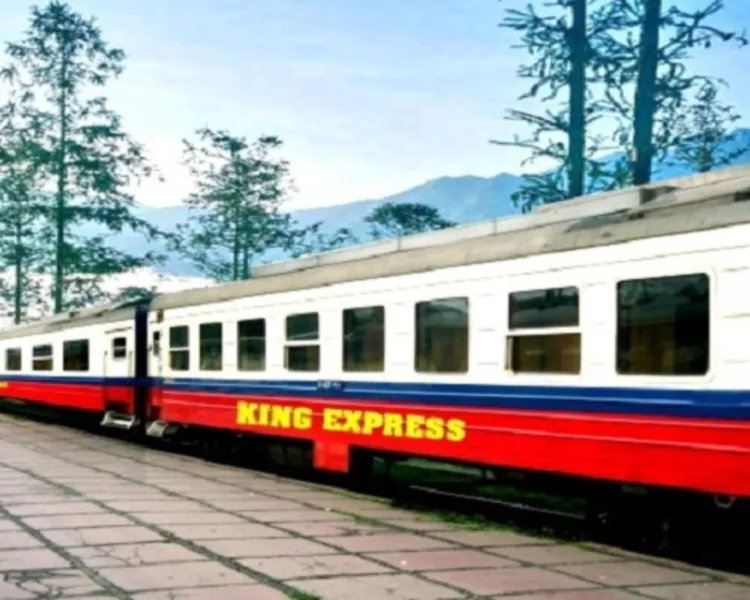 Most Comfortable
Overnight Train
Hanoi–Lao Cai sleeper · ~8 hours · No mountain road
Motorbike Tours in Sapa — The Riding That's Actually Worth It
Once you are in Sapa, a guided motorbike tour gives you the thrill of riding these mountains without any of the risk, paperwork or fatigue of the long haul from Hanoi — you ride pillion or your own bike behind a local guide who knows the roads, the weather and the villages. This is where the real riding is, and it is what we do best.
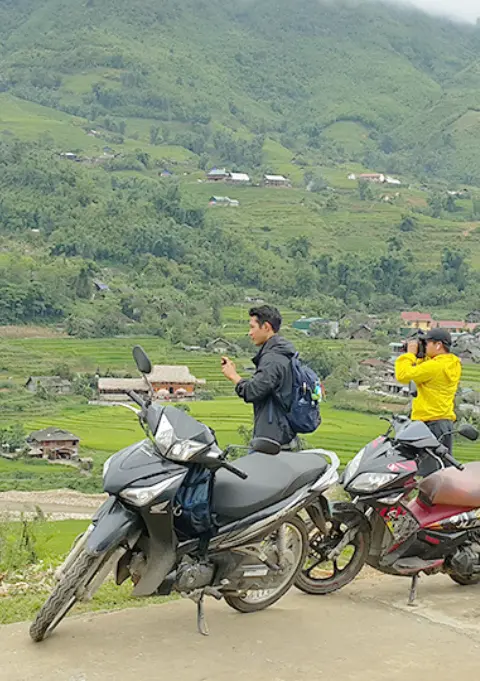
On our tours you reach places no trekking group and no big bus ever gets to: the high passes with valley views on both sides, remote Black H'mong and Red Dao hamlets, the Heaven Gate lookout, and the Love and Silver Waterfalls, all on roads chosen for how good they are to ride rather than how quickly they connect two cities. Because our guides grew up in these valleys, the stops are genuine — you are welcomed into homes, not paraded past them. A one-day tour is the perfect way to cover a huge amount of ground and scenery in a single day; the two-day version adds a night in a Ta Van homestay and reaches even further. Both let you focus on the pleasure of the ride while someone else handles the navigation, the bike and the safety.
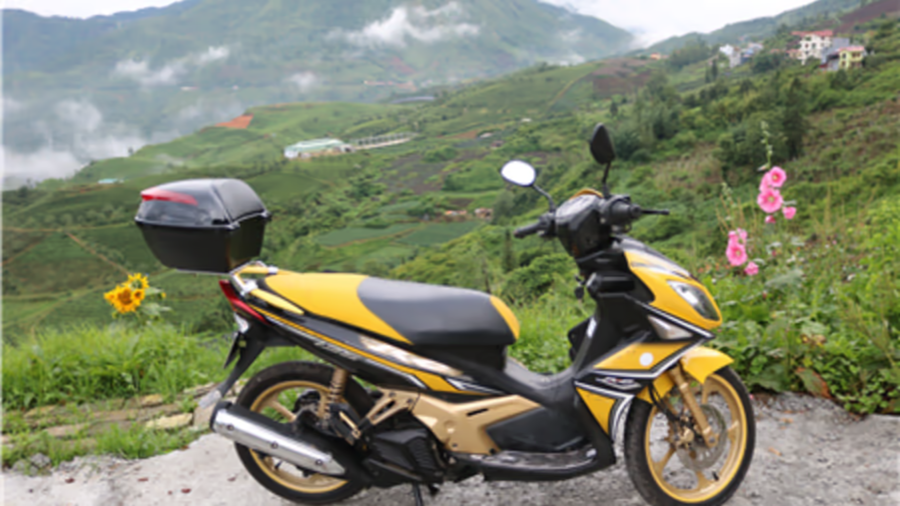
Our Guided Sapa Motorbike Tours
 Best Seller
Motorbike to Rice Fields, Mountains & Valleys
Ride pillion with a local guide through high passes and remote valleys no trekking group reaches — the fastest way to see the most of Sapa in a day.
 2 Days
See Everything in Sapa by Motorbike
Two full days riding to Heaven Gate, Love & Silver Waterfall and 8+ ethnic villages, with a night in a Ta Van homestay.
Best Time to Ride to Sapa
The best months to ride a motorbike to and around Sapa are March to May and September to October, when the weather is driest and mildest and the passes are clearest — the rainy summer and the cold, foggy winter both make mountain riding markedly harder. Because so much of the risk on this trip is weather-driven, timing matters more for riders than for anyone taking the train.
Here is how the year breaks down for riding, on the road up and on the passes around Sapa:
| Season | Riding conditions | Verdict for riders |
|---|---|---|
| Spring (Mar–May) | Mild, mostly dry, green terraces, clear passes | Best — the sweet spot |
| Summer (Jun–Aug) | Hot lowlands, heavy rain, mud, landslide risk in the mountains | Hardest — avoid if you can |
| Harvest (Sep–Oct) | Dry, golden Mu Cang Chai terraces, comfortable temperatures | Excellent — book ahead |
| Late autumn (Nov) | Cool and generally dry, quieter roads | Very good |
| Winter (Dec–Feb) | Cold, thick fog on O Quy Ho, occasional ice up high | For hardy riders only |
Whenever you come, the golden rule on the passes is the same: if the fog closes in, slow right down or wait it out. The O Quy Ho and Lao Cai–Sapa climbs are beautiful in clear weather and treacherous in cloud, and no viewpoint is worth pushing on blind. If you are riding the scenic route for the Mu Cang Chai terraces specifically, aim for the harvest in late September and early October, and reserve your accommodation early — it is the busiest window of the year.
What Riding Actually Costs versus Taking Transport
Riding a motorbike from Hanoi to Sapa is not necessarily cheaper than the bus or train once you add up rental, fuel, one-way drop-off fees and a night or two on the road — and it always costs you far more time. Travellers often assume the bike is the budget option; on this particular route, that assumption frequently does not hold.
The bus is genuinely inexpensive and the overnight train is mid-range, and both get you there in a single night or afternoon with zero effort on your part. A motorbike, by contrast, carries a daily rental charge, a one-way drop-off surcharge if you are not riding back, fuel for 300–400 km of mountain roads, and — because the ride takes so long — at least one and often two nights of accommodation en route that you would not otherwise pay for. Add the value of the day or two of your holiday spent commuting rather than exploring, and the "cheap" ride starts to look expensive. Where a motorbike genuinely wins is on the experience: if the riding is your holiday, no bus can compete. If it is just how you planned to reach a trek, the numbers and the clock both point towards taking transport up and, if you want to ride, doing a motorbike tour once you arrive. For a fuller breakdown of what a Sapa trip costs overall, see our guide to Sapa trekking costs.
Our Honest Recommendation
Our honest recommendation is this: ride from Hanoi to Sapa only if you are an experienced motorcyclist with days to spare and the journey itself is your goal — otherwise take the train or a limousine van up and get your riding fix on a guided Sapa motorbike tour. We give the same advice whether or not you ever book anything with us, because it is simply what works.
If you are a confident rider, you have a week or more, and the idea of the Mu Cang Chai terraces and the O Quy Ho Pass is what excites you, then the scenic QL32 route over two or three days is a spectacular trip and we would send you off with our blessing and a warning about the fog. If you are here mainly to trek the Muong Hoa Valley, to see the villages, and to enjoy Sapa — and the motorbike was just meant to be transport — then do not spend two hard days each way on trucking highways to get here. Come up overnight on the train or in a van, arrive fresh, and let us take you out on the genuinely great roads around Sapa. Either way, tell us your plans and we will give you a straight answer about what suits you.
How to Book a Sapa Motorbike Tour or Transfer
Booking a Sapa motorbike tour or a transfer up from Hanoi takes one message: send us your dates, group size and riding experience on WhatsApp, and we will confirm the right option and the full price, holding your place with a small deposit. We reply within 5–10 minutes with honest advice, not a hard sell.
Tell us whether you want a one-day or two-day motorbike tour around Sapa, whether you would rather ride your own bike or go pillion behind a guide, and whether you also need help getting up from Hanoi — we can arrange the sleeper bus, limousine van or overnight train alongside your tour so the whole trip is sorted in one conversation. Our motorbike tours run in small groups or privately, and we recommend booking two to three days ahead — earlier for the September–October harvest. Cancellation is free up to 7 days before departure, and a date change is free with 48 hours' notice. Once you are confirmed we send your pickup details and a short what-to-bring note, and all you have to do is turn up ready to ride.
Frequently Asked Questions
Yes, you can legally ride a motorbike from Hanoi to Sapa, but only on the national highways — the fast Noi Bai–Lao Cai Expressway is closed to motorbikes. That means the trip takes about nine to eleven hours of riding on the direct QL70 route, or two to three days on the scenic QL32 route through Mu Cang Chai and the O Quy Ho Pass. It is a rewarding ride for experienced motorcyclists but a long, demanding one, and the wrong choice if you are a nervous rider or short on time.
On the direct QL70 route it is about 315 km and roughly nine to eleven hours of actual riding, which most riders sensibly split with an overnight stop rather than doing in one push. On the scenic QL32 route via Mu Cang Chai and the O Quy Ho Pass it is around 380–400 km, best ridden over two or three days so you can enjoy the terraces and passes. By comparison, a limousine van on the expressway takes about five and a half hours and the overnight train around eight.
The Noi Bai–Lao Cai Expressway (CT.05) is a limited-access motorway reserved for cars, buses and trucks; motorbikes, bicycles and pedestrians are banned for safety reasons, as on expressways throughout Vietnam. This is why a car or bus makes the trip so much faster than a motorbike — they can use the direct expressway, while riders are legally required to take the slower, more mountainous national highways such as QL70 or QL32.
It carries real risks that depend heavily on your experience, your bike and the weather. The main hazards are heavy trucks on the national highways, tight switchbacks on the mountain climbs, thick fog on the O Quy Ho Pass, rain and landslides in the summer wet season, and fatigue on the long direct route. Experienced riders on a sound bike in the dry season manage it fine; beginners, or anyone riding in fog or rain on bald tyres, should not attempt it. If in doubt, take transport up and ride a guided tour around Sapa instead.
Yes. To ride legally in Vietnam as a foreign visitor you generally need a valid motorcycle licence from home plus an International Driving Permit issued under the 1968 Vienna Convention covering your engine size. Riding without the correct licence is illegal and usually voids your travel and medical insurance if you crash — a serious risk on mountain roads. Rent in Hanoi, where bike choice and one-way drop-off options are best, inspect the bike carefully, and make sure your helmet fits properly.
For most travellers, taking a bus, van or overnight train up to Sapa and then doing a guided motorbike tour is the better choice. The long ride from Hanoi is mostly busy, slow highway, while the genuinely spectacular riding — the O Quy Ho Pass, the Muong Hoa Valley and the remote villages — is all around Sapa itself. Coming up by transport means you arrive rested and spend your energy on the best roads, without the license, insurance and drop-off hassles. Ride from Hanoi only if the long-distance journey is itself the goal and you have the experience and time for it.