 Sinh Giang
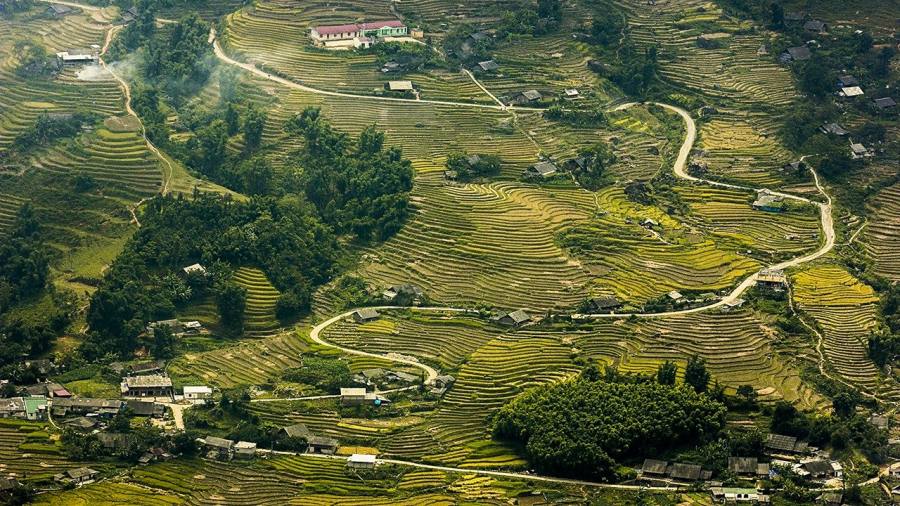
The smell hits you before the view does. Somewhere on the stone staircase descent above Lao Chai village, between the wet paddy smell and the woodsmoke drifting up from the Black H'mong houses below, you stop walking. Not because you are tired — the gradient is gentle here. You stop because you have just rounded a bend and the entire Muong Hoa Valley has opened up in front of you: tier after tier of rice paddies stacked against the hillside, the Muong Hoa River a silver thread at the bottom, and the ridge of Sa Seng Mountain cutting across the far horizon.
I have walked this route hundreds of times with our guests and I still stop at that bend. That is the honest reason to trek the rice terraced fields in Sapa — not a tick on a list, but a moment on a hillside path that you will actually remember. This guide covers everything you need to plan it properly: which route, which season, what to expect under your boots, and who you will meet along the way.
Why Sapa's Rice Terraces Are Worth a Trek (Not Just a View)
Sapa's rice terraced fields are among the most photographed landscapes in Southeast Asia. The problem is that most people see them from a viewpoint at the edge of town, take a photo, and leave. What they miss is everything that happens at ground level.
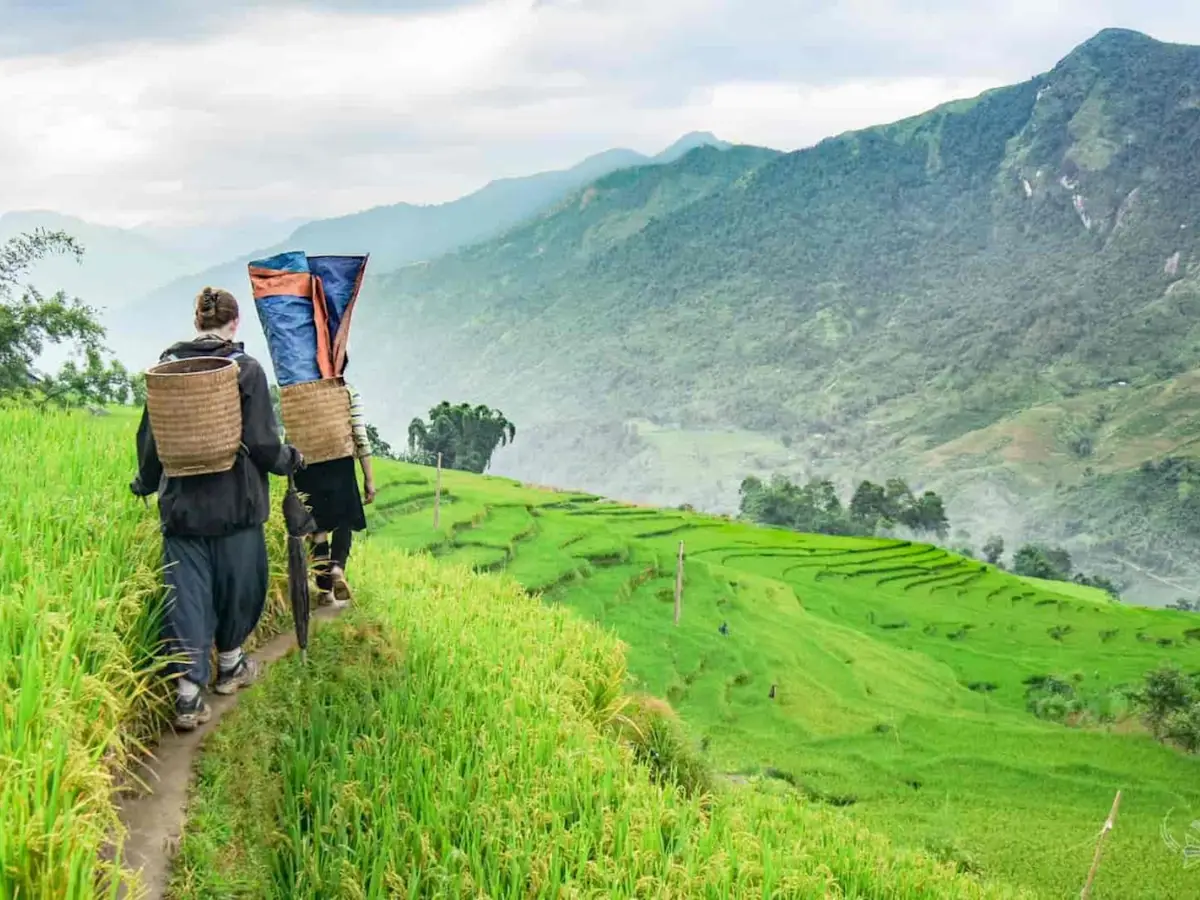
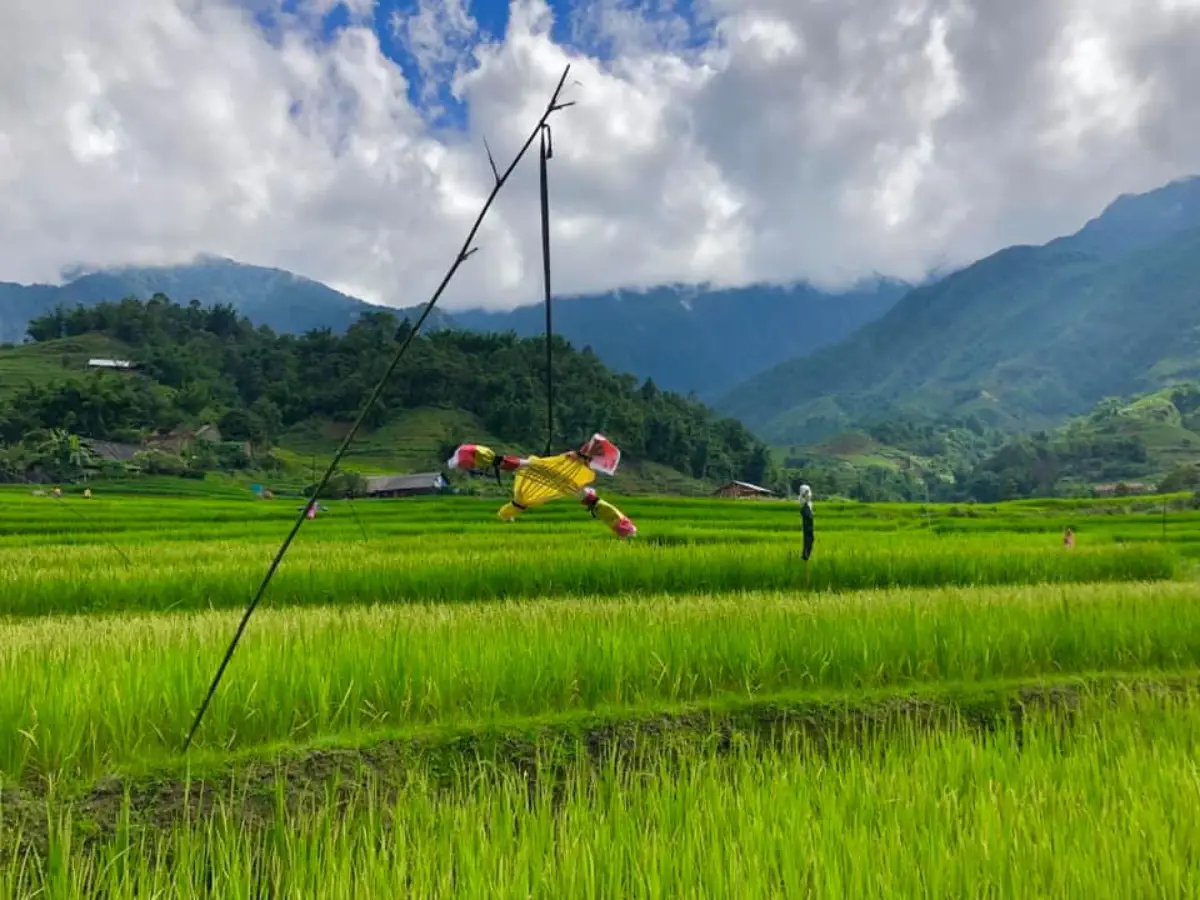
The Muong Hoa Valley terraces were built by the Black H'mong and Red Dao communities over centuries of painstaking labor — each paddy wall hand-packed, each water channel cut to follow the natural contour of the hillside. Walking through them, you are not observing the landscape from a distance. You are walking on the ridges between paddies that a Black H'mong family tends every day. You cross irrigation channels controlled by a simple stone gate system. You pass a scarecrow made of plastic bags and bamboo, rattling in the wind above a paddy that will be harvested in six weeks. The context changes everything about what you see.
As one of our Black H'mong guides who grew up in Lao Chai village puts it: "When I walk with guests I can show them the water buffalo's name, which family planted which paddy, how the H'mong and the Red Dao share the valley but do not mix their farming methods. This is not information you find on a sign."
The Muong Hoa Valley — The Heart of the Rice Terrace Experience
The Muong Hoa Valley is the primary trekking corridor in Sapa, running roughly east-to-west below the town. The valley floor sits at around 800 metres above sea level, compared to Sapa town at approximately 1,500 metres — that elevation drop is what creates the staircase effect as you descend from the ridge. The Muong Hoa River feeds the entire irrigation system; without it, none of these paddies would exist.
The valley contains several distinct communities. On the western slopes you pass through Black H'mong villages: Y Linh Ho, Lao Chai, and Hang Da. On the valley floor and eastern side, Red Dao families farm the lower terraces and live in villages like Ta Van and Hau Thao. The visual difference between H'mong and Red Dao farmland is subtle to a newcomer but clear once you know what to look for — H'mong paddies tend to be higher on the slope, smaller, and more irregular in shape; Red Dao paddies on the valley floor are larger and flatter.
Muong Hoa Valley — Quick Facts
- Location
- 6 km south of Sapa town, Lao Cai Province, northern Vietnam
- Valley floor altitude
- ~800 m above sea level (Sapa town is ~1,500 m)
- Main communities
- Black H'mong (Lao Chai, Y Linh Ho, Hang Da) and Red Dao (Ta Van, Hau Thao)
- Paddy calendar
- Planted May–June · growing July–August · harvest September–October · bare November–April
- Trek start point
- 105 Thach Son Street, Sapa Town — we drive you to the trailhead
Lao Chai and Ta Van — The Classic Route
The standard Trekking Through Rice Terraced Fields route starts above the valley rim and descends by stone steps through Black H'mong terraces to Lao Chai village. The first hour of this descent is where most of the elevation loss happens — 300 metres over about 3 km — and it is also where the views are widest. The steps are old and uneven; they are not difficult to walk, but they demand attention.
Lao Chai is a Black H'mong settlement of about 80 households. The architecture here is distinctive — wooden houses with slate roofs, pigs and chickens underneath the raised floor, and drying frames outside where corn and chili hang through October. We often stop here for a short break; if our local guides are leading, they usually know someone in the village and a brief conversation will happen that is not on any itinerary.
From Lao Chai the path follows the valley floor to Ta Van, roughly 4 km of easy flat walking along paddy ridges and through a thin strip of riverside forest. Ta Van is a Red Dao settlement — you will notice the difference immediately in the clothing (Red Dao women wear their distinctive red headdress), the house style (larger, more ground-level construction), and the herbal smell from the village's red dao herb bathing tradition. Lunch is normally at a local family's home in or near Ta Van — we use the same two families regularly; the food is simple, home-cooked, and genuinely good.
The stone path between Lao Chai and Ta Van has a short section that crosses a narrow paddy ridge above a flooded terrace. It is about half a metre wide and perfectly safe in dry conditions — but after rain it turns greasy. This is the one moment on the whole route where walking poles genuinely help. We keep a supply at the office at 105 Thach Son Street; ask when you book and we will bring them on the day.
Best Time to Trek the Rice Terraces
The terraces change entirely with the season, and which version you see depends on when you visit. There is no single "best" time — it depends on what you want to experience.
| Month | What the Terraces Look Like | Conditions | Rating |
|---|---|---|---|
| Jan–Feb | Bare ploughed earth, sometimes frost on higher ridges | Cold (5–10°C), dry, clear skies | Fair |
| Mar–Apr | New planting — small green shoots in shallow water | Mild, occasional mist, comfortable walking | Good |
| May–Jun | Flooded terraces — water mirrors reflecting the sky and clouds | Warm (18–24°C), can be muddy after rain | Peak |
| Jul–Aug | Deep green paddies, tall rice almost ready | Monsoon rains, slippery paths, lush but wet | Fair |
| Sep–Oct | Gold harvest — entire valley turns amber, harvest activity everywhere | Cooling, dry after rains, ideal walking weather | Peak |
| Nov–Dec | Post-harvest — some paddies bare, some replanted | Cool and clear, good visibility, fewer visitors | Good |
September and October is what most people mean when they talk about the rice terrace season. The paddies turn from deep green to amber and then gold over a three-week window; you can often watch the harvest itself happening while you walk, with Black H'mong families cutting by hand with curved sickles and loading the bundles onto their backs. The mornings in September are cool — around 15°C at 7 am — and the light on the terraces at that time is the best of the year.
May and early June is our second recommendation. The flooded terraces look nothing like the harvest photos; instead you get a mosaic of water mirrors at different levels, each one reflecting a slightly different patch of sky. It is less dramatic but strangely calming. Some guests prefer it precisely because it is quieter — tourist numbers in May are lower than October.
Rice Terrace Treks — Book Direct With a Local Guide
 Best Seller
Trekking Through Rice Terraced Fields
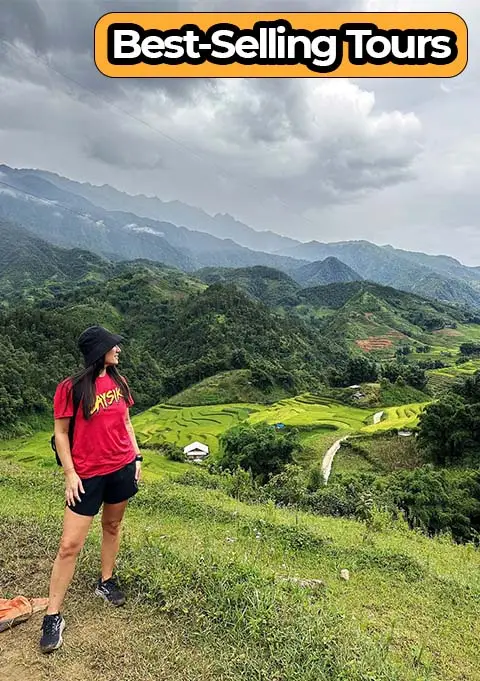
The full Muong Hoa Valley route — Lao Chai, Ta Van, lunch at a local family home. Best September–October.
Rice Paddies and Cultures – Easy Hiking
Flat valley walking with Red Dao village stops. Designed for travelers wanting culture without a steep descent.
 Seniors & Families
Sapa Easy Trekking For Seniors
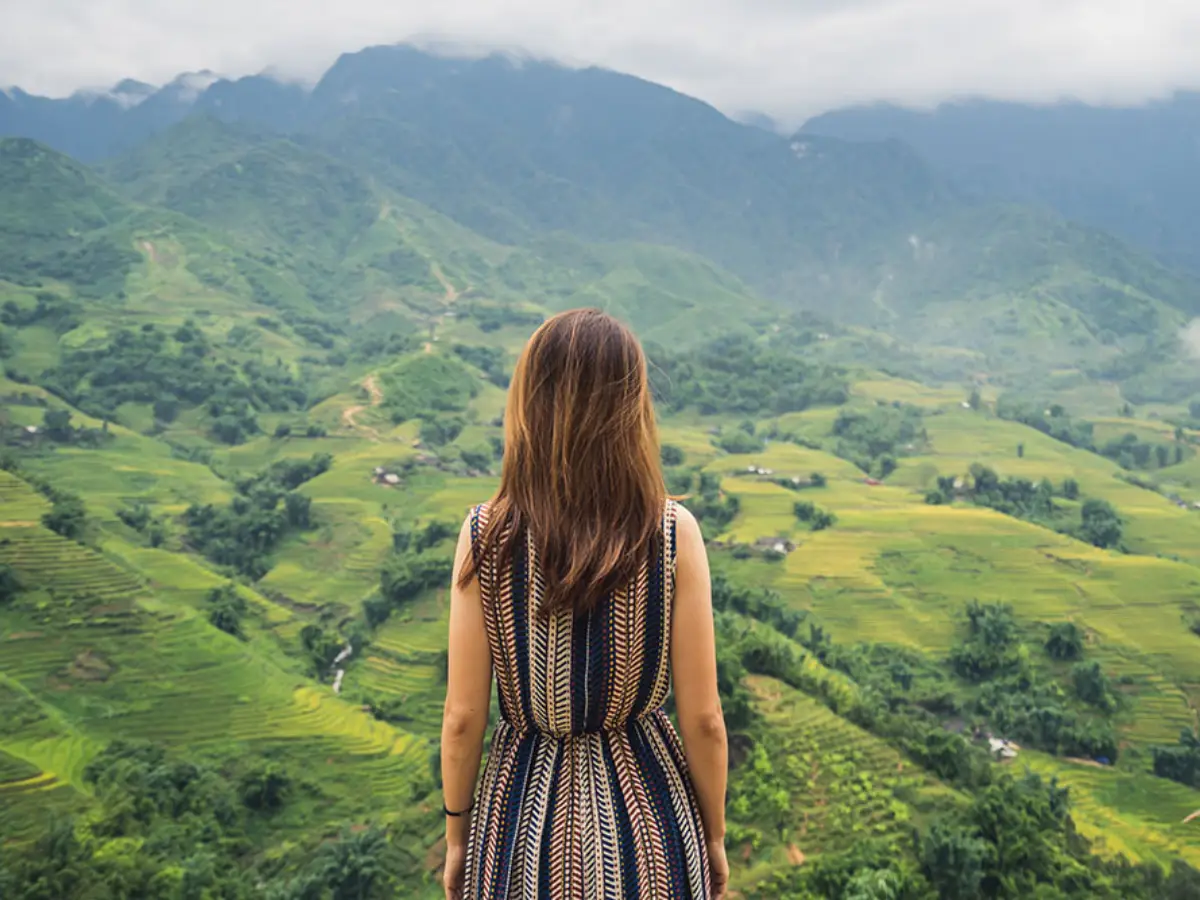
Gentle terrace paths with walking poles provided. Regularly done by travelers in their 60s–70s. No steep sections.
What the Trail Is Actually Like
The trail is not a formal hiking path. There are no trail markers, no distance signs, no ranger stations. It is a network of footpaths that the communities in the Muong Hoa Valley have been using for daily movement for generations — to the fields, between villages, to the market in Sapa on Saturday mornings.
The first section, from the ridge descent down to Lao Chai, is the most challenging. The stone steps are old and worn smooth; they are about 30–40 centimetres wide and the gradient is consistent but manageable. After rain in July or August this section becomes slippery enough to require care. In September and October it is dry and firm underfoot.
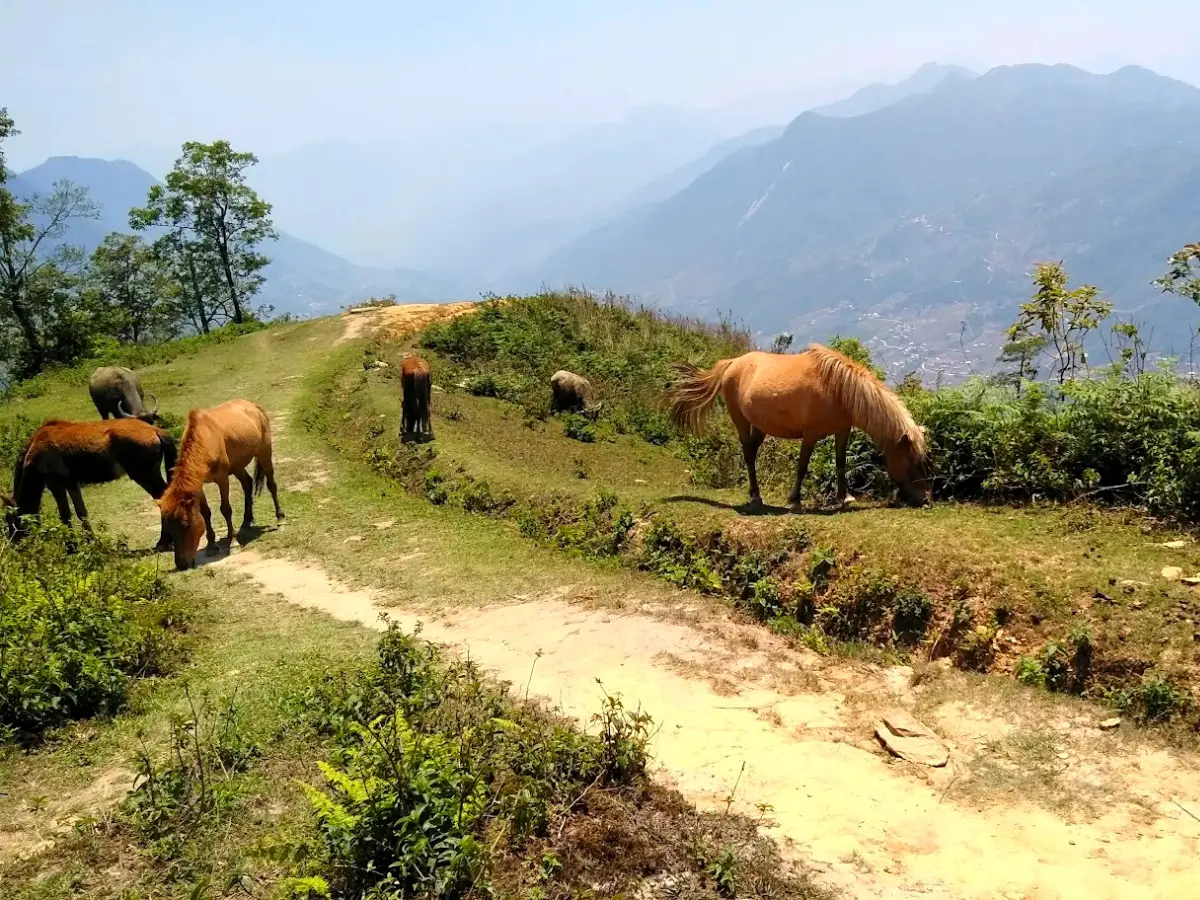
The valley floor section between Lao Chai and Ta Van is entirely different — flat, wide paths through working farmland. You will share these paths with Black H'mong women carrying goods on their backs in traditional conical bamboo baskets, with water buffalo being walked to different paddies, and occasionally with a small motorbike moving between villages. The path splits constantly; without a guide you will end up on the wrong side of an irrigation channel within twenty minutes.
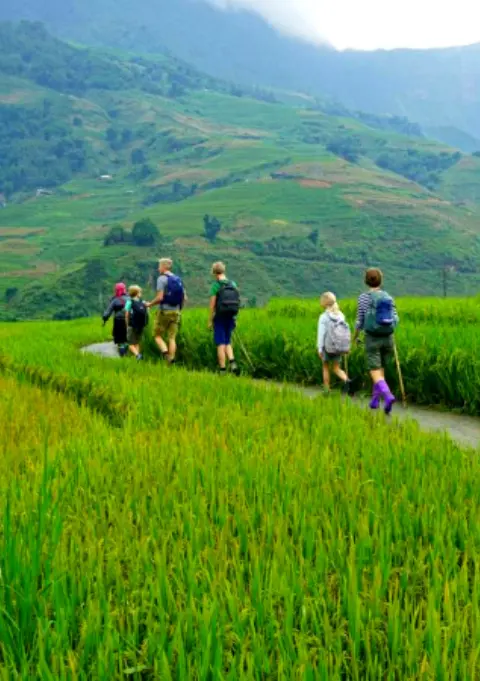
Total walking time is 4–5 hours including stops, not rushing. We usually start at 8:30 am to avoid the midday heat and finish around 2–3 pm. The tour includes a vehicle return to Sapa town at the end — you do not walk back uphill.
The Muong Hoa Valley is at a lower altitude than Sapa town, which means it is warmer and sunnier when it rains in town. But it also means that when the valley gets rain, the stone paths stay wet for hours. July and August are the monsoon months — expect mud. If you are visiting in July or August, waterproof boots are not optional; they are the difference between an enjoyable day and a miserable one. We can also provide waterproof boots for rent at the office if needed.
The People You Will Meet Along the Way
The Black H'mong community in Lao Chai has lived alongside tourism for two decades — long enough that a guide bringing a small group through is a normal part of daily life rather than an interruption. That familiarity is one of the things that makes the Muong Hoa Valley route work: the interactions feel natural rather than staged.
Some of our guides grew up in Y Linh Ho, one of the first Black H'mong villages you pass through on the descent. Their families still farm there. When they walk through Y Linh Ho with a group, there are conversations — about the crop, about the harvest schedule, about a neighbor's new house — that you would never witness on a self-guided walk. The Red Dao women in Ta Van are similarly accustomed to visitors and generally willing to talk, especially about their herbal bathing traditions and the distinctive embroidery on their clothing.
What I would ask you to keep in mind is that the Muong Hoa Valley is not a museum. The families in Lao Chai, Ta Van, Ma Tra, and Hau Thao are farming families living their actual lives. They are not there for your photographs. Our guides are good at setting the right tone — we do not point cameras at people without asking, we do not treat homes as tourist attractions, and we contribute directly to the communities we visit through the lunch stops and the informal economy that our presence creates.
How to Book a Rice Terrace Trek in Sapa
The simplest way is to message us directly on WhatsApp. Tell us your travel dates, your group size, and whether you prefer a group tour or a private tour, and our team — usually Trang Mua or Sinh Giang — will reply within 5–10 minutes with availability and pricing. We operate seven days a week from 6:30 am to 10:30 pm.
Group tours run daily and include up to 12 travelers led by one of our Black H'mong guides. They start from USD 35 per person and include guide, lunch at a local family home in Ta Van, and hotel pickup in Sapa town. Private tours give you a dedicated guide and a fully flexible schedule — these start from USD 60 for a solo traveler and adjust down per person as your group size increases.
We recommend booking at least 2–3 days in advance, especially September through October when the harvest season brings high demand. We do accept same-day bookings when space is available. Cancel 7 or more days before the tour for a full refund; cancel 2–6 days before for a 25% refund. Within 24 hours of the start time, the deposit is non-refundable.
Rent at Our Office Before You Trek
 Gear Rental
Trekking Boots Rental
Waterproof ankle-support boots. Cleaned and checked before each rental. Available at 105 Thach Son Street.
 Gear Rental
Walking Poles Rental
Trekking poles available to rent at $2/day at our office, 105 Thach Son Street. Essential for descents.
Frequently Asked Questions
The classic route descends from Sapa town into the Muong Hoa Valley, passes through the Black H'mong village of Lao Chai, and ends at the Red Dao village of Ta Van. The 12 km / 7.5-mile walk takes 4–5 hours at a relaxed pace. It is graded easy — no technical sections, just long staircase descents on stone paths cut into the hillside.
September to mid-October is the harvest window — the paddies turn from green to gold and the terraces are at their most photogenic. May–June shows the flooded terraces (water mirrors reflecting the sky) which is a completely different but equally beautiful sight. December–February is the dry off-season when the paddies are ploughed bare.
The Muong Hoa Valley rice terrace route is graded easy-to-moderate. The main challenge is a 300-metre descent on stone steps at the beginning, which can be slippery after rain. The valley floor is flat to gently rolling. Most people with normal fitness complete the standard route without difficulty. The terrain is harder in July–August monsoon when the paths are muddy.
Technically yes, but you will miss most of the experience. The paths through the terraces have no signage, split constantly, and lead through private farmland. Without a guide, you will either get lost or stick to the main tourist road. Our Black H'mong guides know every path, every family in the villages, and can introduce you to people you would never meet walking alone.
Yes. The standard Muong Hoa Valley route is one of the most accessible treks in Sapa. We run it with first-time trekkers, families, and travelers in their 60s–70s. The main thing to manage is footwear — waterproof shoes or light hiking boots are strongly recommended, especially May–October. We supply walking poles at the office.
Our group rice terrace treks start from USD 35 per person, including English-speaking guide, lunch at a local family home, and transfers. Private tours start from USD 60 for a solo traveler. Prices include hotel pickup in Sapa town. Contact us on WhatsApp for exact pricing based on your group size and dates.