 Sinh Giang
The smell of indigo vat is specific — earthy and slightly fermented, somewhere between tea and river mud. You get it the moment you step inside a working textile workshop in Ta Phin village, north of Sapa town, where Red Dao women press folded hemp cloth into barrels of blue-black dye the same way their mothers did. Nothing about it is staged for visitors. The cloth comes out dark and wet, left on wooden racks outside to oxidize in the mountain air. That oxidation — the color deepening from teal to near-black over 24 hours — is something the women here have been reading by eye for generations.
Sapa's craft tradition is rooted in necessity before it became identity. The Black H'mong of the Muong Hoa Valley and the Red Dao of Ta Phin and Hang Da made their own textiles, tools, and jewelry because there was no other option for communities living at 1,500 meters above sea level in Lao Cai province. What you can see and buy today in Sapa's workshops and villages is the living continuation of that tradition — modified by contact with the outside world, but not replaced by it.
H'mong Embroidery — The Most Distinctive Craft
The embroidery of the Black H'mong is the craft that most visitors encounter first — and the one most often counterfeited at the souvenir stalls near the Sapa Stone Church. Real H'mong cross-stitch uses a hand-spun hemp base cloth dyed with indigo. The geometric patterns — diamond grids, spiral hooks, stepped triangles — are not decorative in an arbitrary way. They identify which sub-group a woman belongs to, and in more traditional contexts, they signal social status and marital availability.
Learning to read the patterns takes years. A woman from Lao Chai will have slightly different motifs than one from Hang Da, and both will be distinct from the embroidery made in Y Linh Ho. When you are at the Saturday market in Sapa town, look closely at the stitching quality: machine-made imitations have uniform thread tension and perfectly straight stitch lines. Handwork has small irregularities — a thread pulled slightly tighter here, a stitch that catches the edge of a weave line differently there. Those irregularities are what you are paying for.
At the Saturday night market, go after 7pm when village women from Lao Chai and Ta Van come down with pieces made in the last two weeks. The embroideries at the front of any stall are usually the best ones — women put their newest work out first. If a piece has been folded and stored, ask to see it fully unfolded in the light before buying.
Indigo Dyeing Workshops in Sapa
Indigo dyeing is practiced mainly by the Black H'mong and, in a different style, by the Red Dao of Ta Phin village. The Black H'mong grow their own indigo plants — small-leafed, shoulder-height shrubs that grow between the corn rows above Lao Chai and Ma Tra. After harvesting, leaves are soaked and fermented for several days to extract the blue pigment. The vat is kept alive indefinitely with regular feeding of lime and fermented rice water.
For visitors, the most accessible dyeing workshops are at Sapa O'Chau, a social enterprise founded by Tran Thi Set, a Black H'mong woman who grew up selling bracelets to tourists before she could read. The organization runs half-day workshops where you work with real indigo vat, learn the wax-resist batik technique used to create white patterns on blue cloth, and leave with a small piece of fabric you made. The revenue goes directly back to the village women who teach the sessions. The workshop space is on Cat May Street in Sapa town — ask at our office on 105 Thach Son Street and we can point you there directly.
In Ta Phin, the Red Dao approach to dyeing uses a different set of plant dyes alongside indigo — including sappanwood for red tones and tannin-rich bark for browns. The Red Dao women of Ta Phin are also known for their embroidered headpieces, which take 40–60 hours of work and are worn daily, not just for ceremony. If you visit Ta Phin village, the craft cooperative near the village entrance runs informal demonstrations; no booking is needed.
Trek Through the Communities Where These Crafts Are Made
 Best Seller
Trekking Through Rice Terraced Fields
Walk through Lao Chai and Ta Van — both active H'mong embroidery and weaving villages in the Muong Hoa Valley.

Rice Paddies and Cultures – Easy Hiking
Flat valley route with stops at Red Dao homes — you will see looms and drying indigo cloth as you walk.
 Seniors & Families
Sapa Easy Trekking For Seniors
Gentle paths through Y Linh Ho and Ta Van — with time to stop and watch embroidery being made at a family compound.
Bamboo and Rattan Weaving
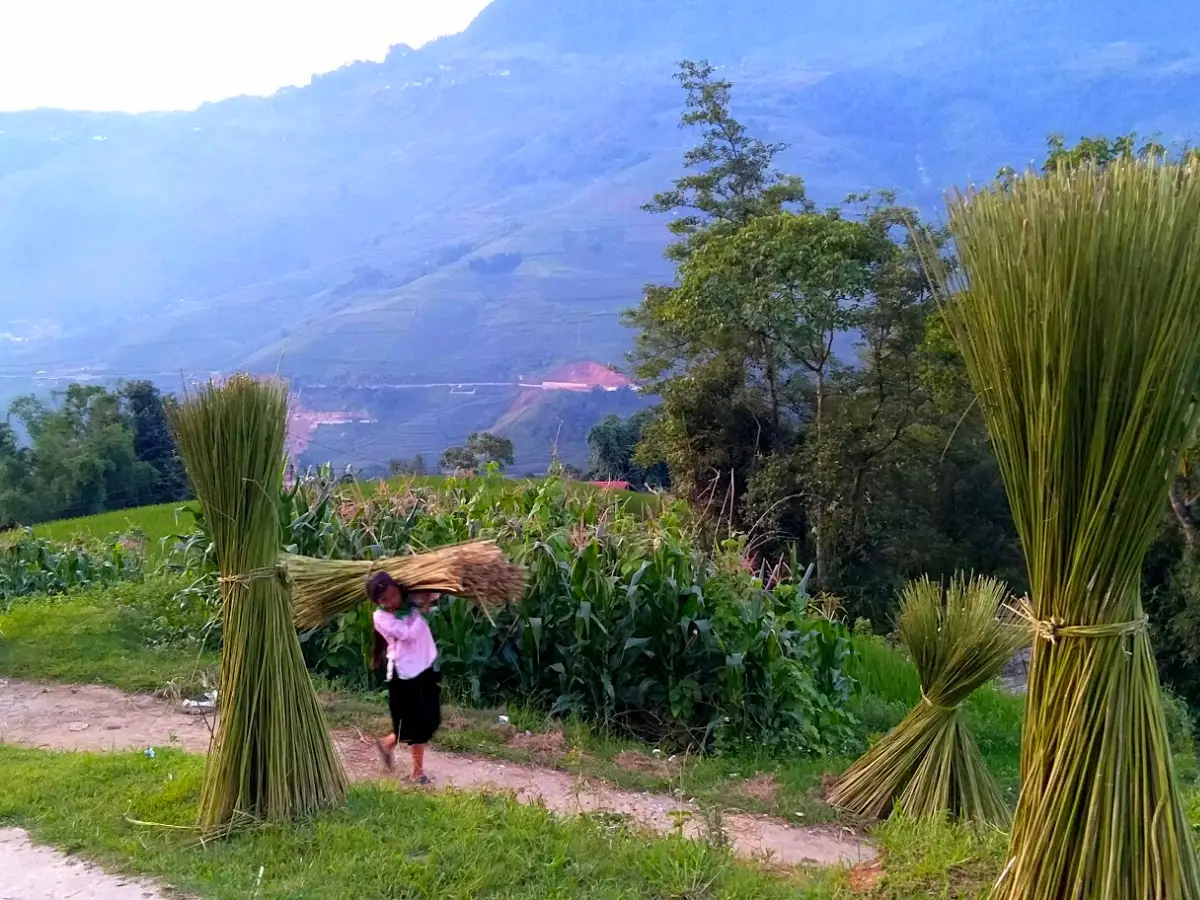
Bamboo weaving is less visible in Sapa town but very much present in the valley villages. In Hang Da and Hau Thao, you will see men and women splitting bamboo into flat strips and weaving them into baskets, fish traps, and carrying frames. The carrying frames — called gai in the local Black H'mong dialect — are designed to distribute the weight of heavy loads across the forehead and back. They are still in daily use. You will pass women carrying 30-kilogram loads of grass or firewood in them on any morning walk through the Muong Hoa Valley.
There is no organized bamboo weaving workshop in Sapa as of 2026, but the families in Hang Da and Hau Thao are often willing to show you their technique if you arrive with a guide who speaks the language. Our local guides, both from Black H'mong families in the valley, know which families have time for a short demonstration. If that kind of informal interaction is what you are looking for, mention it when you book a trek with us and we will route accordingly.
Silver Jewelry — Red Dao Craftwork
The Red Dao of Ta Phin are the primary silversmiths of the Sapa area. The jewelry is functional and ceremonial: large neck rings, elaborate earrings, and coin-decorated aprons worn at New Year festivals. Silver is worked by hand using hammers, punches, and chisels — there is no casting. The characteristic decorative motifs on Red Dao silver include curling vine spirals and stylized animal forms that appear on no other ethnic group's jewelry in the region.
You can buy Red Dao silver at the Saturday market in Sapa town and directly from families in Ta Phin village. A word on authenticity: genuine Red Dao silverwork is heavy (real silver), shows hammer marks on the reverse side, and has slight irregularities in the surface decoration. The imitation silver sold in the tourist shops near Ham Rong Mountain is cast aluminum or zinc alloy, noticeably lighter and with perfectly uniform stamped patterns.

Best Craft Centers in Sapa Town
The organized craft centers in Sapa town worth visiting are few. Most of what calls itself a "craft center" near the main square sells machine-made imitations at handmade prices.
Verified Craft Venues in Sapa Town (2026)
- Sapa O'Chau Cat May Street, Sapa town. Workshops (embroidery, indigo batik), cafe, and shop. Revenue goes to village women. Best option for a half-day hands-on experience.
- Saturday Night Market Central Sapa town, weekly from Friday evening. Village women sell directly — no middlemen. Best selection of authentic handmade pieces. Go after 7pm.
- Ta Phin Village Co-op Ta Phin village, 12 km northeast of Sapa. Red Dao textiles and silver jewelry sold directly by makers. Take a motorbike or join a tour that routes through here.
- Hang Da Village Muong Hoa Valley. Informal bamboo weaving demonstrations — ask your guide. No fixed workshop hours; works best with a local guide who knows the families.
- Avoid Shops along Cau May Street near Ham Rong Mountain and the tourist strip by the main square — predominantly machine-made goods sold as handmade.
Village Craft Experiences on Trekking Tours
The most honest way to see H'mong and Red Dao crafts in 2026 is not in a workshop — it is walking through the villages where the work happens. On our treks through Lao Chai, Ta Van, and Ma Tra in the Muong Hoa Valley, you will pass through family courtyards where women sit with embroidery frames in their laps, children threading needles beside them. The work continues whether or not there are tourists on the path.
What our local guides can do that no independent visitor can is pause the walk at the right moment and facilitate a real conversation. Our guides' families are in the valley, and their relatives are among the active weavers you will pass. On the overnight homestay treks, some families will bring out their loom after dinner and show you how the back-strap weaving technique works, with the cloth stretched across the weaver's body rather than on a fixed frame. It is informal, it is part of the evening, and it is not something you can book separately.
If seeing crafts being made is a priority for you, tell us when you book. We can route certain 1-day treks through Ma Tra and Hang Da rather than the more heavily visited Lao Chai path, and we can time the walk to arrive at a family compound in the mid-morning when the outdoor work is most active.
What to Buy and How Much to Pay
The single clearest rule: buy directly from the maker and pay close to what is asked for clearly handmade work. A woman who spent three weeks embroidering a skirt earns less than USD 5 a day for that work at fair prices. The pressure to accept USD 15 for a piece that should sell for USD 50 comes from comparison with tourist-shop prices — but those shops sell machine-made fabric, not the real thing.
- Small embroidered patch (15x15 cm): 50,000–100,000 VND (USD 2–4)
- Hand-embroidered bag or wallet: 150,000–400,000 VND (USD 6–16)
- Indigo-dyed hemp fabric (per meter): 80,000–200,000 VND (USD 3–8)
- Full H'mong skirt with embroidery: 500,000–2,000,000 VND (USD 20–80)
- Red Dao silver earrings (genuine silver): 300,000–800,000 VND (USD 12–32)
- Bamboo basket (medium, carrying grade): 100,000–250,000 VND (USD 4–10)
Machine embroidery has perfectly uniform stitch tension and no variation in thread color within a single run. Handmade H'mong embroidery has micro-variations in stitch length and occasional color shifts where a thread was re-knotted. On indigo-dyed fabric, real hand-dyeing shows uneven color absorption — some areas are slightly darker — while printed "indigo" fabric has sharp, uniform color boundaries. On silver jewelry, genuine hand-hammered pieces show tool marks on the reverse side; cast imitations have smooth undersides.
Rent at Our Office Before You Trek
 Gear Rental
Trekking Boots Rental
Waterproof ankle-support boots. Cleaned and checked before each rental. Available at 105 Thach Son Street.
 Gear Rental
Walking Poles Rental
Trekking poles available to rent at $2/day at our office, 105 Thach Son Street. Essential for descents.
Frequently Asked Questions
The Black H'mong of Sapa are famous for their indigo-dyed textiles, batik fabric with wax-resist patterns, and cross-stitch embroidery featuring geometric designs. The patterns encode cultural meaning — different motifs identify which village a person comes from. You will see women selling and wearing these at the Sapa market and in villages along the Muong Hoa Valley.
Yes. Several organizations offer half-day embroidery workshops in Sapa town. The Sapa O'Chau social enterprise (founded by a Black H'mong woman) runs textile workshops where the income goes directly to village women. You learn the basic cross-stitch techniques and create a small piece to take home.
The Saturday night market in Sapa town is the best place for authentic crafts — village women come down with handmade embroideries, indigo fabric, and silver jewelry. Avoid the souvenir shops near the main square which sell machine-made imitations. In the villages of Lao Chai, Ta Van, and Ma Tra, you can buy directly from the makers.
A small embroidered patch (15x15 cm) costs 50,000–100,000 VND (USD 2–4). A hand-embroidered bag or wallet ranges from 150,000–400,000 VND (USD 6–16). Full traditional H'mong skirts with embroidery take weeks to make and cost 500,000–2,000,000 VND (USD 20–80). Always buy directly from the makers — middlemen add 40–60% markup.
Gentle negotiation (10–15%) is expected and accepted at the open market. However, for handmade work that took days or weeks to create, pushing for deep discounts is unfair. If a piece is clearly handmade, accept a price close to what is asked. The women in the villages earn very little — paying fair prices directly impacts their livelihood.
Yes — on our trekking tours through Lao Chai, Ta Van, and Ma Tra, you will pass through working yards where women sit weaving and embroidering. Some homestay families will show you their weaving setup after dinner. It is informal, not performative — part of the family's daily work, not a tourist show.